The shocking force of a gag

 Reuters/Jose Luis Gonzalez
A striking photo of a protestor in Mexico circulated in the news this week. Kelly Grovier looks at why attempts to gag those who want to speak out rarely succeed.
In the Frame
Each week Kelly Grovier takes a photo from the news and likens it to a great work of art.
Art is ungaggable. Like truth, it cannot be silenced. As tyrants throughout history have invariably discovered, quashing free expression, whether journalistic or creative, is, at best, an exercise in postponement. It roars back. A powerful photo from Ciudad Juárez in Mexico that has circulated in the news this week reminds us of the shared resilience of art and truth and how their determination to be heard and seen and felt can never be quieted.
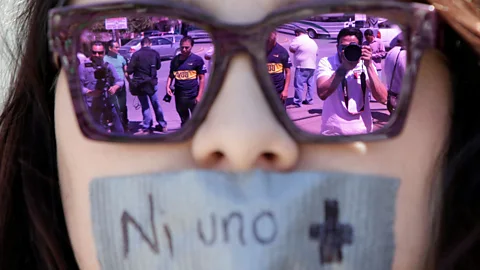
The image, captured by the photographer Jose Luis Gonzalez, is an intense close-up of a woman protesting the murder of a reporter who investigated organised crime and drug trafficking. The third Mexican journalist to be killed in the space of a month, Miroslava Breach was shot eight times in her car in the company of one of her children (who was not injured). Officers investigating the crime found a taunting note left by her assailants. It read, “For being a loud-mouth”.
Reuters/Jose Luis GonzalezAfter news broke of Breach’s murder, fellow journalists staged a demonstration against authorities whom they hold responsible for failing to curb the escalating attacks on reporters. Though the young woman in Gonzalez’s photo is probably a journalist too, it is difficult to know for sure given the eerie thoroughness of her self-denying disguise. Masked by a pair of large reflecting sunglasses and, stretched across her shut lips, a wide swathe of duct tape on which the words “Ni uno” and a plus sign (“not one more”) have been written in defiance, the anonymous woman is as absent as she is present.
The female protester, whose cropped and magnified face occupies the image’s entire visual field, may appear at first glance to be the primary subject of the photo. In fact what has been captured by Gonzalez is the tireless fortitude of free expression in the face of even the most menacing intimidation. Look deeper into the mirroring surface of the woman’s left lens (the one on our right) and we see the photographer himself gazing back, suspended forever in the act of shooting the very picture at which we’re looking – his face half-eclipsed by the wide yawn of his penetrating zoom. Rare in photojournalism, which demands the removal of subjectivity from the story, Gonzalez’s image is an audacious self-portrait of truthful reporting – an endless ricochet of unstoppable staring.
 Università di Bergamo
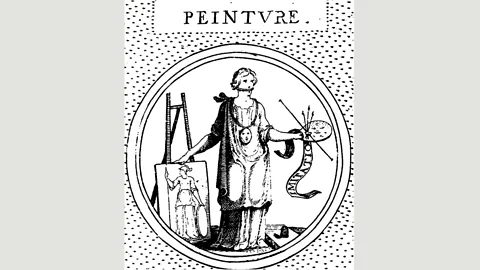
Further intensifying the resonances of his image is a distant, though uncanny, art historical echo that locates Gonzalez’s photo in the tradition of celebrating the irrepressibility of art, truth, and the truth of art. In 1603, an Italian butler to the recently deceased Cardinal Antonio Maria Salviati published an enormous volume he’d compiled in his spare time of allegorical representations (both verbal and visual) of every human quality, pursuit, and state of mind one could name, from jealousy to generosity, sincerity to superstition.
Among the more intriguing entries in Cesare Ripa’s bulging Iconologia, which went on to inspire generations of artists (including Johannes Vermeer), is the one devoted to painting, or “Pittura”. Its essence, as crystallised by Ripa, is a woman with a theatre mask hanging from her neck (signifying art’s imitation of nature) who stands at an easel while holding a palette and fistful of brushes. Her mouth is disturbingly gagged. While the gag at the time probably symbolised the silence of the visual arts (as compared to poetry or music), when placed alongside this week’s striking photo from Mexico it absorbs an anachronistic urgency. Art is a survivor. It thrives when threatened. Like truth, it cannot be silenced.
If you would like to comment on this story or anything else you have seen on BBC Culture, head over to our Facebook page or message us onTwitter.
And if you liked this story, sign up for the weekly bbc.com features newsletter, called “If You Only Read 6 Things This Week”. A handpicked selection of stories from BBC Future, Earth, Culture, Capital, Travel and Autos, delivered to your inbox every Friday.
