Cate Blanchett as you’ve never seen her before


 Sundance Press Office
The great actor plays 13 roles in Manifesto, an experimental film consisting entirely of monologues on art and philosophy. Does it work? Sam Adams has an answer.
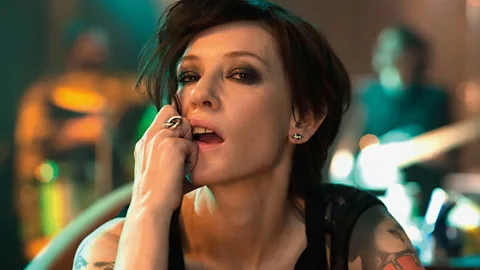
Julian Rosefeldt’s Manifesto may not know what it believes in, but it believes in Cate Blanchett. In this film, which began life as a multichannel video installation, Blanchett plays 13 roles, from a turbaned choreographer to a nuclear scientist, with all of her dialogue spliced together from nearly 60 artistic manifestos of the 20th Century. A prim housewife recites Claes Oldenburg as the preface to a family meal in lieu of grace; a CEO greets the guests at her party with excerpts from Vassily Kandinsky and Barnett Newman.
In its incarnation as an art installation, mounted in Melbourne, Berlin and, most recently, New York City, Manifesto allowed viewers to wander freely among its dozen tableaux, each projected on its own screen. This ‘linear version’, as it’s called, trims more than two hours of footage to less than 90 minutes (not counting credits), and the scenes are intercut to create a patchwork.
Although these scenes – which have titles like “Stridentism/Creationism (the punk rocker)” and “Vorticism/Blue Rider/Abstract/Expressionism (the CEO)” – are organised roughly by category, Rosefeldt’s interest is in a manifesto’s form rather than its substance. “To put out a manifesto, you must want,” says Blanchett, quoting the surrealist Philippe Soupault, intones over the image of a fuse sputtering in the darkness, “to organise prose into a form of absolute and irrefutable evidence.”
It’s the “want” that concerns Manifesto, not the evidence. By slicing and dicing his source material, and by further recombining the scenes in the film version, Rosefeldt makes it impossible to lay hold of a coherent train of thought. What remains is the language of the manifesto – exhortatory, idealistic, sometimes violent – but not its overriding philosophy or the art it was meant to inspire: its style, not its substance.
Manifesto’s visual inventiveness and Blanchett’s multifarious performances make the movie consistently engrossing, even when the relationship between Blanchett’s character and the words coming out of her mouth – or, more often in this version, spoken by her in voiceover – seem purely arbitrary.
Making a statement
Some of the characters, too, are more fully conceived than others: her sneering, Sid Vicious-style punk singer is a cringe-inducing embarrassment, and the comically nasal drawl she gives the stockbroker who lays out the principles of Futurism emanates from nowhere on Earth outside a beginners’ acting workshop. The charitable interpretation is it’s deliberately fake, part of a performance designed to highlight the segment’s artificiality; the less charitable is that Blanchett shot the 12 scenes in 11 days and that was one of the ones she didn’t rehearse. It’s diverting for a while to see Blanchett done up as a homeless man, wandering through industrial rubble as she shouts Situationist dogma at the lens in a Scottish accent, but there’s nothing to it beyond technique.
Blanchett is at her best with the characters who are erudite, middle or upper class: a CEO, a TV news reader, a primary-school teacher. The latter two, which Rosefeldt wisely holds for last, are the highlights, the roles in which Blanchett seems to be playing a fully fledged person and not a concatenation of actorly tics and costume design. The news reader lays out the tenets of conceptual art, as laid down by Sol Lewitt and others, in a hectoring voice that conveys authority without understanding; then she throws the conversation to her weather forecaster, also played by Blanchett, standing outside in a downpour. Their “Over to you, Cate,” “Thank you, Cate” back-and-forth is the most fun Blanchett’s had acting opposite herself since Jim Jarmusch’s Coffee & Cigarettes. In the final segment, Blanchett is a teacher, patiently schooling a classroom full of scribbling children in the ideas of Jean-Luc Godard and the Dogme 95 manifesto as she paces the rows of desks in pleated slacks. Perhaps it’s telling that Manifesto’s best segments extol the virtues of conceptual art, in which, as Lewitt-via-Blanchett puts it, the idea behind the work is far more important that its execution, and artistic appropriation, via the (probably apocryphal) Godard dictum, “It’s not where you take things from; it’s where you take them to.” Manifesto has plenty of concepts, even if they’re mostly borrowed, but manifestos are meant to inspire action, and this one only aims to impress.
★★★☆☆
If you would like to comment on this story or anything else you have seen on BBC Culture, head over to our Facebook page or message us onTwitter.
And if you liked this story, sign up for the weekly bbc.com features newsletter, called “If You Only Read 6 Things This Week”. A handpicked selection of stories from BBC Future, Earth, Culture, Capital, Travel and Autos, delivered to your inbox every Friday.