Look closer: What a background can reveal

 Wikipedia
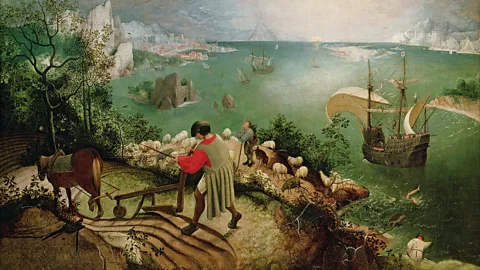
This image isn’t what it appears at first glance. Kelly Grovier examines the details in the background that can show another side to the story.
There are always two dramas in life. In the foreground, there’s the intimate story that you know by heart – the one in which you are the main character who’s been given all the lines. In the background, an overarching historical story unfolds out of your control, a grand backdrop of events against which those intimate moments are played out. For most of us, the life of the world and the world of our lives rarely, if ever, compete for attention.
 Odd Andersen/AFP/Getty Images
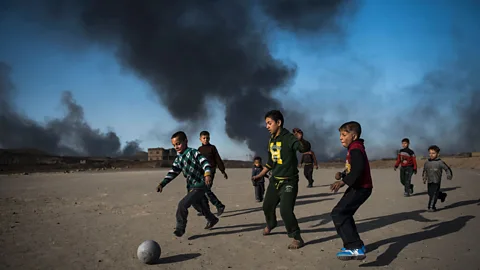
A photograph taken this week in Iraq reveals what happens, however, when the intimate and historical collide. Taken just outside Mosul, the photo captures the joyful, if otherwise seemingly unremarkable action of a group of children playing football on a desolate scrap of parched land. But the ordinary is immediately dislocated into the extraordinary when the scrum’s innocent focus on the dusty ball is set against an apocalyptic sky. Behind the scampering children, insidious plumes of toxic smoke rise from distant oil wells that have been set alight by retreating IS fighters in the ongoing struggle for control of Iraq and its rich resources.
However attached it may seem to the distressed landscape of one particular trauma unfolding in one specific region of the world, the photo reflects the mercy of distracted focus more generally. “Human kind,” TS Eliot famously wrote, “cannot bear very much reality”. In times of stress, our survival and sanity depend upon diversion and on our ability to keep our eyes focused on the ball that rolls before us, not the drama unfolding in the darkening sky behind.
 Wikipedia
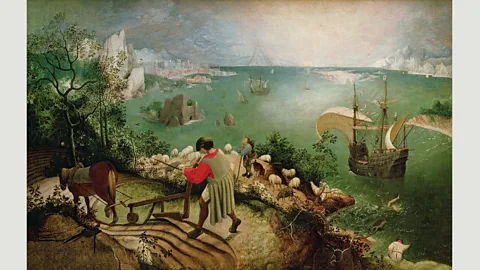
Eliot’s contemporary, the Anglo-American poet WH Auden, was likewise fascinated with the laws of distraction – “how everything turns away”, as he wrote in a poem in 1938, “quite leisurely from the disaster”. Auden was describing the action that takes place in the 16th-Century Netherlandish painting Landscape with the Fall of Icarus – thought to be a copy of a lost earlier work by the Renaissance master Pieter Bruegel the Elder.
The famous canvas depicts in dazzling light the mundane routine of ploughmen and shepherds who appear utterly oblivious to the tragedy taking place behind them: the mythological figure Icarus, his wings melted by the heat of the sun, descending to his splashy death in the water behind them. Like the boys playing football in this week’s photo, the “expensive delicate” ships in the painting appear unmoved by the cosmic events: “a boy falling out of the sky”. They, like all of us, “had somewhere to get”, as Auden concludes his poem, “and sailed calmly on”.
If you would like to comment on this story or anything else you have seen on BBC Culture, head over to our Facebook page or message us onTwitter.
And if you liked this story, sign up for the weekly bbc.com features newsletter, called “If You Only Read 6 Things This Week”. A handpicked selection of stories from BBC Future, Earth, Culture, Capital, Travel and Autos, delivered to your inbox every Friday.
