9/11 Memorial Museum: How to remember?


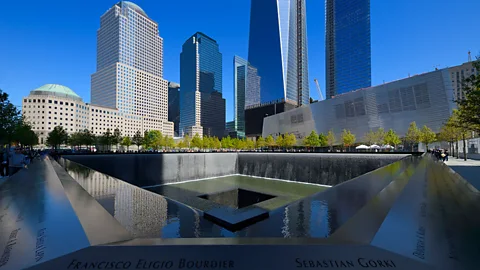
The new 9/11 Memorial Museum has a responsibility not just to honour the dead, but to explain the day’s terrible events and their effects, writes Jason Farago.
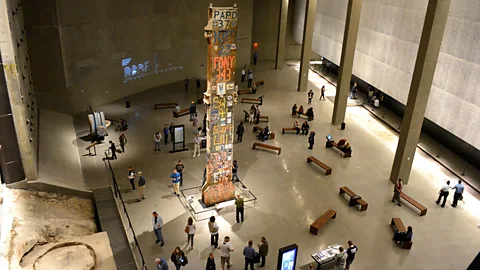
The descent to the National September 11 Memorial Museum begins at the corner of Greenwich and Liberty Streets in lower Manhattan, a corner that has been closed to pedestrians for nearly 13 years. The entrance, designed by Norwegian architectural firm Snøhetta, is the only building that stands on the massive plaza where the Twin Towers once stood. But the small crystalline pavilion does not suggest the scale of the museum’s dark, windowless galleries, which lie 20m underground. Down at the bedrock, deep beneath what some New Yorkers, a decade on, still call Ground Zero, the subterranean museum tells the story of the city’s deadliest day on the very spot where it happened. The enormous, metre-thick slurry wall, which keeps the Hudson River from flooding the site and which held firm on 9/11, is finally visible to all.
Things have not gone well at the new World Trade Center. The little-loved memorial, with its far too large waterfalls, needed ten years to open to the public. The five new towers, mostly incomplete and of no great architectural distinction, have found almost no tenants and testify mostly to the ability of its developer, Larry Silverstein, to siphon off public funds for his own private gain. But more than either of those, it’s the museum, which was dedicated last week by Barack Obama and opens to the public on Wednesday, that’s endured the most criticism. This being America, the land without a culture ministry, the September 11 Museum has received no government funding, and sparring between national and city governments has delayed public assistance. It also has no endowment – hence the extreme $24 admissions charge. Hence, too, the tasteless gift shop offering dinner plates reading “REMEMBER” and stuffed dogs wearing search-and-rescue vests.
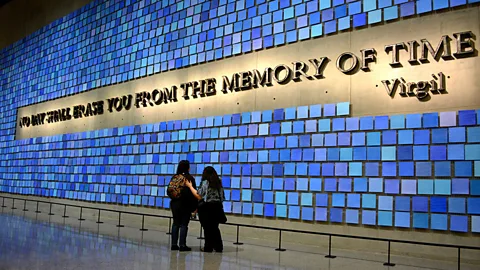
Even the classical inscription on the museum’s repository of remains has come in for a drubbing. Unlike almost every other museum of its type, the 9/11 museum stands directly on the site of the disaster it commemorates – and therefore contains a facility preserving the remains of perhaps thousands of victims, which New York’s medical examiner is still attempting to identify. “No day shall erase you from the memory of time,” reads its inscription, which sounds nice enough, until you realise that the verse from Virgil eulogizes two bloodthirsty Trojan warriors (and lovers, by the way) who slaughtered dozens of enemy soldiers, hacking off their heads and stealing their armour.
‘News, not analysis’
Still, at least the museum is open. The victims’ lives are recounted and honoured. There will be time, in the months and years to come, to debate whether the 9/11 museum succeeds in its mission of explaining the significance of the attacks, or whether, with its many twisted steel beams and destroyed fire trucks and ambulances, it aestheticises the horror of the day. Questions about the museum’s arguments and propriety have abounded for years. They will not be settled this week.
What is striking, though, is the limited nature of the museum’s mission. Early visitors have described the wrenching experience of its permanent collection galleries as if they were reliving that awful day, but there is little about the causes of 9/11, except for a short film that has been widely criticized as Islamophobic.. Holland Cotter, the New York Times’s co-chief art critic, noted that the museum’s depiction of 9/11 is “not so much wrong as drastically incomplete,” offering “news, not analysis.” And, if it remains so, the museum might not have the importance for future generations that it does for ours.
Very few museums focus with such single-mindedness on one disaster or one historical crime: Holocaust museums, say, or the Hiroshima Peace Memorial. Even battlefield sites, such as the Gettysburg Museum in Pennsylvania, regularly take in larger remits than the single event that happened at the site. That’s for good reason. Museums do best when they not only narrate history, but place it in context and set it in motion. The Smithsonian, for example, does not recount the history of slavery in a standalone institution; slavery is right in the middle of the National Museum of American History. And that’s as it should be – the history of the United States is inseparable from the history of slavery, and to separate the part from the whole would diminish both.
In context
With an event as traumatic as 9/11, whose history is still being written and whose victims are still among us, a more capacious view might be difficult. (And there is some history here. In 2005, George Pataki – the former New York governor and the great villain of the World Trade Center’s reconstruction, who also overruled his own jury’s recommendations for the site’s design – evicted a planned historical museum from the 9/11 museum’s site, which conservatives bashed as a “blame America monument.”) But even the greatest traumas, with the greatest need for respect and remembrance, offer room for context. One excellent case study is the United States Holocaust Memorial Museum in Washington. Even while the museum insists on the uniqueness and irreducibility of the Holocaust, it also looks more broadly at anti-Semitism and discrimination, as well as at other genocides and war crimes, some dismayingly recent. The museum’s permanent exhibition, with its searing display of thousands of victims’ shoes, has lost none of its force in the decades since it opened. But it has also presented exhibitions related to Bosnia, Darfur, and most impressively Rwanda – a genocide with horrible parallels to the Holocaust, and which the museum has researched in depth since 1994. Last month, museum officials traveled to Kigali for the 20th anniversary commemorations of the Rwandan genocide; accompanying them was Margit Meissner, a Holocaust survivor.
Alice Greenwald, the director of the 9/11 museum, is a veteran of Washington’s Holocaust museum. Having steered the new institution to this week’s opening, I hope that she thinks about the successes of her previous one, and begins to imagine ways in which the atrocious events of 9/11 could be placed in their historical epoch, rather than shown as an event wrenched out of time. Maybe the political risks are too formidable, and maybe it’s too soon: Khalid Sheikh Mohammad, who has admitted to planning the 9/11 attacks, is still being held at Guantánamo Bay, where his trial is once again delayed.
But in a few years, perhaps, the museum may be ready to look beyond the few hours of that Tuesday in September and take into its narrative all the stories that came before and since: the attacks in Madrid and London and Bali, the ongoing revelations about government surveillance, and the wars in Afghanistan and Iraq. That would be the best way to ensure that 9/11 retains its relevance when the millions of us who lived through it are gone, and it is left to New Yorkers born after 2001 to educate the living and commemorate the dead.