'Fair-weather fans and the plain uncool': How the Eagles' Greatest Hits broke the US charts

 Getty Images
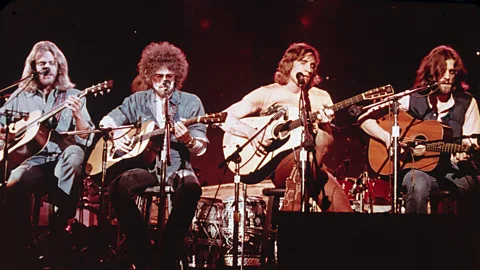
Released 50 years ago this year, Their Greatest Hits isn't on any "best album of all time" lists, yet it's sold more than The Dark Side of the Moon, Purple Rain and Abbey Road combined – why is it so phenomenally popular?
If you owned a record player in 1976, chances are you also owned at least one of the two Eagles albums released that year. The second was the more obvious choice. It had the band's signature song as its title track, produced two number one singles, and is comfortably their most critically acclaimed work. In 2012, Rolling Stone called it the 37th greatest LP of all time. It's also proved phenomenally popular and enduring, and is currently the third-best-selling record ever in the US.
Warning: This article contains language that some may find offensive.
But it's statistically more likely that you picked up the first of the two discs, the one that doesn't have Hotel California on it and isn't on any "best album of all time" lists. It's a record the Eagles themselves didn't want to issue and which their biggest fans would have had little reason to buy.
And yet, in purely commercial terms, Their Greatest Hits (1971–1975), released 50 years ago this year, is the Eagles' defining work. In fact, you could argue that it's the defining work of American pop music. On 22 January this year, the Recording Industry Association of America (RIAA) awarded the LP the first ever quadruple diamond certification, for 40 million copies sold. It's officially the most popular album of all time in the US, and one of the top five globally.
Neil Tennant of the Pet Shop Boys coined the term "imperial phase" to describe an era when an artist can do no wrong, commercially speaking, and the Eagles were certainly in the midst of theirs when their record company, Asylum, issued their first "best of" set.
Their fourth album, 1975's One of These Nights, had been the band's big breakthrough and first number one, and they were halfway through a run of six consecutive top five singles (including four chart toppers). They were also at a crossroads. Bluegrass-influenced multi-instrumentalist Bernie Leadon (formerly of country rock pioneers the Flying Burrito Brothers) had left, taking with him the last of the group's early country-folk flavour and clearing the way for the full-on soft rock of Hotel California.
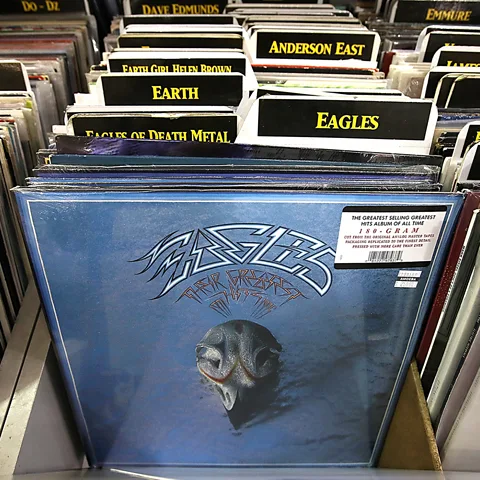
The cover of Their Greatest Hits (1971–1975) seemed to signal this transition from dusty Americana to sleek '70s studio excess. It depicts a painted eagle skull sitting atop a sheet of silver mylar, with the material's textured, reflective surface looking a lot like a mirror covered in cocaine (a supposedly accidental resemblance that did not go unremarked on by the band or fans).
 Getty Images
According to biographer Marc Eliot, in To The Limit: The Untold Story of the Eagles, the push to release a "best of" came from incoming Asylum boss Joe Smith, who was seeking to raise funds while the band themselves (responsible for over 50% of the label's revenue in the mid-'70s) delayed work on their fifth album in an attempt to renegotiate their royalties deal.
Drummer-vocalist Don Henley called the record "the forced and hideous marriage of art and commerce" and told Eliot that Asylum "didn't give a shit whether the greatest hits album was good or not. They just wanted product." Henley, who'd envisioned the Eagles' second LP, Desperado, as a concept album, particularly objected to the inclusion of its tracks stripped of their thematic context.
An immediate smash
The concept of Their Greatest Hits 1971-1975 is entirely straightforward: all nine of the band's singles to date plus the title track of Desperado. The record was an immediate smash, spending five weeks on top of the Billboard 200 album chart, and finishing the year as America's fourth most popular record, behind Peter Frampton's Frampton Comes Alive, Fleetwood Mac's self-titled 10th album, and Wings' Wings at the Speed of Sound. After that it just kept on selling and selling, spending more than two years on the Billboard 200.
From the 1980s onwards it began trading places with Michael Jackson's Thriller for the title of the US's bestselling album ever, before finally establishing a clear lead in controversial circumstances in 2018. Asylum's parent company, Warner Music Group, conducted an audit of old sales and royalty reports to produce proof, to the satisfaction of RIAA, of previously uncounted purchases. Overnight, Their Greatest Hits 1971-1975 increased its sales tally by nine million copies. Both Sony and the Michael Jackson estate expressed their concern at the time.
 Getty Images
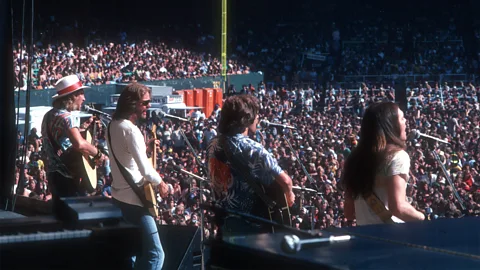
On one level, the spectacular success of Their Greatest Hits 1971-1975 makes sense. The Eagles were a huge band in the mid-'70s, commercially if not quite in terms of cultural influence or artistic respect. They were about to become, for a couple of years, the US's biggest. With the blockbuster crossover success of Hotel California coming just a few months later, the compilation gave new fans the chance to catch up with the essence of the band's back catalogue in one go.
And the record resonated with the cultural moment: a vaguely hippie, vaguely outlaw balm for a nation's soul. "The message in their early music was a quintessentially optimistic one, perfect for a troubled nation still reeling from the Vietnam War and social turmoil," Richard Aquila, history professor at Penn State University, tells the BBC. "Even the group's name was emblematic of America."
The Eagles "reminded older listeners of what they had loved about the '60s, with all the radical experimentation and political idealism removed", music historian Peter Doggett tells the BBC. "That is what has made their music so timeless for subsequent generations: it's very melodic, very professional and doesn't actually mean anything."
Yet it's still strange to see this slight compilation so far ahead of its competition. A 10-track rehash of recently released material from a band barely halfway through the most productive part of their career, its sales tower over iconic, acclaimed original works like Thriller, Led Zeppelin IV and Fleetwood Mac's Rumours. It's sold more than Pink Floyd's The Dark Side of the Moon, Prince's Purple Rain and the Beatles' Abbey Road combined.
How greatest hits albums took off
Part of the perceived "wrongness" of this huge success may come from music snobbery. The idea that the greatest hits is the preserve of fair-weather fans and the plain uncool. More about commerce and convenience than real art. "For devoted fans, greatest-hits records can feel like a cheat, in part because they repudiate the long-playing album as a sacrosanct document, inviolate and complete," writes Amanda Petrusch in the New Yorker.
Labels have been repackaging and reselling old hits for as long as modern pop music has existed, seizing the irresistible opportunity to generate sales without any of the start-up costs associated with getting a band into a studio to record new material, or persuading audiences to listen to that material for the first time. But the greatest hits album really emerged as a thing, a distinct (if slightly naff) cultural artefact on its own terms, in the mid-'70s.
More like this:
In 1976, the Eagles shared the Billboard end-of-year top 10 with compilations from fellow FM radio mainstays Chicago (Chicago IX: Chicago's Greatest Hits) and America (History: America's Greatest Hits). The year before, Elton John's Greatest Hits had been the biggest selling album in the US (the first compilation to do so since Elvis's Golden Records in 1958, a disc some claim as the first true greatest hits) and would go on to rank 13th of all time.
In the UK, the boom period was even more pronounced. Best-ofs topped the year-end charts in 1974 and 1975, and 1976's top 10 featured five greatest hits packages, including the Eagles, The Beach Boys, Glen Campbell, and a TV-pushed retrospective of yodelling '50s singer Slim Whitman. The top seller was another early-career greatest hits from a group that would go on to bigger things: Abba.
 Chloe Weir
While the TV-driven budget compilations quickly faded from the cultural conversation (or were supplanted by newer "best of" packages), several of the "proper" mid-'70s retrospectives – with their short, curated track lists and bespoke cover artwork that made them, on the surface, pretty indistinguishable from new studio albums – sold millions year after year. And, by some alchemy of popular taste, industry trends, and the dedicated work of Warner's data analysts, the Eagles' sold the most of all.
In many ways, they were the right band for the job. The Eagles were, according to music critic Greg Kot, "quintessentially a singles band", and by putting all of these on one disc, they easily supplanted their first four studio efforts for anyone interested in the "country-tinged" portion of their career. Theirs was a definitive retrospective and, for several years, stood alone as the entry-point for casual fans.
And Their Greatest Hits 1971-1975 functions like a studio album. It feels deliberate and considered. Side one has four up-tempo numbers that showcase the Eagles at their most "rock 'n' roll" and ends with a slow-burning ballad. Side two consists wholly of smooth, mid-tempo jams.
The sequencing shifts back and forth between older and newer work, and between lead singers.
"A listener alienated by too much twang will quickly get some searing guitar riffs," says musicologist Olivia Mather. "Someone who wants something softer will quickly get a song like Peaceful Easy Feeling or Desperado." It may not have been an "authored" work, with the sort of unifying concept beloved by Don Henley, but at a tight 43 minutes, it did what it set out to do with ruthless efficiency and without indulgence. It stuck to the true greatest hits maxim: all killer, no filler.
The Eagles are playing at The Sphere until April and final tour dates in the US in May.
--
If you liked this story, sign up for The Essential List newsletter – a handpicked selection of features, videos and can't-miss news delivered to your inbox every Friday.
