'There's going to be a bandwagon': After Heated Rivalry, women are driving a gay erotic boom on screen

 Sabrina Lantos/ HBO Max
The man-on-man hockey romance has been a cultural phenomenon among straight female viewers – and will likely lead to more same-sex love stories in film and TV.
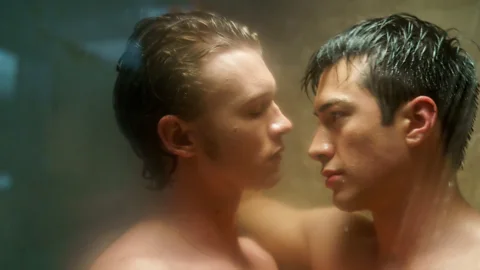
"Ilya Rozanov?" One young man, bundled up in a winter coat and hat asks another man, who is smoking a cigarette outside a sports stadium. "Shane Hollander. I wanted to introduce myself." With this brief but loaded exchange, so begins the screen romance that has dominated the pop culture conversation in recent weeks – between the two leads of erotic drama Heated Rivalry.
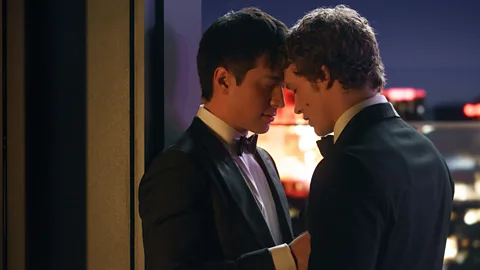
Adapted from Canadian author Rachel Reid's Game Changers novel series, the show tells the story of two young ice hockey players, Rozanov (Connor Storrie) and Hollander (Hudson Williams), who play for rival teams. But these would-be-enemies quickly (incredibly so; within the show's first 17 minutes) become lovers, and their sexually-charged relationship is depicted explicitly across six episodes covering a decade, from 2008 to 2018.
 Sabrina Lantos/ HBO Max
What should have been a niche, small-time show – created for Crave, a small Canadian streaming service – has exploded across global broadcasters. HBO Max picked up the series a week before its Canadian launch on 28 November, and began broadcasting it on the same date in the US; since then, it has been met with a rapturous response by critics and audiences alike. After just two episodes, Harper’s Bazaar listed it among its best LGBTQ+ television series of all time.
That it had a positive response from this fanbase might well have been predicted, but what has been more surprising to some is the show's other core demographic: women, and specifically straight women. From Cosmopolitan to NPR many media outlets have been asking why the show's male-on-male sex scenes have been getting women so hot-under-the-collar. Really though, this shouldn't be a surprise at all – given the long history of women engaging with this kind of material, on the page if not on screen.
The history of the phenomenon
Since the 1960s, certainly, it is well-documented that male-on-male romance and erotica stories have provided fantasy fuel for a female audience. One notable case of this was when female fans of the then-new sci-fi series Star Trek began to imagine something going on between Captain Kirk and Spock. They wrote their own, intricate stories where these two characters were lovers, creating what has also become known as "slash" fiction, a particular type of fan fiction pairing up same-sex characters.
In a pre-internet world, it's difficult to imagine how this very specific group of female fans with an unusual fantasy might have connected, but they found a way, explains Lucy Neville, author of 2018's Girls Who Like Boys Who Like Boys: Women and Gay Male Pornography and Erotica. "I interviewed a lot of women who were into fanfic back in the '60s," she says. "And it was all about photocopied zines. They would take them along to fan events and then try and sniff out other 'slashers'. And they would form little subgroups, and they'd all swap their zines around and read each other's stories. So it was very grassroots and organic." However the arrival of the internet in the '90s offered fans a more fertile space to create whole parallel romantic and sexual stories around characters on TV.
The publishing and literary world also has a long history of women creating and enjoying male-on-male romance stories. In 1970s Japan, a community of female artists known as the Year 24 Group began creating what was known as shōjo manga – Japanese comics aimed at girls, which sometimes explored same-sex male relationships. In the 1980s and 1990s, this evolved into the yaoi or Boys' Love scene, which focuses exclusively on stories of male/male sexual relationships, typically written by women.
 Prime Video
In the US and UK, the Black Lace imprint – a racier alternative to the popular romances of Mills & Boon – launched in 1993, with a focus on erotica exploring a wide range of female tastes, including male same-sex stories, which were all written by women. Meanwhile, in the present day, publishing imprints like Harlequin's Carina Adores, Dreamspinner and Riptide feed into a thriving industry of male-on-male or M/M romance, consumed by women.
An especially popular and niche variation has been the "hockey romance", with Reid's Game Changers one of several book series in which male ice hockey players get it on; others include Eden Finley's CU Hockey and Amy Aislin's Stick Side books. The sports world makes a good milieu for these romance stories – these men – in peak physical form – "battle" rival teams, driving the drama, while often proving to be tough guys with a heart of gold.
What is the female appeal?
The appeal of these same-sex erotic stories can in part be boiled down to aesthetics. As New Statesman writer Catharine Hughes noted in her article about Heated Rivalry: "Sometimes the riddle really is as straightforward as: what's better than one hot man? Two." Another theory put forward among the reams of discourse around the show's erotic appeal to women is the potential it offers to enjoy depictions of sex untainted by misogyny or gender imbalances.
But in focus groups for her book, Neville found that for many women, the appeal of gay male erotica was something more primal. "I asked a question to the group about whether they ever fantasised about being a man having sex," she explains. "And more than half the sample, almost 300 women, said: 'Yeah, I've always done that'. And for some of them, it was related to a kind of trans-ness [they felt]. But for the vast majority, it was entirely separate from how they perceive their gender identity. It was just purely something when they were fantasising."
As explored by academics like Henry Jenkins – an expert on fan fiction and author of seminal fan-culture study Textual Poachers – and gender studies scholar Judith Butler, it could also be down to the fact that from the age women learn to read, they are mostly exposed to stories where they're asked to identify as a male character. From Peter Pan to Holden Caulfield in The Catcher In The Rye, girls grow up imagining what it's like to be a boy when they read fiction, and it becomes almost second nature. "Judith Butler says: 'Well, that could then become part of your sexual identity too'," adds Neville. "And I think I really saw that for a lot of these women, it was very easy for them to imagine being a man having sex. It didn't feel odd to them."
While the market for male-on-male romance has grown exponentially in the publishing world, Hollywood has been slower on the uptake. Back in 2005, Brokeback Mountain – featuring Jake Gyllenhaal and Heath Ledger as cowboys discovering their "forbidden" love for each other – looked like it might pave the way for many more same-sex male romances on screen. But as writer Tim Teeman noted in a BBC feature on the 20th anniversary of the film last year, there's since been "little consistency and regularity in the flow of queer-themed stories and lead characters to the screen".
 BBC/ Prime Video
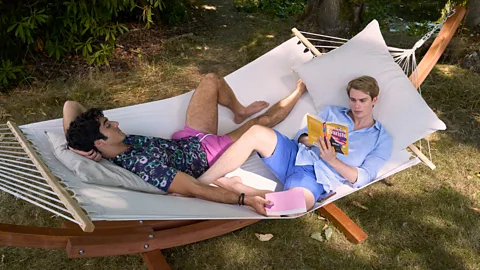
However, that may all be set to change, certainly when it comes to gay male love stories. Before Heated Rivalry, another book adaptation, 2023 film Red, White and Royal Blue, proved there was a wide market for them. Adapted from a story by the non-binary author Casey McQuiston, it centred on the burgeoning relationship between the son of the US president and a British prince and – like the source material – was a big hit with a female audience. It quickly became one of Prime's most-watched romantic comedies of all time – and a sequel has just gone into production.
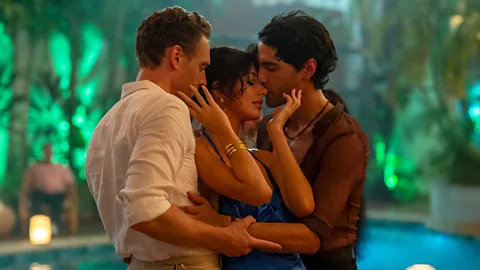
Recently, gay male romance and eroticism have been prominently depicted in shows from Benito Skinner's Overcompensating (also on Prime) to Rachel Sennott's I Love LA (HBO). Series four of Industry is set to feature sexual activity between two of the male leads in coming weeks, while The Night Manager season two flirts with the idea of a homoerotic energy between its hero Jonathan Pine (Tom Hiddleston) and villain Teddy Dos Santos (Diego Calva).
More like this:
Is there any potential tension created by gay male sexuality becoming fetishised by straight female viewers, as suggested in a recent Salon piece? Neville says from her research, it's unlikely. "I interviewed more than 200 queer men about this, and the overwhelming response from them was that they really, really could not care less, if [the representation] was vaguely positive. They were like, 'if there's more people producing gay content, then great'."
"Some of the gay men I spoke with said things like: 'I grew up thinking people who aren't gay are going to be probably neutral at best or at worst homophobic towards me – like thinking about you and your boyfriend together makes me feel sick. It's disgusting. So actually knowing that women are thinking about you and your boyfriend together is hot; I love it'."
One thing seems sure: Heated Rivalry's imprint on culture is going to be a long-lasting one. With Storrie and Williams doing the red-carpet rounds and becoming the stars du jour, the series has already been commissioned for series two. And it's been suggested by Storrie that it could shoot this summer, with showrunner Jacob Tierney saying that it will be based on Reid's follow-up book about the couple, The Long Game.
As for the wider man-on-man romance genre, "I think it's [one] we're going to see more of on screen," says Neville, "definitely after the success of Heated Rivalry. I can see there's going to be a bit of trying to jump on the bandwagon, but I think that’s a good thing." And, if they are going to capitalise on the phenomenon, studios and production houses aren't going to struggle for content or inspiration: "They've got a wealth of source material," adds Neville. "With decades and decades of fan fiction, they're not going to run out of it any time soon."
Heated Rivalry is streaming now on HBO Max in the US and Sky and Now in the UK.
CORRECTION: A previous version of this article referred to Casey McQuiston as a female author. Their gender identity and pronouns have been corrected.
--
If you liked this story, sign up for the Essential List newsletter – a handpicked selection of features, videos and can't-miss news, delivered to your inbox twice a week.
