The lava river in a quiet neighbourhood

 Getty Images
The volcanic eruption in Hawaii provided stunning images of magma flowing down a residential street – it recalled paintings of Vesuvius, writes Kelly Grovier.
“People never believe in volcanoes”, the Spanish-born poet and philosopher George Santayana once wrote, “until the lava overtakes them”. Suffice it to say that no inhabitant of the island of Hawaii’s District of Puna is today in any doubt about the fierce reality of Kīlauea, the resident volcano that earlier this month roared into international headlines when several seething, sulphuric vents suddenly opened in its ancient architecture. Spluttering ceaselessly since 1983, Kīlauea was kicked into overdrive after a spate of earthquakes shook the island in recent weeks, including a seismic jolt that reached 6.9 on the Richter Scale on 5 May – the largest to hit Hawaii in 40 years.
 Getty Images
Just days before this huge quake, a fragile shelf that had formed atop the volcano gave way. The collapse unsettled a reservoir of smouldering magma that is now shouldering its way to the island’s surface, opening fresh fissures of fast-moving molten ooze that is destroying everything in its path. The relentless shove of lava has occasioned panic, evacuation, and a stream of remarkable journalistic images chronicling the devastation.
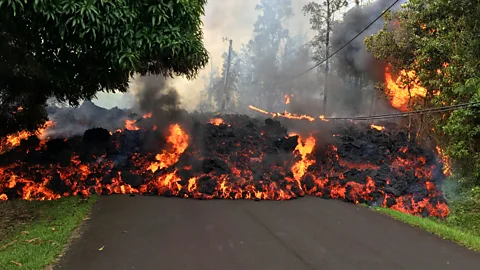
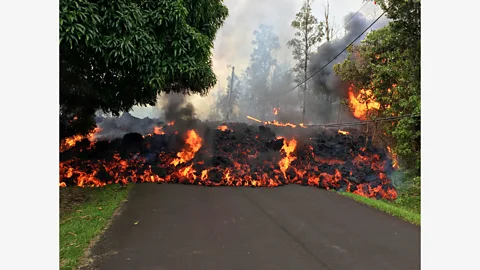
Among the more astonishing photos is one that captures the lava as it bulldozes towards the photographer up Makamae Street in the Leilani Estates – the populated region of the island whose very fabric is now melting away. The image suspends the lava’s lethal assault, freezing it in the eerie shape of a slow tsunami of ash and fire. In the frame, vulnerable vestiges of civilisation catch our eye. Along a banal slouch of telephone wire that dangles above the embering slag on the right side of the image, flames race towards us, as if the wick of a timebomb has just been lit. In the foreground of the photo, the foreshortened street that connects our eye to the fast-approaching menace no longer seems a simple stretch of asphalt so much as a panting tongue lolling from the maw of an overheating beast.
It is not, of course, the first time that visual reportage from the environs of an active volcano has stopped the world in its tracks. Two and a half centuries ago, ominous rumblings from Italy’s serially eruptive Mount Vesuvius preoccupied the imagination of British artist Joseph Wright of Derby, who spent a month in the autumn of 1774 studying the volcano first hand in the Bay of Naples. Having established a formidable reputation back home, with canvases such as An Experiment on a Bird in the Air Pump (1768), as a great dramatist of luminosity and shadow, Wright was understandably obsessed with the fire and fury of volcanic spectacle. Though Wright missed witnessing a major volcanic event by several years, he nevertheless caught sight during his stay in Italy of sufficient sulphuric grumbling to justify exclaiming in a letter to his brother that he’d seen “a very considerable eruption at the time” and, subsequently, to devoting himself to making over 30 paintings of Vesuvius in the ensuing years.
 Alamy
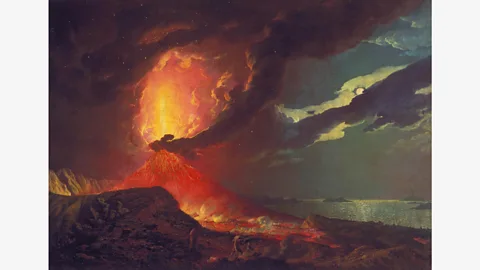
AlamyArguably the grandest and most affecting of Wright’s efforts to honour the volcano’s power is his apocalyptic Vesuvius in Eruption, with a View over the Islands in the Bay of Naples, which he painted after his return to England, between 1776 and 1780. The air of genteel Enlightenment reasoning that Wright celebrates in An Experiment on a Bird in the Air Pump, whose nocturnal narrative is illuminated by the softness of a concealed candle at its centre, has been supplanted by the ferocity of nature’s raw power in the later work. The elegance of intellect and grace of the human form (truncated to a few struggling and easily-overlooked souls lugging a victim of the volcano in the painting’s middle distance) is eclipsed by the savagery of Vesuvius’s merciless spewing. Though our eyes may ride the violent visual waves of Wright’s Vesuvius in Eruption differently than they do the contours of this week’s photo from Hawaii, the two images are similarly intensified by retinal cues that both whorl our gaze into, and hurl it back out of, the turbulence sizzling at their respective centres. Both images simultaneously impel and repel our stare, fixing us in helplessness. Both images open gaping fissures in our imagination that let the lava seep in and leave us little choice but to believe in volcanoes.
If you would like to comment on this story or anything else you have seen on BBC Culture, head over to our Facebook page or message us onTwitter.
And if you liked this story, sign up for the weekly bbc.com features newsletter, called “If You Only Read 6 Things This Week”. A handpicked selection of stories from BBC Future, Earth, Culture, Capital and Travel, delivered to your inbox every Friday.
