Refugees on film: ‘How can you make people care?’

 Alamy
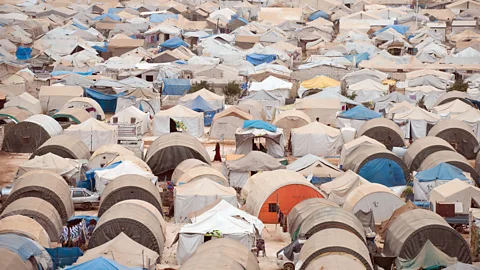
AlamyThe attention of the world is now focused on the Syrian refugee crisis. Can film-makers ensure we see those affected as people rather than statistics? Emma Jones reports.
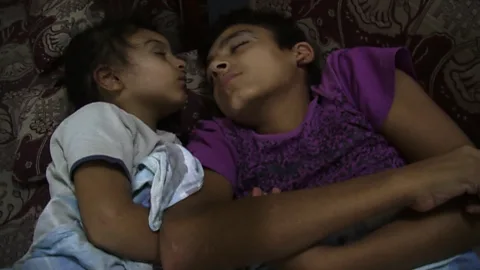
He is the son and grandson of refugees and now Tamer Ismail is one himself. The 14-year-old, born to a Palestinian family in Syria, finds himself in claiming asylum in Austria after his parents bought his passage – alone – to Europe. In the short film The Purple Field which premiered at the Dubai International Film Festival in December, Tamer narrates waiting at the EU borders as like “the Day of Judgement. There were Syrians, Palestinians, Iraqis, Afghans, Iranians – none of us knew what was going to happen, and we were all afraid.”
Made by Palestinian director Nasri Hajjaj, the son of refugee parents in Lebanon, the film was funded by sympathetic Austrians and is one of the first attempts by cinema to create a first-person account of the experiences of thousands of people who have crossed from the Middle East to Europe this year.
The problem, according to British director Sean McAllister, who showed his award-winning documentary A Syrian Love Story at Dubai, “is always how to put a human face to suffering.” He found his with Raghda and Amer, a couple who meet in a Syrian prison before the civil war, only to find their relationship crumbling under the pressure of exile in France.
“When I started to make the documentary, no one cared about Syria,” says McAllister, “and I’m not sure who really cared about Syrian refugees until that photo of that poor little drowned toddler hit the headlines. That was almost pornographic in the way it shocked. That’s the challenge of the director too – to find an image that will linger with audiences, to resonate in a way a 30 second news report can’t.”
 Nasri Hajjaj
The best-known film-maker yet to tackle what he himself calls “the desperation and the loneliness of ‘the other’ in society” is Jacques Audiard, whose Tamil-language film Dheepan won the Palme D’Or at Cannes this year. Audiard says he made Dheepan in Tamil, which he doesn’t speak, so he too could understand the isolation of the refugee.
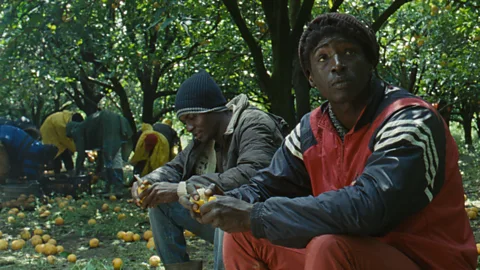
Others are even more radical in their methods, asking refugees to tell their own story, not through documentary, but in feature film. Mediterranea was the runner up in this year’s Lux Prize, which is awarded by the EU to a film “that casts a spotlight on the heart of European public debate.” First-time director Jonas Carpignano, an Italian-American, follows the trek of a young man from North Africa to Lampedusa in Italy. He is played by the director’s best friend, Koudous Seihon, who himself made the journey from Burkina Faso to Italy some years ago, almost drowning at sea.
 Auto Images
“If you can spend a moment with one person at a crucial time of their life, you understand them better, and judge them less,” reasons Carpignano. “Who better to evoke those emotions than Koudous, who lived through it?”
Carpignano adds that the small Italian town where they both live has seen a steady tide of North African refugees reach its shores since 2008, commenting wryly, “I feel almost late to the party in documenting this. Shipwrecks and survivors – they’ve become part of life here.”
Human journeys
On the other side of the world, Israeli director Noam Kaplan also hired local immigrants for a different purpose – Manpower is a fictional film in which Israeli police strongarm undesired African refugees and emigrés to leave the country. But the film, which was shown at the recent UK Jewish Film Festival, has its roots in what Kaplan claims is “the racism of the Israeli authorities towards non-Jewish arrivals in the country. If you aren’t Jewish, you are not necessarily welcome.”
Kaplan cast several Africans who said they had experienced hostility from the police to play leading roles; they did it, he suggests, “for pride, for money, but also because they really want to belong to Israel. And most of them can’t go home.”
But the most famous immigrant nation of all – the US – shows little sign of wanting to document anything other its own history of migration, although the film industry itself was built on refugees in the 1920s and 30s. As film historian Tony Thomas remarked, “Adolf Hitler was Hollywood’s greatest benefactor”: Billy Wilder, Fred Zinnemann, Henry Koster and many others made careers in Los Angeles after fleeing Nazi persecution. Casablanca (made by Michael Curtiz, a Hungarian immigrant) was set against a backdrop of human trafficking in Morocco during World War Two.
 End Cue
Since then, Casablanca has seen few challengers; District 9 and Children of Men may deal with the alien and the refugee, but from the comfortable distance of the future or a different species – and both were made by directors born outside the US. Two of the UK’s best known directors, Michael Winterbottom and Stephen Frears, produced films on the issue in 2002, In This World and Dirty Pretty Things, both of which flopped at the box office. A French film by Philippe Lioret, Welcome, about a refugee in Calais determined to get to Britain, made little impact in 2009 – although it might have received more press had it been released this year.
Empathy gap
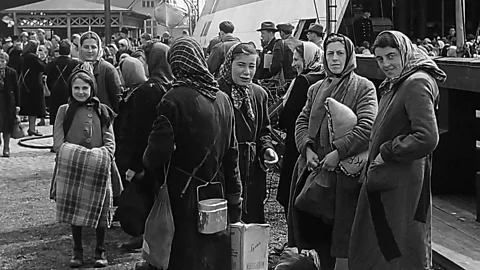
“Why is it a surprise that we are all finding it difficult to connect with a situation outside of our experience?” asks Swedish director Magnus Gertten, who has made a documentary, Every Face Has A Name, tracking down refugees from grainy black and white footage of them arriving at Malmö in Sweden in 1946. Most of them were liberated from concentration camps, and were welcomed willingly by a post-war Sweden desperate for labour.
“We are all being criticised so much for seemingly caring more about the terrible killings in Paris than in Beirut, “ says Gertten, “but for most of us, it’s just about connection – many more of us in the West will have visited Paris over Beirut. We have to understand in order to empathise. That’s why I needed to find out the names and the stories of all these people. Otherwise we are swimming in a sea of the nameless.”
Twenty-eight-year-old Briton Isobel Mascarenhas-Whitman has made her own short film for social media, Rats That Eat Men, which is free to view and share online, and features two migrants who find themselves sharing a squat in London. Whitman, who has worked and lived with migrants in the past, thinks her film is necessary because “most of the debate I am seeing for my generation is on Facebook, but social media isn’t a substitute for human interaction, and most people have absolutely no idea of how tough it is to be a refugee in London. It’s really just another tool to increase understanding.”
Ironically though, the only film to be submitted for the Oscars on the subject was Bulgaria’s entry for best foreign language picture – Stephan Komanderev’s Judgement – and that is filmed from the perspective of the traffickers of Syrian refugees. Meanwhile, Jonas Carpignano worries that all visual mediums will soon reach a saturation point, calling it “a bombardment of images and misery that is becoming reality. We may all become numb to it. I know that every year in May the waters will be warm, there will be a human tragedy and the world will talk about it, and then it will die down again. The challenge for us will still be, how can we keep making people care?”
