Film Review: Could Carol win best picture at the Oscars?

 The Weinstein Company
Todd Haynes’ new 1950s drama about the forbidden love between a socialite (Cate Blanchett) and a shop girl (Rooney Mara) is one of the year’s very best, writes Owen Gleiberman.
The last time director Todd Haynes went back to the 1950s, he delivered a visionary deconstruction of that outwardly placid but troubled era. Far From Heaven (2002), his magnificently warped facsimile of a Douglas Sirk soap opera, was a drama at once transporting and head-spinning.
It was such a memorable achievement that you’d be forgiven for thinking that Haynes’ new film, Carol, is more of the same – yet another attempt to take the soul of Old Hollywood and project it into a hall of mirrors. Carol, like Far From Heaven, is designed like a classic tear-jerker but with a fabulous anachronism – a forbidden same-sex love affair – right smack in the middle of it.

This time, though, Haynes pares away his fetish for studio-system visual aesthetics. Set at the dawn of the Eisenhower era, Carol recreates the past not by filtering it through the artifice of the dream factory but by asking what the early ’50s might actually have looked and felt like. The answer is: darker, shabbier, more hushed and mysterious than we’re used to, with a lingering hint of late-’40s gloom.
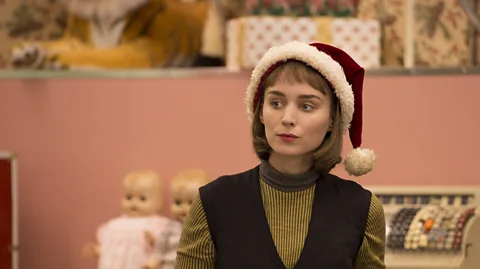
The opening scene, set at Christmas in the toy section of a department store, is almost spooky in its pre-technological stillness: the dolls in glass cases might be playthings from a distant century, and the dusky lighting blankets everything in shadow. It’s the perfect place for Therese (Rooney Mara), a doleful shop girl wearing a Santa Claus hat that’s the only jolly thing about her, to meet Carol (Cate Blanchett), a vamp in a mink coat who just about devours Therese with her appraising and adoring glances.
The movie is based on The Price of Salt, a 1952 Patricia Highsmith novel that was originally published under a pseudonym. The Highsmith world is a jungle that brims with predators, and when we first see Carol, with her hot-pink hat and scarf and slightly bored, grand manner, it’s easy to assume that she’s some sort of restless femme fatale. Blanchett gives her a smile that’s obscenely ripe, as well as a voice of aristocratic hauteur that puts the sin in insinuating. It’s all very Barbara Stanwyck-as-black-widow.
Yet there’s a good reason for Carol’s highly suggestive manner. She’s wealthy and privileged but trapped in a society that has no place for her desires, so she has little choice but to suggest them. She’s like a secret agent of love. Her seduction of Therese, which begins over a lunch of creamed spinach and martinis, almost has to be cloaked and conniving, because she’s opening up the younger woman to feelings that no one at the time even has words for.
It’s easy to regard Therese, with her mousy bangs and ambition of becoming a photographer, as the film’s coming-of-age heroine. Carol, with her luxe manner and gray stone mansion (the film’s one token Sirkian touch – it’s right out of his 1956 melodrama Written on the Wind), seems, at first, the unambiguous aggressor. But our feelings about Blanchett’s Carol become more complex as soon as we learn that she’s in the middle of a divorce, grasping to get joint custody of her young daughter.
Her stuffy husband (Kyle Chandler) knows about her affairs with women, deeply resents them, and loves her anyway. It’s really a control issue; he doesn’t want to give her up. Yet Carol’s decision to end their marriage isn’t just about her need to get away from a man who’s a possessive lout. It’s about something deeper – the yearning for a life in which her desires can openly define her existence.
Secret love
Carol, instead of playing cinematic games, comes closer to being a lesbian counterpart to Brokeback Mountain: the story of a passion that takes full flower in the shadow of how powerfully it must be concealed and denied. It would be wrong to say that Haynes harbours nostalgia for the oppression of the past, yet what he does have is a bone-deep aesthetic nostalgia for the romanticism of gay culture before it was allowed to speak its name.
Haynes turns the early ’50s into a darkly enveloping underworld, in which secrecy becomes a kind of sanctuary. Carol takes Therese on a road trip to Chicago, and it’s during this ramshackle odyssey of diners and motels that their love blossoms. Blanchett and Mara don’t just act together, they dance with their eyes. They make every moment tremble.
When Highsmith wrote The Price of Salt, it was a departure for her not just because of its audacious (and autobiographical) subject matter, but in terms of the suspense genre in which she worked; this one is more soap opera than thriller. Yet a bit of the author’s cunning sneaks through. Carol and Therese are trailed by a private detective, and in the movie, when the snoop’s hidden tape recorder is exposed, the spectre of electronic surveillence – so routine to us now – acquires a shock of violation in this sleepy ’50s context.
Once Carol’s privacy zone has been destroyed, she’s threatened with losing all access to her daughter, and it’s out of that fear that the film acquires a grave moral force. The prospect of severing the bond between mother and child carries a special cruelty, but that’s really Haynes’s way of asking: how can we, as a society, refuse to sanctify any kind of love? Carol is a powerfully relevant film that says that as long as the connection between two human beings comes with invisible strings of oppression attached, we’re all living in a 1950s shadow.
Carol isn’t quite the masterpiece that Far From Heaven was. Yet it has a furtive soulfulness that sneaks up on you. It’s the real thing – a true romance – merged with a resonant riff on what might be called the metaphysics of tolerance. I wasn’t sure how much I loved the film until the gaze-locking final scene, which packs the primal emotional punch of An Officer and a Gentleman spiced with a touch of Vertigo. For Haynes, falling in love really is about falling, and Carol is a beautiful journey into the depths.
★★★★★
If you would like to comment on this story or anything else you have seen on BBC Culture, head over to our Facebook page or message us on Twitter.
