Movie review: David Fincher’s Gone Girl

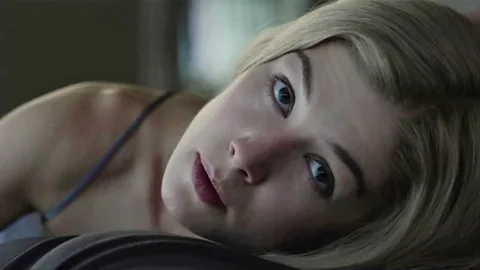
The adaptation of the bestselling thriller by Gillian Flynn might be the most anticipated film of the year. Film critic Owen Gleiberman gives his verdict.
The days when people would go to a movie based on a popular novel and leave the cinema muttering "the book was better" seem like ancient history. It's not that the page-to-screen dynamic has changed all that much. Nine times out of ten, the book still is better. What have changed are audience expectations: viewers drawn to an adaptation of a novel they adore are now more likely to accept, and even embrace, a movie that merely illustrates the novel in a nuts-and-bolts way, offering up a surface facsimile of the book's deeper pleasures. I'd argue that the change in attitude occurred around the time of the early Harry Potter films: those movies didn't come close to capturing the off-kilter, mad-tea-party enchantment of JK Rowling's prose, but it didn't seem to bother anyone. The movies mostly stayed true to the characters and events and supernatural facts of the books, and for viewers, that was enough.
Gone Girl, David Fincher's meticulously overwrought screen version of Gillian Flynn's he-said/she-said novel of marital discord gone malevolent, is a film that sticks to its source with an almost fetishistic precision. If you're eager to see a Hollywood movie that shows you what the characters and incidents in Gone Girl look like, then Fincher's film – with a script by Flynn – will more than do the job for you. Here's Ben Affleck, navigating his way through a dozen pitch-perfect shades of antsy and beleaguered, as Nick Dunn, a laid-off New York magazine writer turned Missouri slacker. He arrives at his prefab suburban palaceon the morning of his fifth wedding anniversary, only to learn that his wife, the alluring blonde Amy (Rosamund Pike), has gone missing. Here's the smashed coffee table and smears of blood that make it look like she was assaulted, abducted and possibly killed. And here's Nick at the morning-after press conference, appearing woeful yet flashing a stupid grin, so that it seems like he doesn't care.
Here's the growing media firestorm, whipped up by a tabloid-TV demagogue (a thinly veiled riff on the US TV anchor Nancy Grace), that suggests Nick is, in fact, behind his wife's disappearance. Here's the mountain of evidence – credit card bills, an altered life-insurance plan – that suggests he is guilty. And then the big twist arrives, with its knockout punch – though since it occurs relatively early in the film, we've got an hour and a half to go with no real mystery at all.
Here, as well, are the book’s juicy supporting characters, all cast and played with exquisitely offbeat perfection: Carrie Coon as Nick’s tart-tongued sister; Tyler Perry as the affable superstar lawyer Tanner Bolt, who signs up to defend Nick; and Kim Dickens and Patrick Fugit as the surly local cops whose inept investigation winds up placing a noose around Dunn’s neck. As a kind of literal, illustrated version of Flynn's novel, Fincher’s Gone Girl could scarcely be better.
Surface appeal
And yet, for all the slavish fidelity on display, something fundamental is missing. Reading Gone Girl, you believed in the marriage of Nick and Amy, the beautiful, sharp-witted magazine puzzle writer who falls in love with him and agrees to move to his southern midwest hometown. Their spiky romantic relationship had texture, intrigue, a seesawing complexity. Early on, the film gives us a sprinkle of moments in which the two are shown to be addictively involved, yet these scenes drift by without resonance or consequence. Fincher and Flynn are so devoted to cramming as much of the novel into two hours and 25 minutes that Nick and Amy's true romancejust registers as another skittish plot point. Gone Girl the movie plays as the story of a toxic relationship rather than a good relationship turned tragically bad. And that's a crucial difference: once the story gets rolling, all the homicidal teases and tricks aren't expressing anything – they’re just ‘whodunit’ gambits packaged to get a rise out of you. The movie is like the trashy 1985 marital-homicide thriller Jagged Edge, but with pretentions.
Then again, if Fincher's Gone Girl fails to evoke the glimmer of honest emotion in the novel, it reproduces all too faithfully the escalating implausibilities and reckless pulp extravagance that turnedthe second half of Flynn's book into a thriller of diminishing returns. The novel was greeted, in some quarters, as the second coming of Patricia Highsmith. But Highsmith, with her ruthless misanthropic clarity, would have turned up her nose at the crucial – and awful – section of the book in which Amy, having established that she's the most clever of the duplicitous mates, thencompromises her scheming brilliance for no other reason than the fact that the plot requires her to. Pike can be a wonderfully sympathetic actress, but in Gone Girl she plays Amy like a bug-eyed vixen who’s fast on her way to becoming a Stepford zombie. She tries, in her way, to be subtle, but what's missing is the agony that Amy had in the novel, which is why she now seems so over-the-top. Pike makes you long for the loving, caring tenderness of Sharon Stone in Basic Instinct.
The shifts in tone from the novel only ratchet up the movie’s farfetched quality. The Nancy Grace character – in the book, a witty piece of media commentary – now seems to be on the air 24/7, as if she headlines the only television channel in the US.And there’s a hint of desperation in the way that Fincher by the end tries to play the escalating duel between Nick and Amy as satire, repositioning the material as a knowingly funny burlesque of what marriage really is: two people who want to kill each other agreeing to accept that as the basis of their relationship. The film seems to be snickering at developments one step ahead of the audience, as if Fincher is saying, “Go ahead and laugh! We know this is absurd!” Gone Girl ends up twisting itself in knots to say that men are saps and women are ruthlessly unknowable. You could call that vision misogynistic, and you wouldn't be wrong, but you'd be far more accurate if you simply called it ludicrous.
★★☆☆☆
If you would like to comment on this story or anything else you have seen on BBC Culture, head over to our Facebook page or message us on Twitter.
