The firm outfitting the world’s armies

 Getty Images/ Gabriel Buoys
From the heart of Yorkshire, England, a tiny, family firm is running a global empire – not in steel or machinery, but in military uniforms and ceremonial clothing. More surprising still, their customers have included everyone from great leaders to notorious dictators, royalty to pop stars.
When Wyedean was founded in 1852, it offered just 12 items. Today, the firm can produce any of 10,000 products or patterns from a catalogue that dates back decades – with some designs unchanged since the 19th Century. The company’s clients include militaries in Saudi Arabia, Fiji, New Zealand, Nigeria, Sri Lanka as well as the United Kingdom.
 David Urban
Why Wyedean?
Despite its niche product line, Wyedean still competes with manufacturers from the UK and overseas – including several factories in Asia which have lower labour costs.
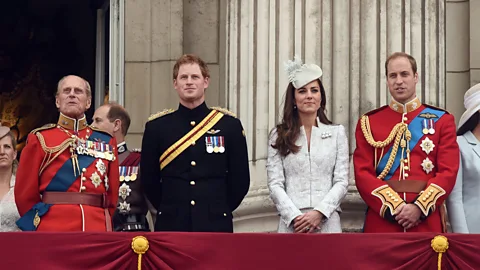
The firm says it has survived by adhering to a basic business tenet: reputation is key. Wyedean’s longstanding relationship with the British Ministry of Defence in particular has helped it win confidence from buyers abroad. Their client list now includes the United Nations as well as the military and security services of 60 other countries.
 Getty Images /Anwar Hussein
Robin Wright, the company’s managing director, said that Wyedean sells just under $3m worth of products to the MoD per year. That makes up nearly half of Wyedean’s turnover, which last year hit a company record of $6.1 million.
Colonial connections also still play a role in Wyedean’s businesss and some of the firms production has been done from Pakistan since 2000. Many former colonies’ military uniforms, for example, still mimic those of the UK even decades after independence. “What Commonwealth countries wear in uniform accoutrement is traditionally British (in style), and the main driving force for overseas client sourcing from UK manufacturers such as ourselves,” Wright said.
Given Wyedean’s far-flung networks and commonwealth contacts, it perhaps not that surprising that some of its clothing has wound up being worn by infamous despots. Among the roster: Idi Amin, Muammar Gaddafi and Saddam Hussein.
{"image":{"pid":"p03xlm1g}}
But, says Wright, it is rare that Wyedean has direct contact with any recipients; most trade is conducted through third-party representatives.
In another example of how unpalatable events can be good for business, wars – or more accurately the victors of them – can also be lucrative clients. Although they also provide regular military uniforms, most of Wyedean’s business is for ceremonial dress – and with military power comes ceremony, commemorative parades and a rise in product demand. At the end of the Sri Lankan Civil War, for example, the new government “wanted to buy ceremonial dress,” Wright said.
Dealing with foreign clients, including those in countries enduring political upheaval, can be a roller-coaster. One such example came in 1979 after a coup in Ghana saw the company lose out on an order of 5,000 duty armlets for the national police. The money lost from the sale falling through “was a big hit and a learning curve for the company.”
 David Urban
But this has not stopped Wyedean from pursuing international deals.
Wright said he strives to strike the right balance between domestic and worldwide commitments. This was put to the test in 2015 when the company accidentally double-booked an important international exposition in Abu Dhabi with a royal visit to the Haworth factory. Wright had to fly from Manchester to the United Arab Emirates and back again within 30 hours – sleeping on planes each night to ensure he greeted Princess Anne, but also could manage the trade exhibition.
Despite Wyedean’s focus on international clients, the MoD remains crucial. This once-reliable income stream may soon narrow, though, as defence spending diminishes. “Naturally the market to expand is foreign businesss – that is our target,” Wright said.
In particular, the firm is looking to the Gulf states, where they say that gold garments and British products are held in high esteem – hence the double-booked Abu Dhabi exhibition.
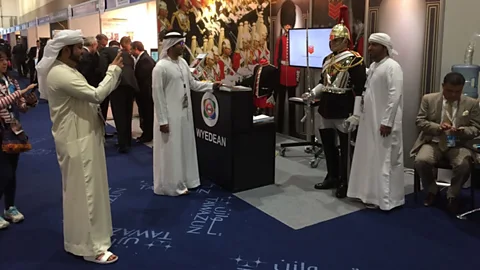 Wyedean Weaving
During the same exhibition, where a wide range of military hardware was on display – from underwater pistols to multi-million-pound Apache aircraft – Wyedean found themselves nestled in among the big guns. Even so, the company managed to strike a deal with the Saudi Arabian National Guard.
From military uniforms to MJ
As their customer base is shifting, so are their products. In particular, Wyedean’s braids, ribbons and sashes that used to serve armies now adorn actors. Theatrical and film costumiers look to outlets like Wyedean to add authenticity and realism; the company has helped with costuming for films including Saving Private Ryan, Lord of the Rings, The Last Samurai and Indiana Jones: Raiders of the Lost Ark. Despite providing less than 2% of annual turnover, the Hollywood connections, Wright says, add interest to the firm.
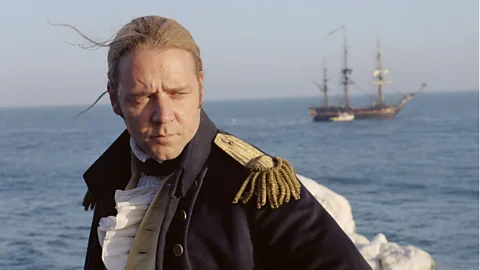 Twentieth Century Fox Film Corp
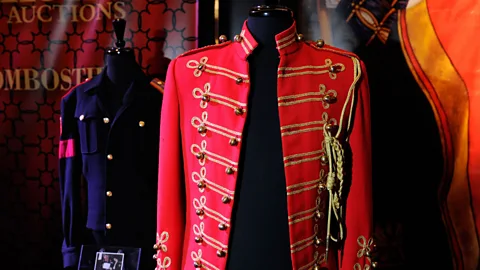
Michael Jackson was another icon Wyedean added to their list of celebrity recipients. The star’s tailor purchased a military tunic from Wyedean that Jackson liked, but the singer wanted to personalise it. There was one particularly novel addition: “The tailor who made the finished item revealed that they put air-conditioning inside of it, a little refrigeration unit to keep him cool,” said Wright.
Getty Images/ Gabriel BuoysWyedean may have faced challenges and conflicts during its 150-year history. But as long as wars are fought and films are made, it seems the brand will continue to adorn kings and queens, armies and dictators – and even the occasional celebrity.
This story is a part of BBC Britain: a series focused on exploring this extraordinary island, one story at a time. Readers outside of the UK can see every BBC Britain story by heading to theBritain homepage; you also can see our latest stories by following us onFacebookandTwitter.
To comment on this story or anything else you have seen on BBC Capital, please head over to ourFacebook page or message us onTwitter.
If you liked this story,sign up for the weekly bbc.com features newsletter, called “If You Only Read 6 Things This Week”. A handpicked selection of stories from BBC Future, Earth, Culture, Capital, Travel and Autos, delivered to your inbox every Friday.