The rise of the 'backup passport'

 Getty Images
After Canada relaxed parts of its citizenship-by-descent rules in December 2025, many Americans began combing through their family trees to see if they could claim Canadian citizenship. For some, the news prompted a sudden thought: could a long-forgotten grandparent unlock a second passport? It's a question increasingly being asked around the world.
When Emily Hill, a novelist from Everett, Washington, heard about the recent changes to Canada's citizenship-by-descent rules, she immediately wondered whether a family connection might make her eligible.
"I felt like I'd been struck by lightning," she says, explaining that her grandmother was born in Montreal. "This possibility was a 26-year dream come true."
Within a week, she had gathered the documents and submitted an application. If approved, she hopes to move permanently to British Columbia. "I'd like to come 'home' and apply my energy in the country of my grandparents," Hill says.
But Americans aren't the only ones suddenly turning their attention to their ancestors. Around the world, people are digging through family archives, birth records and genealogy websites in search of an extra citizenship.
Why dual nationality is rising
The growing interest reflects a bigger shift in how people now think about nationality. For generations, passports primarily signalled where someone came from; today they also shape where people can travel, work and live. Until relatively recently, many countries restricted or prohibited dual citizenship, making multiple passports far less common than they are today. However, as geopolitical tensions, pandemic border closures and shifting visa regimes reshape global mobility – and remote work fuels a growing population of digital nomads – a second passport is increasingly seen as a way to keep options open.
 Getty Images
"The main two motives [for seeking a second citizenship] are mobility and security," explains Yossi Harpaz, associate professor of sociology at Tel-Aviv University, whose research focusses on global trends in citizenship, migration and dual nationality. "For some ethnic minorities, it's also a hedge against discrimination or persecution."
The rise of dual citizenship is also being driven by a growing sense of political uncertainty, says Kristin Surak, associate professor of political sociology at the London School of Economics and author of The Golden Passport: Global Mobility for Millionaires.
"What were once seen as stable democracies no longer look so stable to many people," she explains. "Brexit led a number of UK citizens to search for an Irish grandparent and take up Irish citizenship to retain the benefits of EU membership. The extreme politicalisation of US politics over the past several years has had a similar effect of driving people to look for exit options."
Even if they don't move immediately, or at all, Surak adds, many applicants want the peace of mind of knowing there's a way.
"It's citizenship as an insurance policy," she says.
For many people, the search begins with family history.
After the Brexit referendum in 2016, applications for Irish passports surged as Brits looked for ways to maintain freedom of movement within Europe. Anyone with an Irish parent or grandparent born in Ireland is entitled to Irish citizenship, and the UK permits dual nationality. Between 2017 and 2020, more than 350,000 Irish passports were issued to people living in Great Britain, according to Ireland's Department of Foreign Affairs.
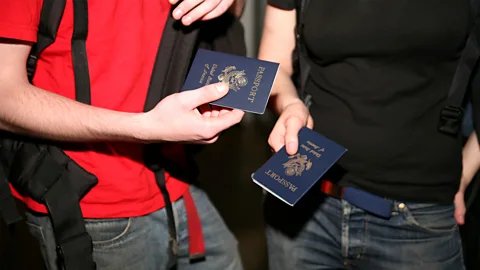
Immigration lawyers are seeing similar interest in ancestry-based citizenship. "In the past few years particularly, there has been an exponential increase," says Italian attorney Marco Permunian, founder and CEO of Italian Citizenship Assistance.
 Getty Images
Permunian says many people hoping to gain Italian citizenship initially approach the process wanting to learn more about their family history. "They are curious about their ancestors' background – where they came from and the culture and language that forms their family's roots," he says.
But practical considerations often play a role as well. "Of course, they also want to obtain EU citizenship for strategic reasons," he says. "Living in an increasingly global society has made people realise that their options for living, work and travel aren't as limited as they might have been in the past."
New limits on heritage passports
The surge in ancestry applications is prompting some governments to rethink the rules. Italy, traditionally one of the most popular routes for people claiming citizenship through distant relatives, tightened its laws in 2025 in response to the growing number of claims. The reforms largely limit automatic citizenship to those with a parent or grandparent born in Italy, narrowing a system that had previously allowed claims to stretch back many generations.
Wiltshire-based Jamie Caldwell only realised he might qualify for Irish citizenship after a friend mentioned they were applying. He submitted his application in 2019, as Britain prepared to leave the EU.
"It hadn't occurred to me that I might be eligible," he says. "I applied mostly with my children in mind."
When the passports finally arrived, Caldwell turned the moment into a small family celebration. "I poured out some Guinness, played some Celtic music and presented the passports," he says. "They were really only interested in the Guinness!"
Since then, he says his three children have come to appreciate the opportunities much more. Two have already spent time working in the Netherlands and another plans to study abroad as part of a university language degree.
"I would like my children to experience living and working in other countries," Caldwell says. "Having European passports makes that much easier."
The new rush for Canadian citizenship
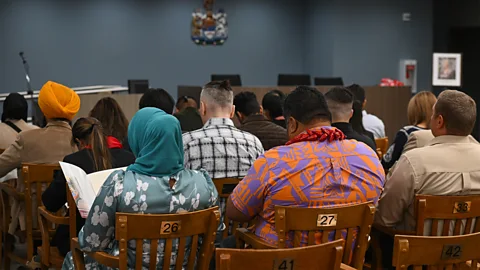
The changes to Canada's citizenship-by-descent rules, passed on 15 December 2025, have added fresh momentum to the ancestry trend. They address gaps in earlier rules that prevented some Canadians born abroad from passing citizenship to their children – a change that could expand eligibility for tens of thousands of descendants living outside the country.
"We've absolutely seen an uptick in Americans inquiring about Canadian citizenship," says Evelyn Ackah, founder of Ackah Business Immigration Law in Calgary. "Americans are definitely looking into family genealogy to see if they have any Canadian roots. We are doing so many consultation sessions to help people understand what they need to provide to qualify."
 Getty Images
While many of Ackah's clients merely see citizenship as a safety net, others plan to move as soon as they can. "Some are also interested to retire in Canada for the healthcare benefits offered to citizens," she adds.
George M, a Chicago-based software engineer, only realised he might qualify last week after seeing an online discussion about the law. Within days, he had begun gathering documents tracing his family line to his grandmother's father, who was born in Canada.
"Getting the Canadian passport seems like a no-brainer," he says. "I don't think it makes sense not to keep a door open if it's available."
When citizenship becomes an escape plan
While many applicants in stable democracies see second citizenship as a form of contingency planning, it can be far more urgent in other parts of the world.
Over the past decade, many Venezuelans have applied for Spanish or Italian citizenship, drawing on family connections that date back to waves of European migration to South America in the late 19th and early 20th Centuries. Those historic ties now provide a legal pathway to second citizenship for some of their descendants.
According to Harpaz, second passports often remain dormant for many years, with dual citizens only leaving in large numbers during severe crises, such as the tightening of Chinese control over Hong Kong in 2019-2020 and Argentina's economic collapse in the early 2000s.
More like this:
• The Caribbean islands that give you a passport if you buy a home
• Going to Europe this summer? Prepare for a long queue
• Dual nationals face scramble for UK passports as new rules come into force
As Venezuela's economic and political crisis deepened, those ancestral links have become an increasingly important exit route. In Spain alone, more than 35,000 Venezuelans gained citizenship in 2024, according to Spain's National Institute of Statistics, making them one of the largest groups acquiring nationality that year. Venezuelans are now among the largest immigrant groups in Spain, with the diaspora numbering around 700,000.
The luxury passport market
At the other end of the spectrum, some second passports are simply being bought. In December, the US rolled out the Trump Gold Card, allowing foreign nationals to obtain US residency and a path to citizenship by paying a $15,000 processing fee and a $1m contribution to the US government. Several small nations, particularly in the Caribbean and parts of Europe, operate citizenship-by-investment programmes that grant nationality to foreigners who contribute significant funds to government development schemes or property markets.
 Getty Images
Supporters say these programmes generate much-needed revenue for small economies. Yet the growing trade in additional passports also highlights deep disparities in global mobility.
"This market has emerged at the intersection of inequality between countries – in terms of what a person's citizenship and passport gets them – and inequality within countries, between those who can afford such programmes and those who can't," says Surak.
Interestingly, Turkey has emerged as a major player in the citizenship-by-investment market over the last few years. According to Surak, it now accounts for roughly half of all citizenship-by-investment approvals globally.
"Unlike the small island programmes, Turkey is a large regional hub and relatively easy to qualify for," she says. Applicants just need to purchase property worth at least $400,000 and hold it for three years, with Surak noting that the programme has proven particularly attractive to applicants from countries with more limited mobility, including Iraq, Iran, Pakistan and Syria. "Even if a standard Turkish passport doesn't bring visa-free access to the EU, it's still better than a lot of others."
That appeal reflects the vast differences in what the world's passports actually allow. According to the Henley Passport Index, the world's most powerful passport in 2026 – Singapore – allows visa-free travel to 192 destinations, while the lowest-ranking passport, Afghanistan, grants access to just 24.
As mobility becomes more valuable, it seems that citizenship itself is increasingly being treated as a strategic asset. For a growing number of people, the passport tucked into a desk drawer is no longer just a document of identity but a form of insurance – a backup plan in an uncertain world.
--
If you liked this story, sign up for The Essential List newsletter – a handpicked selection of features, videos and can't-miss news, delivered to your inbox twice a week.
For more Travel stories from the BBC, follow us on Facebook and Instagram.
