Kanuchi: A nut-based soup to celebrate autumn

 Metta Nielsen
In her new cookbook, Corn Dance, Loretta Barrett Oden celebrates the diversity of Native American recipes, including a warm, nutty soup called kanuchi.
Loretta Barrett Oden is 81 years old and just came out with her first cookbook, Corn Dance: Inspired First American Cuisine, this past October. In the book, Oden shares stories and recipes that are intended to educate and enlighten the home cook with a celebration of indigenous foods. "I should have written this book many, many years ago," she said, "but I've just stayed so busy with one project after another, one restaurant after another, that I just now found the time to sit down and write." After years of telling the stories of other chefs and cultures, it was finally time to share her own.
Oden was born in Shawnee, Oklahoma, a small town 40 minutes by car east of Oklahoma City, Oklahoma. Her paternal grandmother was a descendent of the Mayflower, a card-carrying member of the Daughters of the American Revolution. Her mother was from a large family of Potawatomi origins, now known as Citizen Potawatomi Nation. The nine different tribes of Potawatomi peoples are mostly from the Great Lakes region of the US and Canada. Oden refers to her tribe as Anishinaabe, a larger group of Indigenous peoples that encompasses Citizen Potawotomi Nation as well the Ojibwe, among others.
"Back in the 1940s and 1950s, it was not really cool to be native," Oden said. "I'm rather fair-skinned, I have kind of blue-green eyes, and hence, I kind of 'passed' as we called it back then."
"Passed", Oden explained, refers to being perceived as white.
By the age of 10 or 12, Oden came to understand that she was Native, the same as her many cousins who had darker skin. "Growing up with the influences of both sides was a little confusing, but then things started clarifying when I learned more about both family's history."
Over the years, Oden, who was an avid home cook, became increasingly interested in indigenous ingredients and cuisine. In 1993, she opened The Corn Dance Café (now closed) in Santa Fe, New Mexico, with one of her sons, Clay. Back then, she observed that Indigenous chefs were tapped for the spotlight pretty much exclusively around Thanksgiving, but now, she said, "We're fashionable year-round."
Oden's restaurant highlighted native ingredients, which included turkey with cornbread dressing, no matter the time of year. When guests asked why there was always Thanksgiving food on the menu, Oden would reply, "Here, every day is Thanksgiving Day." Oden celebrated Thanksgiving with her family as a child, and carried that tradition on with her sons, referring to it as "a huge holiday for us, and a time for the families to gather."
 Ethan Stewart
In carrying on her quest to showcase diverse indigenous ingredients, Oden includes many recipes in her book using them. One such recipe is the Cherokee dish called kanuchi, a thick soup made of nuts. "Many south-eastern tribes have their own version of kanuchi," Oden writes. "Years ago, nutmeat paste would be shaped into softball-sized hunks and stored in wood barrels or clay pots to be used for making this soup and thickening stews throughout the winter."
Traditionally, kanuchi is made with hickory nuts (a nut tree that's endemic to North America) that are pounded into a paste using a mortar and pestle. If you can't find hickory nuts, Oden suggests using raw pecans or a mix of pecans and walnuts. As for transforming those nuts into a paste, Oden says you can opt to stick with a mortar and pestle, as she does (she likes the therapeutic feel of grinding things "the old way"), or simply pop the nuts into a blender.
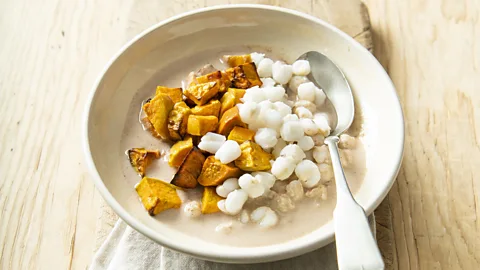
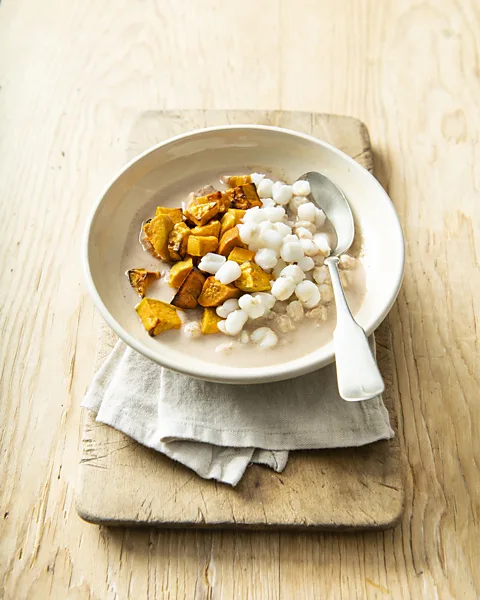
Oden serves kanuchi the traditional way, over hominy (dried corn treated with lye), with the added flair of roasted sweet potato on top. She likes the sweet toastiness of the sweet potatoes with the nuttiness of the kanuchi, balanced with the chew of the hominy. The hominy itself nods both to the book's title and to The Corn Dance Café.
Oden has dedicated the second part of her life to storytelling through food. In 2006, she won an Emmy for a PBS series she hosted, Seasoned With Spirit, about the foodways of different Native American communities across the US. In 2021, she became the Indigenous food consultant to Thirty Nine Restaurant in Oklahoma City's First Americans Museum.
Oden has been excited by the increasing wave of young Native American chefs who have opened high-profile restaurants, and the many cookbooks coming out that delve into different sides of Indigenous culture. "I think our presence is being recognised," she said.
"We're an oral tradition people, we really didn't have a lot written down," Oden said. "Now it's all getting written down. It's documented. We're able to cook and share this food and tell the stories. And that's my favourite part."
 Metta Nielsen
By Loretta Barrett Oden
Serves 4 to 6
In this recipe, a food processor transforms the nuts into a paste (saving the time of pounding). It's made with the simplest ingredients, so the taste of the nuts shines through.
Ingredients
113g (4oz) raw hickory nuts, pecans or a mix of walnuts and pecans
1 litre (1qt) cold water
1 tsp salt, or more to taste
1 tbsp maple syrup, or more to taste
1 cup cooked and drained whole or cracked hominy or 1 sweet potato, roasted, peeled, and cut into ½-inch dice
Method
Step 1
In a food processor fitted with a steel blade, process the nuts to form a thick paste, scraping down the sides of the bowl once or twice, about 3 minutes. Scrape the nut paste into a large stockpot and add the water and salt. Set the pot over high heat and bring the water to a boil, whisking the nut paste until it dissolves and the liquid thickens. Reduce the heat and simmer uncovered, stirring often, until the liquid is reduced by half, about 30 minutes.
Step 2
Stir in the maple syrup, increase the heat, and bring the mixture to a boil, cooking until any separated fats on the surface have emulsified back into the soup. Taste and adjust the seasonings. Serve warm over hominy or roasted sweet potatoes.
BBC.com's World's Table "smashes the kitchen ceiling" by changing the way the world thinks about food, through the past, present and future.
---
Join more than three million BBC Travel fans by liking us on Facebook, or follow us on Twitter and Instagram.
If you liked this story, sign up for The Essential List newsletter – a handpicked selection of features, videos and can't-miss news delivered to your inbox every Friday.
