A brined turkey to 'rival all others'

 Design Pics/Alamy
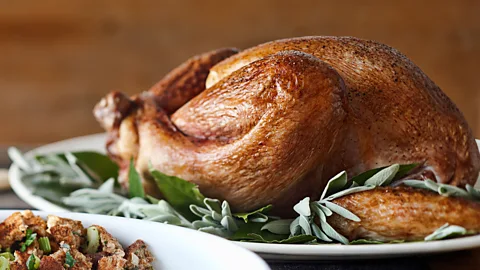
In her new cookbook, Chími Nu'am, Sara Calvosa Olson celebrates Indigenous American ingredients and seasonal flavours, like roasted turkey with apple brandy acorn gravy.
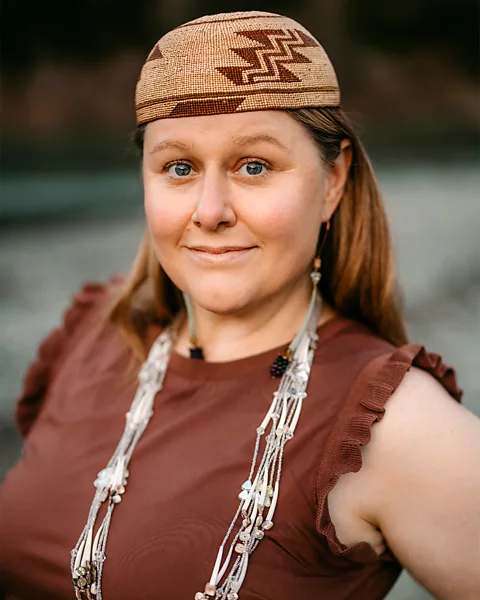
Sara Calvosa Olson, the author of Chími Nu'am: Native California Foodways for the Contemporary Kitchen, published this past September, is a descendant of the Karuk tribe of Indigenous Americans, the the second largest Native American group in California.
With Chími Nu'am (which means "let's eat" in Kanuk), Olson looks to encourage people to start thinking about a decolonised diet, connecting to the land and native ingredients prior to European colonisation. "This is about cooking not just for ourselves, but for our communities," Olson said. "And having people get into a different way of thinking about food and what's around us and where our food comes from." In other words, Chími Nu'am is as much about understanding the history of each recipe – and its ingredients – as it is about the edible end product.
Take, for example, Olson's apple cider brined turkey with apple brandy acorn gravy. In the US, turkey is largely tied to Thanksgiving, but Olson wants people to reconsider the bird as a perennial staple. "I know that people can tend to get burnt out on turkey at this time of year, but all year long turkey has a place in our diets," Olson said. "It's indigenous to this continent and was specifically introduced to California in the 1800s to provide more wild game for ranchers. Now, there are wild turkeys all around California, and they are an excellent source of protein, low fat, and really flavourful."
Olson sees the autumn months as a chance to gather and feast. This season also marks the beginning of the Karuk new year, which, for her family, involves traditions such as taking the ferry to Alcatraz in San Francisco for the annual Indigenous Peoples Sunrise Ceremony on Indigenous Peoples Day; it's also known as Unthanksgiving Day, honouring Native Americans and their resistance, resilience and survival after European colonisation.
"We appreciate being able to participate in this tradition," Olson writes. "There is nothing better than greeting the rising sun in a place with so much Indigenous history and power, being in community, and starting a new year from a place of strength and togetherness."
 Nelia Marshall Photography
After the ceremony, Olson and her family head back home for a meal complete with a big turkey and tons of sides. "Feasting at this time of year is intrinsic to native communities," Olson said. "Regardless of it being Thanksgiving, we still celebrate it as an opportunity to be together and set our intentions for the next year as a community."
In her cookbook, Olson aims to make indigenous ingredients and traditional Karuk recipes accessible to a whole range of home cooks. But the book might feel, in her words, "inconvenient". That's because many of the recipes call for ingredients that are not so well known and sometimes difficult to find.
"You can't really just go to the grocery store and get acorn flour or peppernuts," Olson said, referring to the nuts of the bay laurel tree, sometimes also called California bay nuts. Although some ingredients that are important to Karuk cuisine, like elk and venison, have become more widely available (and several recipes in the book can be adapted with simple store-bought substitutions), Olson hopes that home cooks go a little bit deeper than reaching for an easy fix.
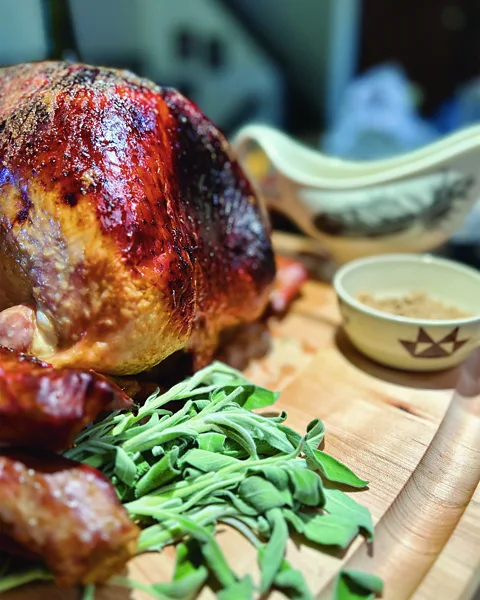
For her autumn feast, Olson argues that her cider-brined turkey is the turkey to rival all others. "If you're anti-turkey because you have always found it dry and flavourless, then please give it one more chance using this recipe," she writes in the cookbook. What makes it so good? The turkey rests for 36 to 48 hours in a brine of warming ingredients like apple cider, juniper berries and cinnamon. It's served with a gravy that's salty and savoury from turkey stock and fruity from apple brandy, but there's also an unexpected depth of earthy flavour from the addition of acorn flour.
 Heyday
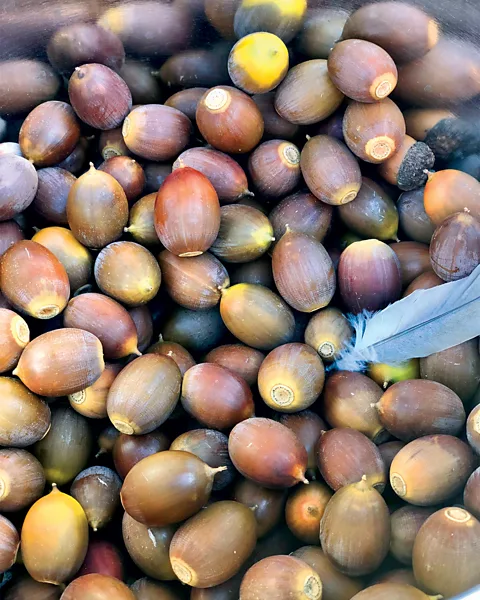
Olson said that she and her family eat acorn flour every day, sometimes as a base for focaccia, or mixed into oatmeal, or even whipped into salad dressings. "They're perfect food," Olson said, nodding to the fact that acorns contain a complete set of amino acids and are therefore incredibly good for you. They also carry a lot of history. "Acorns are traditional to so many tribal communities in California and outside of California," Olson said. "It's one thing that many of us have in common. In hard years, acorns are always there to sustain and feed us."
Making acorn flour entails gathering acorns, letting them dry out, cracking then peeling them, then blending the acorns with water into a milkshake-like consistency. After a few days in the refrigerator, in which you have to continuously drain off the old water and add new water to the acorn meal, it'll be ready to be dehydrated then blended into flour.
Acorn flour isn't widely sold in grocery stores, so Olson recommends two alternatives for the turkey gravy: chestnut flour, which is more available and has similar properties, or coconut flour, which changes the flavour slightly but has the same absorbency as acorn flour, yielding a gravy that's thick and silky.
With Chími Nu'am, Olson hopes to invite readers into her culture. "Let me show you how we do it in our house," she said, "in a way where we are centring Indigenous people." The title of the book says it all.
 Heyday
Apple cider brined turkey with apple brandy acorn gravy recipe
By Sara Calvosa Olson
Serves 6
Ingredients
For the brine:
4 litres (4qts) apple cider
1½ cups salt
¼ cup allspice berries
¼ cup whole star anise
5 whole cloves
10 dried or 2 or 3 fresh bay leaves
1 tbsp juniper berries
1 tbsp peppercorns
1 long cinnamon stick, snapped in half
4 litres (4qts) water
For the bird:
one 7kg (15lb) turkey
½ cup maple sugar
113g (1 stick) butter, at room temperature
6 to 8 sage leaves
2 apples, halved
For the gravy:
2 cups turkey stock, store-bought or homemade
4 tbsp acorn flour (chestnut or coconut flour may be substituted)
¼ cup Calvados (apple brandy) or apple cider or more stock
¼ cup half-and-half
salt and pepper
Method
Step 1
In a large stockpot, heat 1 quart of cider, the salt, and all of the herbs and spices over medium heat, stirring until the salt has dissolved. Add the remaining 3 quarts cider and the water and stir. Set aside to cool. Pro-tip: If you need the brine to cool fast, just add the water in the form of ice cubes.
Step 2
Prepare the turkey by removing the neck and giblets and patting the bird authoritatively. Open an extra-large turkey brining bag and place the turkey inside along with the neck. Pour the brine inside, seal very well, and lug it to the refrigerator to brine for 36 to 48 hours.
Step 3
After it's finished brining, line a roasting pan with plenty of kitchen paper and place the turkey on top. Pat it dry and remove the herbs and spices from the outside. Don't rinse the turkey in the sink, as it can cause the spread of foodborne bacteria. Once you've cleaned it up (including the paper), return the turkey uncovered to the refrigerator to sit overnight.
Step 4
Preheat the oven to 175C/350F. Remove the turkey from the refrigerator. In a small bowl, mix together the maple sugar and butter. Using your fingers, carefully work the skin away from the breast and down and over the drumsticks. Gently shove three-quarters of the butter mixture under the skin, smearing it everywhere generously. Carefully place the sage leaves on top of the butter between the meat and the skin; if it's too difficult, just shove them in there. Rub the remaining butter mixture all over the outside of the bird. Stuff the cavity with apples. Add the brined turkey neck to the pan and roast it to use for stock later.
Step 5
Roast the turkey until the thickest part of the thigh reaches 80C/175F on a meat thermometer. This can take up to 4 hours, depending upon the size of your bird. Generally, it's about 13 minutes per 1 pound of unstuffed bird.
Step 6
Once the turkey is out of the oven, carefully transfer it from the roasting pan to a carving board, tent it with foil, and let it rest while you make the gravy.
Step 7
Pour the pan juices through a fine-mesh sieve into a measuring cup. Skim off 4 tbsp of fat and pour that fat into a large heavy saucepan; set aside the measuring cup and the saucepan.
Step 8
Back to your roasting pan. Pour the turkey stock into the roasting pan and place it directly onto your stove over medium heat. Using a wooden spoon, scrape up all bits from the bottom of the roasting pan. Pour this through a fine-mesh sieve into a small bowl and set aside.
Step 9
In the saucepan with the fat, mix in the acorn flour and heat it over medium heat for 1 minute. Pour in the reserved roasting pan stock and the reserved pan juices, whisking to incorporate. Add the apple brandy and half-and-half and, whisking often, bring the mixture to a boil until the gravy thickens up a bit. Add salt and pepper to taste, pour into a gravy boat, and serve with carved turkey.
BBC.com's World's Table "smashes the kitchen ceiling" by changing the way the world thinks about food, through the past, present and future.
---
Join more than three million BBC Travel fans by liking us on Facebook, or follow us on Twitter and Instagram.
If you liked this story, sign up for The Essential List newsletter – a handpicked selection of features, videos and can't-miss news delivered to your inbox every Friday.
