Where people pierce themselves for devotion

 Tim McDonald
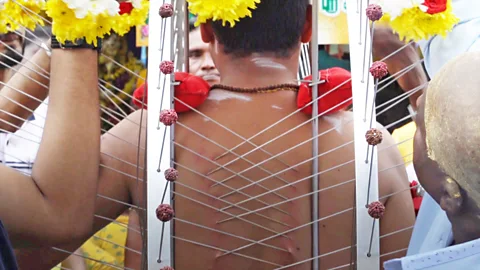
Thaipusam is a beguiling Tamil festival where followers of the Hindu god Lord Murugan pierce their bodies with hundreds of skewers and hooks to show their devotion.
 Tim McDonald
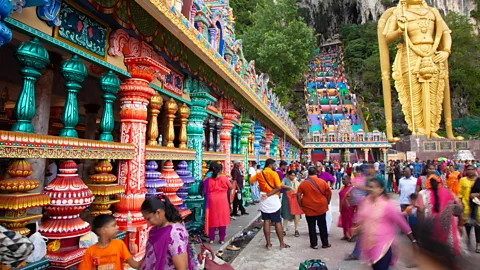
Thaipusam is an overdose for the senses, an explosion of colour and a riot of sounds. It’s also the most important day of the year for devotees of the Hindu god Lord Murugan. And although it’s celebrated across South India, Sri Lanka and Singapore, perhaps nowhere is the beguiling celebration more distinctive than at the Batu Caves, near Kuala Lumpur in Malaysia, where it has been celebrated near the start of each year since 1892.
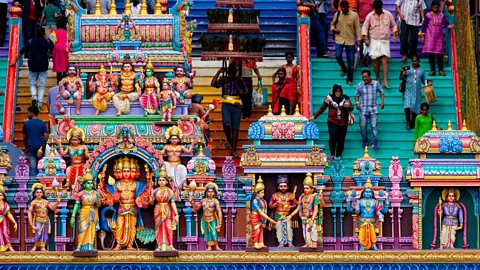
The spectacular backdrop helps. Most years, more than 1.5 million people visit over several days, and at any time thousands of people can be found following drummers down the street before circling around a highway overpass, marching through the front gates of the caves site and up 272 rainbow-painted stairs, past a huge statue of Lord Murugan, to a temple in a limestone cave.
For many Tamils, and a handful of others who have found their way to this brand of Hinduism, Thaipusam caps off 48 days of fasting and devotion to Lord Murugan. Many devotees will carry a kavadi, a kind of ceremonial burden that can take many forms.
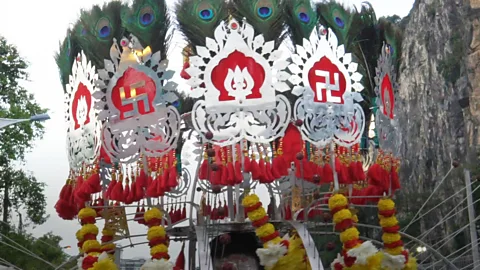
Often, it’s a frame festooned with peacock feathers and flower garlands, with spikes or hooks (sometimes hundreds of them) piercing the body and face of the wearer. It looks painful, but for some devotees, it’s a central part of the celebration.
 Tim McDonald
For me it is nothing to do with pain,” said Chowddhri Kannan, who has carried a kavadi seven times. “It is a joy. Joy of pain,” he added, laughing.
 Tim McDonald
While Islam, Christianity and Judaism claim a single god, a single founder and a single foundational text, Hinduism is different. There’s no founder, and while there are many important texts, there isn’t one that lays everything out like the Bible or Koran. There are many gods – or perhaps just many manifestations of the same god, depending on who you ask. And there are many ways to practice the faith.
In fact, most Hindus don’t celebrate Thaipusam or follow Lord Murugan. It’s a regional celebration that followed the Tamil diaspora here to Malaysia. And within Thaipusam, worship takes many forms. As Kannan explained, there is no one right answer. “It is up to them how they want to present their vows,” he said.
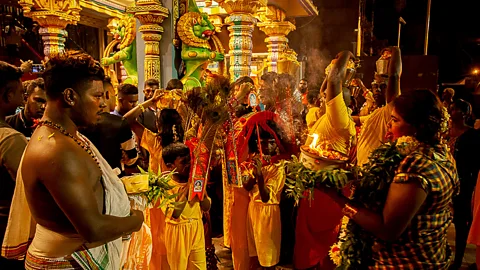
Some devotees carry a milk pot as their ceremonial burden. Others shave their head. Some offer prayers. A few even crawl the entire circuit on their knees. Others, giving thanks for a new child, carry their baby up to the temple in a sling attached to sugar cane. Many fall into a trance, which can involve smiling, laughing, crying, grunting or shrieking
And many pierce themselves. Some use hooks, while others use spikes. Some hook small metal pots or limes to their back. And many carry a kavadi, where spikes or hooks are suspended from intersecting semi-circular frames.
 Tim McDonald
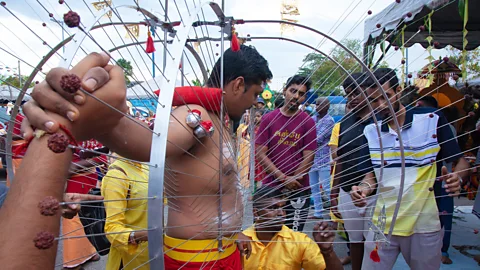
Kishen Kumar (pictured) barely flinches as the spikes pierce his stomach. There are more than 130 spikes and hooks piercing the skin on his torso and arms, and a vel, or cosmic spear, will pierce both cheeks. He doesn’t use any pain relief. For him, above all, this is an act of devotion to Lord Murugan.
“This body is for you. I don’t mind. I bear the pain. It’s for you,” Kumar said.
The pain also serves to intensify spiritual focus, he said, forcing devotees to put aside their ego, anger and other human frailties, and instead concentrate on a closer relationship with Lord Murugan.
His preparation is very much a team effort. Kumar has hand-selected a group of friends and family to do his piercings, including his younger sister. Along with friends from the Sri Siva Sakthi Arulgnana Jothi Lingeswarar Temple (about a 20-minute drive west of downtown Kuala Lumpur), his group has set up a makeshift temple in a tent as a sort of operating base, where they put on their kavadis (a process that can take more than an hour) and pray, before making their way to the main temple at Batu Caves.
 Tim McDonald
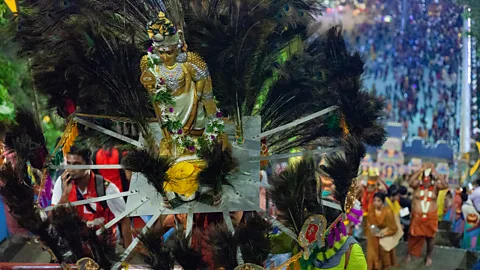
The kavadis on display come in a plethora of shapes and sizes. Some are heavy staffs, carried across the shoulders. A few ambitious devotees attach large hooks in their back to an altar on wheels, although it’s usually others who push it, taking the bulk of the weight. Kumar has spent more than 15,000 Ringgit (nearly ₤3,000) on his kavadi. Some parts have come from Singapore, while others were imported from India. The silver-plated frame is designed to resemble a temple and it’s decorated with a ring of peacock feathers. He plans to make it even more lavish.
“I want to do it in three decks of kavadi, gold-plated. I’ve already sketched all the plans,” he said.
The original kavadi was far simpler – and far more improbable – than the one Kumar carries. According to legend, two hills were attached with serpents to a piece of wood slung over the shoulders of the demon Idumban. Tasked by a sage with carrying the kavadi, Idumban stopped for a rest, only to find a youth sitting on one of the hills, making it impossible for him to lift it again.
An angry Idumban confronted the youth, and a fierce battle followed. Imduban was slain and then restored to life. Only then did he recognise the youth as Lord Murugan in disguise. Idumban was transformed into a fervent devotee and was made the gatekeeper at Lord Murugan’s shrine. Lord Murugan declared that henceforth all who carried a kavadi would be blessed.
 Tim McDonald
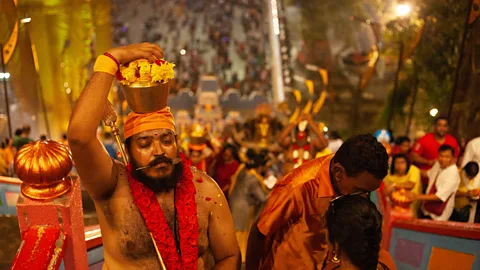
Chowddhri Kannan (pictured) first participated in Thaipusam after a severe case of dengue fever. His guru, who’s also his grandfather, prayed to Lord Murugan for him to get better.
“He prayed to Lord Murugan saying once he’s back, he’ll carry a kavadi to you, so I started my prayers,” he said.
This year, however, he’s getting married, and because carrying a kavadi is a major undertaking, there’s not enough time to prepare. So instead he carries a milk pot, which he will pour onto a temple altar as a symbol of devotion to Lord Murugan. He also carries a ceremonial vel, and has another vel piercing both his cheeks.
Tim McDonaldThe vel is at the centre of Thaipusam as it celebrates the moment that Shiva’s consort Parvati gifted a vel to her son, Lord Murugan. As the devotees march towards the stairs at the Batu Caves, they often call out ‘Vel! Vel!’
Legend has it Lord Murugan used the vel to vanquish a group of demons known as the asuras. But the battle is also about an internal struggle: the asuras stand in for human frailties: ignorance, ego and fear.
Lord Murugan slayed the head demon, who then turned into a mango tree. He took his spear to the mango tree, which then turned into a peacock and a rooster. The latter went on his flag while the former became his preferred means of transport. The rooster isn’t so apparent, but the peacock is everywhere at Thaipusam: kavadis are decorated with peacock feathers, and peacock sculptures adorn the temples.
 Tim McDonald
Thaipusam can feel like a male-dominated celebration. It’s men who carry the kavadis. The drumming troupes that follow them are all men. The gurus are men, too.
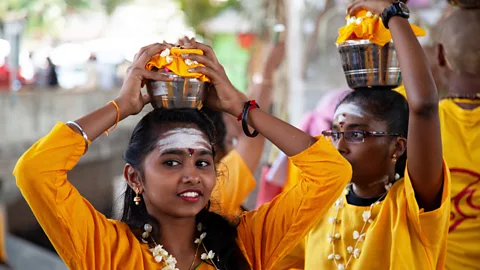
But women are also devotees. Most often they’ll take milk pots to the temple, although this isn’t necessarily the easy option. Shesha Sureshkumar, for example, carried her milk pot 14km from a temple near Kuala Lumpur’s Chinatown to Batu Caves following a ceremonial chariot that carries a vel. She said there are no rules against women carrying a kavadi, but most are put off by the weight and by tradition. She’d like to carry one, some day.
“It’s not that women can’t do it. It’s just that it’s a tradition that men are stronger and they are supposed to do that, and the women are most likely to be supporting the men,” she said. “We bear the pain of delivering a child. It can’t be worse than that.”
 Tim McDonald
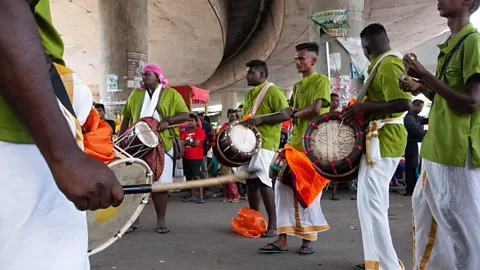
The roar of drums is dense, propulsive, riotous and relentless. The rhythms merge into chaos as kavadis and their entourages pass one another on the way to temple. But music is an essential part of the procession. It’s a reminder that even if carrying a kavadi is an act of devotion, it’s also a celebration.
“When you wear a kavadi, you have to dance,” said Sriganesh Ramadas, a kavadi carrier.
The drums themselves are a little unusual. Some musicians are responsible for the higher end of the scale, hitting the drum with thin sticks that resemble a conductor’s rod. Others beat their drums with hockey stick-shaped mallets. In addition to a thumping sound, they also drag the stick over a drumhead covered in castor oil to produce a distinctive buzzing, wobbling, low-end hum.
Unlike the kavadi bearers, the drumming groups are not attached to a single temple or community. They’re often paid to accompany the pierced devotees as they dance down the road. The drummers have to stop at the bottom of the stairs, though, as it’s too dangerous for anyone to dance their way up.
 Tim McDonald
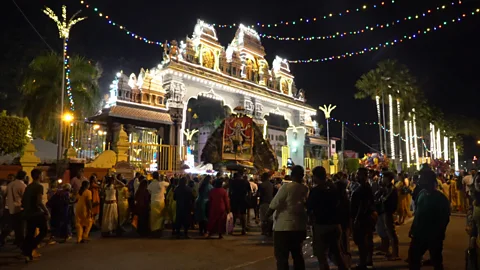
It’s here at this gate, the entrance to the Batu Caves complex, that it gets truly crowded. It feels a little like a busy air traffic control tower, as kavadi bearers and their entourages pause for a beat while others are ushered in the gates toward the steps and the temple.
Inside, it’s hot, noisy and incredibly crowded. Getting out can be a huge hassle. A few tourists come to watch, and there are many photographers stepping into each other’s shots. But overwhelmingly, it’s participants.
Excitement builds as the devotees move haltingly through the crowds to the base of the steps, pausing to rest, to dance or to wait for a path to clear. At the base of the steps, they dance one final time before they part with the drummers and head up the stairs to the temple. There, they’ll remove the kavadis, enter the temple and pour milk on the altar, completing their vow to Lord Murugan.
 Tim McDonald
From the outside, Thaipusam looks to be a test or even an ordeal, but participants are incredibly positive about the whole experience. In truth, the piercings leave only superficial wounds, about the size of a mosquito bite, which will heal within a week, according to Kumar.
Ramadas said that fasting and wearing a kavadi is the easy bit, even if he never celebrates his birthday, which falls in the fasting period. It’s the rest of the year that’s a struggle.
“You’re carrying a family burden in your head, all the while. That’s more heavy and tougher. What is a kavadi? It’s 48 days and then you enjoy it, then you put it down, but there’s another 300 days to go with your family,” he said.
Both say they plan to carry a kavadi until they’re no longer physically able.
Kannan agrees.
“That is the day I’ll stop. Until then, every year I’ll carry a kavadi," he said.
Why We Celebrate is a BBC Travel series that revels in how a festival or event is intertwined with a place’s culture.
