Brexit: Government to help with 'Not for EU' label costs

 BBC
BBCThe government will pay businesses up to £50m to help with the cost of new food labels required by the Windsor Framework.
The framework is the post-Brexit trade deal, which amended the original Northern Ireland Protocol.
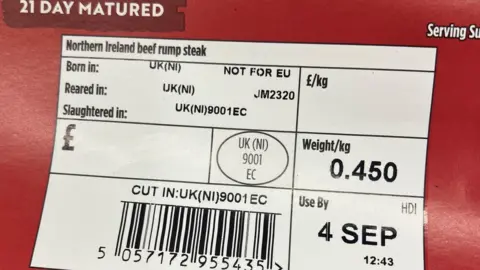
Part of it involves 'Not for EU' labelling on some NI products.
The government will offer retrospective grants at a flat rate, adjusted by business size, for firms who can show additional labelling costs.
It will be open to businesses which have signed up to the framework's trusted trader scheme, the Northern Ireland Retail Movement Scheme (NIRMS).
It will be open to applications between January and March next year with the government saying "we will publish instructions setting out how businesses should apply in the coming months".
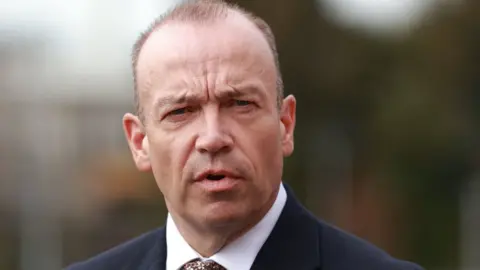
The Secretary of State Chris Heaton Harris says that an additional 1600 businesses have signed up to the new trusted trader scheme, compared to the number who were on the protocol's trusted trader scheme.
 Liam McBurney
Writing in the Belfast News Letter he said: "Some major UK food retailers which were excluded from the old grace periods faced burdensome red tape moving food into NI under the old system.
"But they can now move products through the green lane."
He added that "honest feedback" proposals put forward by the DUP "have put us in a better place" with the systems.
The new labelling rules come into effect on Sunday although some retailers have begun to implement them in advance.
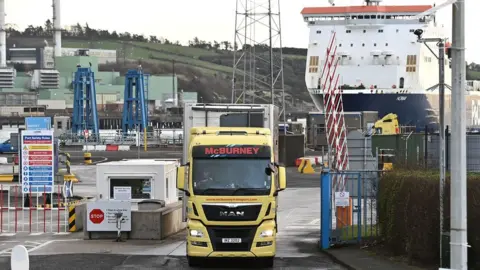
The protocol kept Northern Ireland inside the EU single market for goods, which allowed a free flow of goods across the Irish border.
However, it made trading from Great Britain to Northern Ireland more difficult and expensive.
 Pacemaker
Checks and controls on GB food products entering NI have been some of the biggest practical difficulties. It had to be shown that those products met EU standards.
Under the Windsor Framework, UK public health and safety standards, rather than EU standards, will apply for all retail food and drink.
That means GB trusted traders who are sending food for sale in Northern Ireland should face few routine checks and minimal paperwork.
The flipside of this is the introduction of the "Not for EU" labels on GB food products, to give a level of assurance to the EU that products will not wrongly be sold in its single market.
Shoppers from the Republic of Ireland can still take goods home from Northern Ireland but cannot resell them.
Meanwhile, the government has also confirmed the extension of the Movement Assistance Scheme which helps businesses with the costs of certifications for moving food products to Northern Ireland.
These certificates will still be required in some circumstances, such as when NI wholesalers are bringing in food products which could be sold in either part of Ireland.
The government said: "The Movement Assistance Scheme (MAS), which was due to close in December 2023, has now been extended until 30 June 2025.
"These funding packages underline our ongoing support to the food industry and consumers in Northern Ireland."