First minister 'deeply concerned' by Trump tariffs threat

 Getty Images
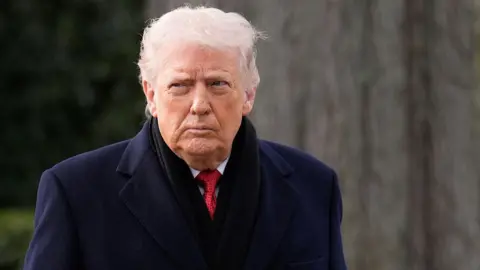
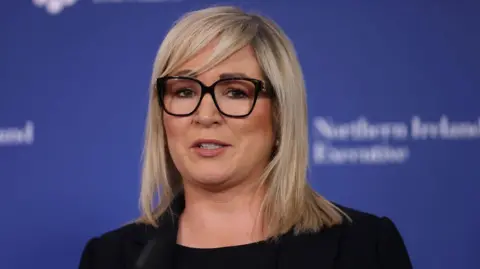
First Minister Michelle O'Neill has said she is "deeply concerned" about the potential impact of Donald Trump's threat to impose tariffs on countries opposing his proposed takeover of Greenland.
On Saturday, the United States president said he would impose 10% tariffs on the UK and a host of other European countries which opposed his plan.
On Monday, Prime Minister Sir Keir Starmer described Trump's threat tariffs on Europe as "very serious" and "completely wrong".
O'Neill has accused the Trump administration of breaching international law in an "attempt to snatch territory".
"We are all aghast at developments," she told the Northern Ireland Assembly on Monday.
"This is an attempt to bully others to kowtow to a position in the US and it is frankly shocking."
On the prospect of new tariffs, O'Neill said: "We have a special and unique circumstance in the post-Brexit world and what happens across the EU, in Britain and elsewhere has a real impact for us and we need to stand firmly against what is being proposed.
"Trade wars are a race to the bottom and we want to ensure our unique circumstances are taken into account when it comes to deciding what happens next."
 PA Media
As part of the post-Brexit trading arrangements, Northern Ireland is part of the UK's customs territory and its exports are covered by the UK's trade agreements.
Therefore, exports from Northern Ireland are subject to the tariffs imposed on the UK by the US or any other country.
However, Northern Ireland is also effectively part of the European Union's single market for goods and enforces EU customs rules at its ports.
That arrangement, called the Windsor Framework, was agreed by the UK and EU as a way of maintaining an open trade border between Northern Ireland and the Republic of Ireland after Brexit.
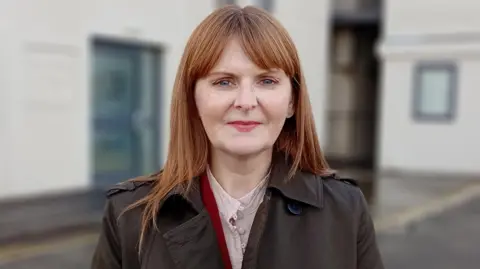
Northern Ireland Economy Minister Caoimhe Archibald also confirmed that she has raised concerns with the British and Irish governments over the weekend about the impact of any fresh tariff hikes.
She has also held talks with businesses who may be impacted by any new tariffs.
'Cycle of Drama'
Democratic Unionist Party leader Gavin Robinson said he did not believe the threat of further tariffs would come to pass, saying global politics was going through a "cycle of drama".
"I don't see any benefit in threatening allies on a tariffs basis because of an aspiration the president of the United States has," he said.
"He [Trump] clearly has a quest, he is engaging with our nation and others... and I suspect in a number of months if not less you'll be asking the question - what was all that about?"
Greenland is a self-governing territory of Denmark and as such is a member of Nato.
Ulster Unionist Party peer Lord Empey said the economic effect of tariffs on such a scale could only be negative.
The former party leader also criticised President Trump's stance on Greenland.
"To treat the Kingdom of Denmark, one of the US's staunch allies in this way, is impossible to justify," Lord Empey said.
 Getty Images
Trump raised the possibility of purchasing Greenland in his first term and has now made it clear that its acquisition is a top administration priority, with tariff threats putting pressure on other Nato countries who have shown their support for Denmark.
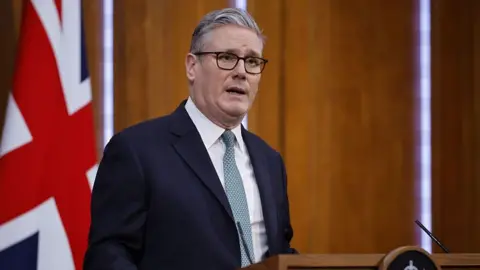
Speaking on Monday, Sir Keir said the use of tariffs against allies was "completely wrong" and "not the right way to resolve differences within an alliance".
He says such actions would hurt British workers, business and the British economy.
"That's why I've been so clear on this issue," he added.
The prime minister also appeared to rule out retaliatory tariffs on US goods, saying a "tariff war is in nobody's interests".
He said he did not think Trump would take military action in Greenland, and the dispute should be resolved through "calm discussion between allies".
