Virtual reality helps NHS doctors spot signs of sepsis

 BBC
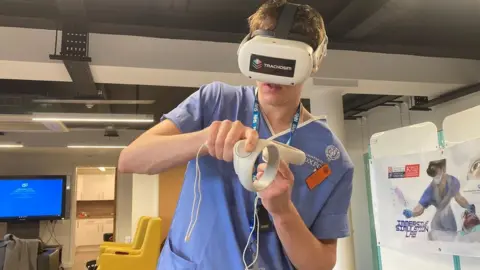
BBCHospital staff and students are being taught how to spot symptoms of sepsis by using virtual reality technology.
Doctors at the Great Western Hospitals NHS Foundation Trust have partnered with training platform Goggleminds on the project.
Immersive headsets are used to develop training scenarios which simulate treating patients with sepsis.
"Training which sticks in the mind, saves lives," said Dr Ron Daniels, founder of the UK Sepsis Trust.
Sepsis is a condition which develops when the immune system overreacts to an infection and begins to damage the body's own tissues and organs.
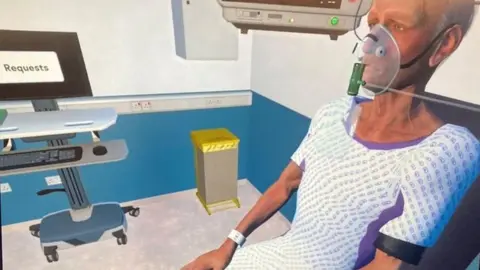
"The challenge facing health professionals working in a pressured NHS environment is that it can be very difficult to spot," said Dr Daniels.
The technology will enable more doctors to be trained outside hospital training rooms and in smaller numbers, with the aim of increasing efficiency.
'Life and death'
It draws on research from the University of Bath into how virtual reality (VR) can provide healthcare students with engaging learning.
Prof Richard Joiner from the university's Department of Psychology said: "Sepsis and anaphylaxis are major challenges in healthcare settings, and how frontline medical teams respond can mean the difference between life and death.
"This new VR simulation addresses this challenge by enabling doctors to train experientially in a safe and realistic environment, without endangering patients."
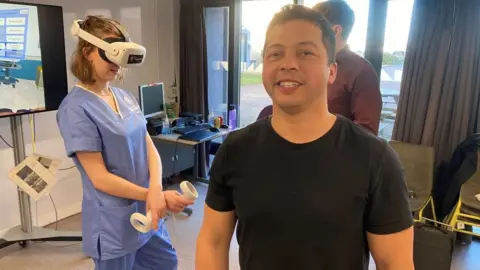
Aziz Naji, CEO and founder of Goggleminds, said the technology could be used for simulating all areas of medicine as it developed.
"We really see this as an international technology that everybody can benefit from," he added.

Follow BBC West on Facebook, X and Instagram. Send your story ideas to: bristol@bbc.co.uk
