Mars: Nasa's Perseverance rover's first 100 days in pictures
NASA/JPL-Caltech/ASU
Nasa's Perseverance rover is celebrating 100 Martian days (sols) since landing on Mars, where it is hunting for signs of past microbial life, and seeking to investigate the planet's geology and past climate.
Since touching down on 18 February, the robot has captured some amazing images from around its landing site, Jezero Crater, a 49km (30 mile) wide impact depression just north of the Red Planet's equator.
A small helicopter, Ingenuity, has also returned aerial images, having made history with the first powered, controlled flights on another planet.
Here is a selection of pictures sent back from the mission so far.
NASA/JPL-Caltech/MSSS
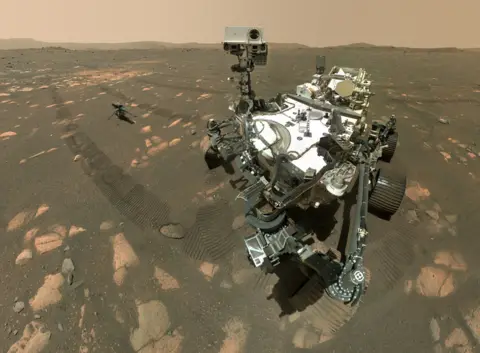
On 6 April, Perseverance used the Watson (Wide Angle Topographic Sensor for Operations and eNgineering) camera to take this selfie next to the Ingenuity helicopter. This photo is made up of 62 individual images which were stitched together once they were sent back to Earth.
NASA/JPL-Caltech/MSSS
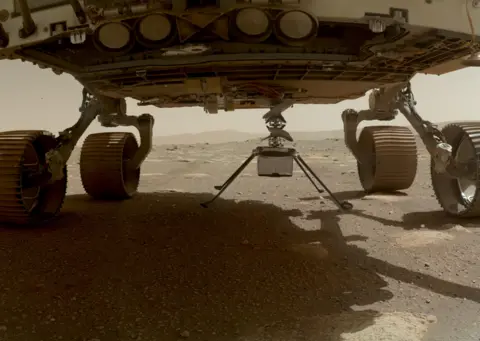
Days earlier, Ingenuity had been deployed from underneath the rover.
NASA/JPL-Caltech/ASU
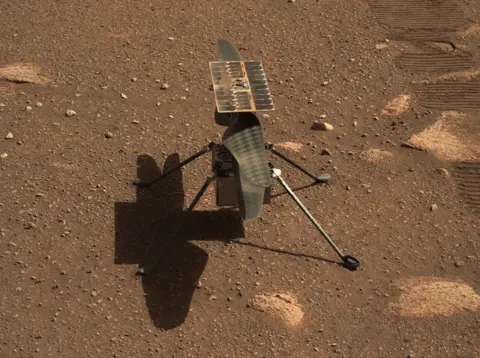
The 1.8kg (4lb) helicopter is regarded as a technology demonstration for the potential of aerial mobility in the thin Martian atmosphere.
NASA/JPL-Caltech
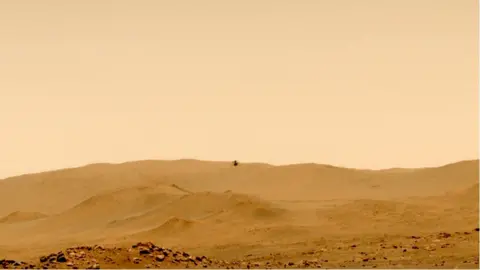
On 19 April, Ingenuity made history with the first powered, controlled flight on another planet. The chopper, which is visible near the centre of this image, rose to about 3m (10ft) above ground and hovered for several seconds, before touching back down.
NASA/JPL-Caltech
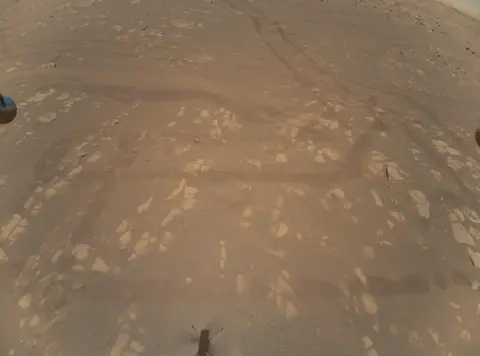
Ingenuity captured its first colour aerial image while on its second flight. The drone hovered about 5m (16ft) above the ground, tilted and moved laterally 2m (6ft), before returning to the spot it took off from. Perseverance's tracks and Ingenuity's shadow are visible on the Martian surface below.
NASA/JPL-CALTECH
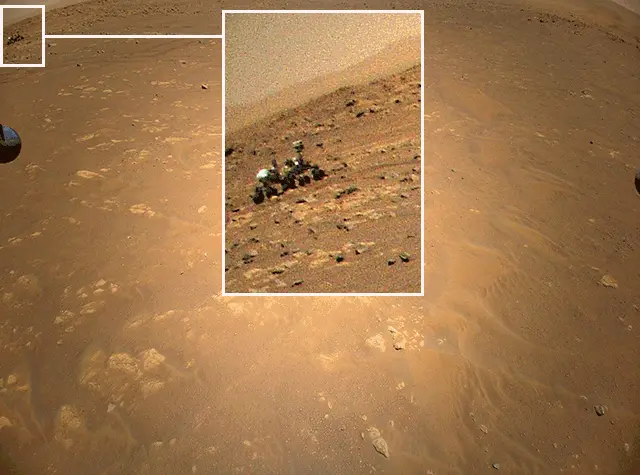
Ingenuity photographed Perseverance while on its third flight. At the time, the mini-helicopter was about 85m (278ft) from the rover and flying laterally at an altitude of 5m (16ft). One of Ingenuity's feet is also visible at the edge of the image, just below the rover.
NASA/JPL-Caltech
On 7 May, Ingenuity reached a height of 10m (33ft), before flying 129m (423ft) to a new landing spot.
NASA/JPL-Caltech
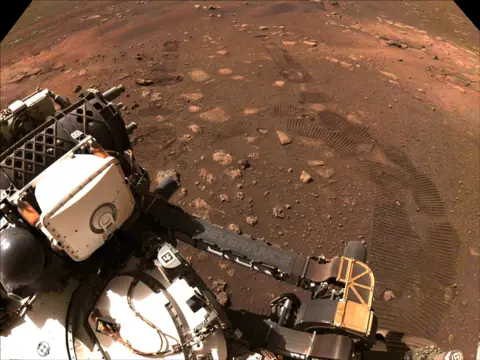
Two months earlier, Perseverance went for its first drive since it landed in Jezero Crater. The one-tonne rover is carrying an advanced payload of instruments to gather information about Mars' geology, atmosphere and environmental conditions.
NASA/JPL-Caltech/ASU
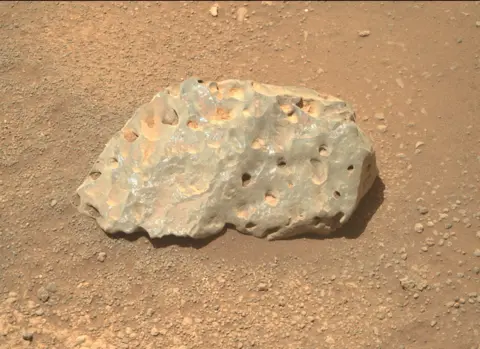
Perseverance is equipped with a laser that is designed to help it collect data on the planet's geology. While investigating this 15cm (6in) rock, the instrument left the faint row of dots that is visible near its centre.
NASA/JPL-Caltech/ASU
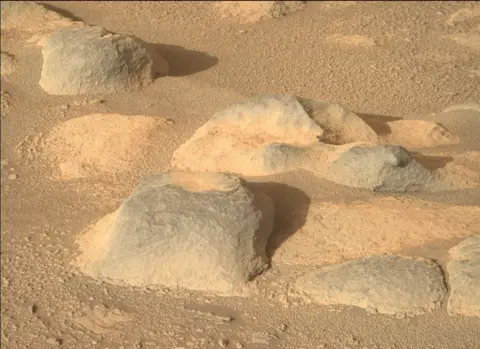
The rover is also equipped with a variety of different cameras. This image was taken by the "right eye" of Perseverance's Mastcam-Z, one of a pair of cameras that provide a stereo view similar to what human eyes would see.
NASA/JPL-Caltech/ASU
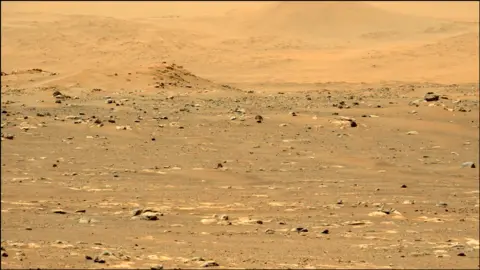
This image was taken with the left Mastcam-Z camera and was selected by public vote to be featured as "Image of the Week" for Week 6 of the rover's mission.
NASA/JPL-Caltech/ASU/MSSS
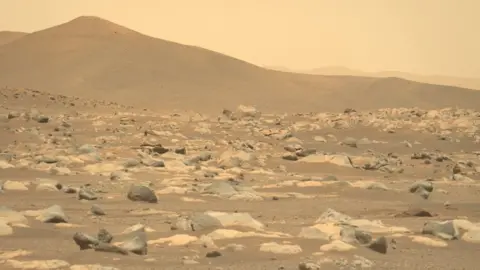
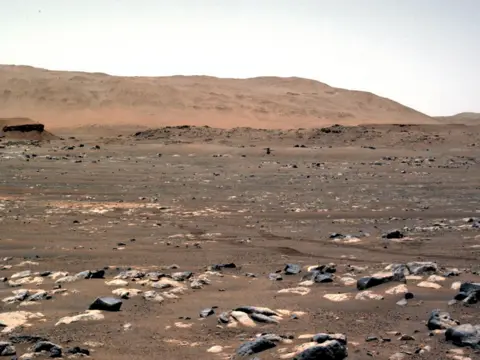
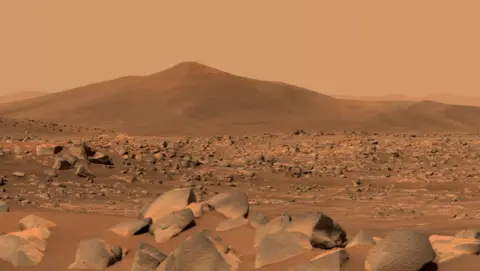
This image shows Santa Cruz, a hill about 1.5 miles (2.5km) away from the rover. The entire scene is inside Mars' Jezero Crater; the crater's rim can be seen on the horizon line beyond the hill.
The Perseverance rover has initial funding to operate for one Mars year, roughly two Earth years.

 NASA/JPL-Caltech/ASU
 NASA/JPL-Caltech/MSSS
 NASA/JPL-Caltech/MSSS
 NASA/JPL-Caltech/ASU
 NASA/JPL-Caltech
 NASA/JPL-Caltech
 NASA/JPL-CALTECH
 NASA/JPL-Caltech
 NASA/JPL-Caltech
 NASA/JPL-Caltech/ASU
 NASA/JPL-Caltech/ASU
 NASA/JPL-Caltech/ASU
 NASA/JPL-Caltech/ASU/MSSS