Girl, 5, beats three life-threatening conditions

 Family photo
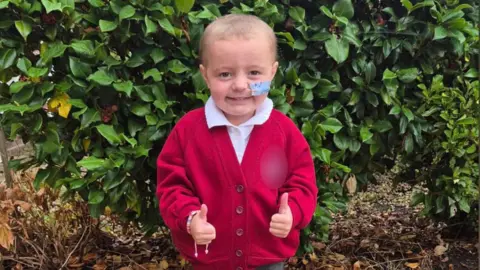
A five-year-old girl who had to deal with three life-threatening conditions before she turned four has been recognised for her courage.
Delilah, from Devizes in Wiltshire, was diagnosed with a rare type of leukaemia aged just two, before becoming seriously ill from the infection C-Difficile and suffering a severe allergic reaction to antibiotics.
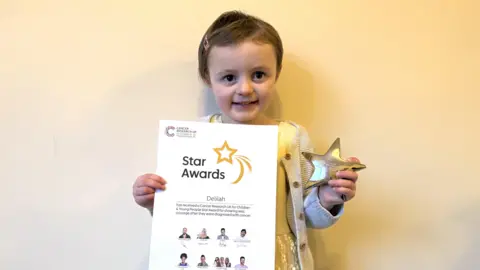
She has now recovered and has won a national Star Award from Cancer Research UK for her bravery.
"Despite all of the challenges she's faced, she's smiled throughout it all and kept us all going with her sense of humour," said Delilah's mum Naomi, who nominated her for the award.
"She's overcome an awful lot for someone so young and her Star Award is something to look back on and be proud of," she added.
 Family photo
Naomi said the only symptoms Delilah displayed before her first diagnosis were a recurring temperature and some tiredness.
"So to be told she had acute lymphoblastic leukaemia (ALL) was a real shock," she said.
Doctors then found Delilah had a rare sub-type called Philadelphia positive ALL and had to adapt her treatment programme.
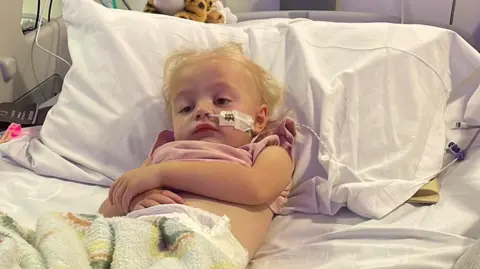
"She's been through so much on top of her cancer treatment, including a horrendous case of C-Difficile at the start which saw her weight drop so severely, she was blue-lighted to A&E," Naomi continued.
"Then on the last day of her treatment she had a severe allergic reaction to antibiotics called methemoglobinemia and her oxygen saturation levels fell dangerously low."
Following two-and-a-half years of treatment and taking part in a clinical trial, Delilah is now well and attending school.
"She's bubbly and happy like it never happened," added her mum.
 Family photo
The Cancer Research UK Star Awards recognise the courage of young people who have been treated for cancer.
Every child nominated receives an award, which includes a trophy, a gift card and a T-shirt, as well as a certificate signed by those who back the campaign, such as children's poet and author Joseph Coelho, US singer and dancer JoJo Siwa and pop star Pixie Lott.
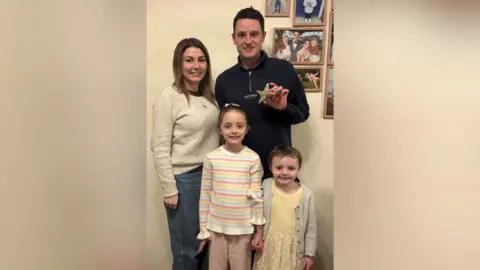
It was "extra special" that Delilah's big sister Imogen received a certificate too, Naomi added.
"It meant she felt included at a time when her sister was receiving a lot of attention and we had to spend a lot of time apart.
"She was also very brave, giving doctors a blood sample in case Delilah ever needed a bone marrow transplant which - thankfully - she hasn't required."
 Family photo
About 400 children are diagnosed with ALL every year, according to Cancer Research UK. But it said new discoveries and breakthroughs were leading to "more effective and less toxic treatments".
The charity's South West spokesperson Elisa Mitchell said: "A cancer diagnosis is heart-breaking at any age, but it can be particularly difficult for youngsters - especially when many may experience life-long side effects from their treatment.
"That's why we're funding dedicated research to find new and better ways to beat this devastating disease."
Follow BBC Wiltshire on Facebook, X and Instagram. Send your story ideas to us on email or via WhatsApp on 0800 313 4630.
