Dylan Thomas 'plagiarised other poets' repeatedly as schoolboy

 Getty Images/Hulton Archive
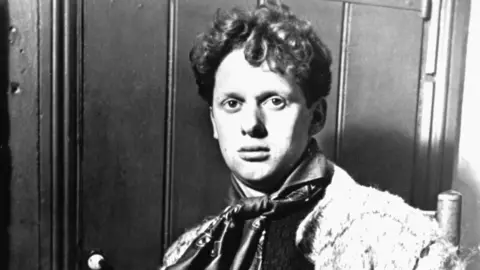
Dylan Thomas copied other poets' work and published it under his own name as a schoolboy, according to an author and publicist who has delved into the iconic Welsh poet's earliest works.
Alessandro Gallenzi made the shock plagiarism discovery, which he described as "wholesale", while he was editing a new collection of Thomas's poetry.
The young Thomas was an enthusiastic contributor to Swansea Grammar School's magazine after joining as an 11-year-old in 1925, but Gallenzi found at least a dozen examples where Thomas had copied wholesale from work published in other magazines.
"It's incredibly interesting, from a biographical, personal and psychological perspective," he said.
 Getty Images
The discovery was first made by Gallenzi's editor Alex Middleton, after they were given access to one of only two known complete collections of Thomas's school magazine in Swansea owned by Geoff Haden, president of the Dylan Thomas Society.
But after transcribing the poems and looking more closely at them, they were not all they seemed.
"My heart stopped," said Gallenzi. "We were close to finishing the collection and we had to go back and start from scratch."
They discovered that 12 poems published while Thomas was at school were someone else's work - and Gallenzi said he believed there could be as many as 20 to 24.
Most are in the pages of the school magazine, but the extent of the plagiarism included His Requiem, submitted by D M Thomas of Swansea and published in the Western Mail newspaper on 14 January 1927, which dated from five years before and was a poem by Lillian Gard, first published in the Boy's Own Paper.
"It was unlikely his readers would notice," said Gallenzi.
"But Thomas could also be audacious - we found a poem which he managed to get published himself in Boy's Own - and remember this was a nationally-read magazine - but was a copy of a poem already published in Boy's Own 15 years before."
 Alma Books
Who was Dylan Thomas?
- Born on 27 October 1914 in Swansea, Thomas was the son of an English teacher and a seamstress.
- He started writing poetry while still at school and became a reporter on the Swansea Daily Post.
- He moved to London in 1934 when his first poetry collection was published.
- He married Caitlin Macnamara in 1937 and they lived at Laugharne in Carmarthenshire, having a tempestuous relationship.
- His collection of stories Portrait of the Artist as a Young Dog was published in 1940.
- His most famous poems include Do Not Go Gentle Into That Good Night, musing on death and dating from 1947.
- His play Under Milk Wood was first read on stage in New York in May 1953.
- Dylan collapsed and later died in hospital on 9 November 1953. He was buried in Laugharne.
Gallenzi said: "The fascinating question is, why did he do it and trying to understand this."
He believes it could be due to insecurity, trying to get noticed, and helped by the fact that Thomas could get away with it.
He said Thomas had started a new, much bigger school and may have been looking to stand out or impress his fellow pupils. He had his first poem published in the school magazine in his first year and later edited the publication.
Another factor, said Gallenzi, who further details his findings in an essay for TLS, was probably the looming presence of Thomas's father, who was a teacher of English at the school and had ambitions for his son.
'Something to show his father'
The young Thomas had also started to write his own poetry and there is an overlap between his original and plagiarised work.
"He found his own voice and his voice is unique," said Gallenzi.
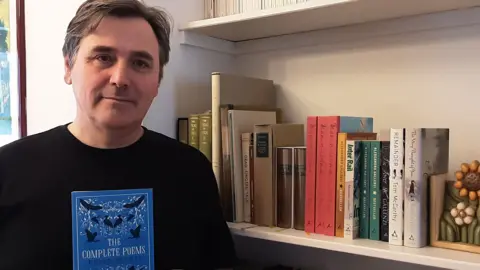
The plagiarised work now finds its place in an appendix to the forthcoming collection Dylan Thomas - The Complete Poems.
Gallenzi, in his editor's introduction, said they revealed "his mood, ambition and, perhaps, impishness at a time when he was starting out as a poet".
A couple of the school magazine poems - alongside the Boy's Own originals - will be on display from this weekend at Dylan's birthplace museum, 5 Cwmdonkin Drive in Swansea.
The museum's curator Geoff Haden said he was not surprised by the revelation, as he was aware of a couple of examples of plagiarism by the schoolboy Thomas.
"The more I look at it, the more it's obvious," said Haden.
"I think he wanted something to show his father and to stop him nagging him about doing homework in other subjects."
