Reform vows to cut Scottish income tax below UK rate
Reform UK has vowed to cut Scottish income tax below rates in England as Nigel Farage's party launched its manifesto for the Holyrood election.
Malcolm Offord, the party's leader in Scotland, said the tax system north of the border would be brought into line with the rest of the UK's before being cut.
Offord, a former Conservative peer, also pledged to reform the NHS, cut "unsustainable" welfare spending and "rehabilitate" the North Sea oil and gas industry.
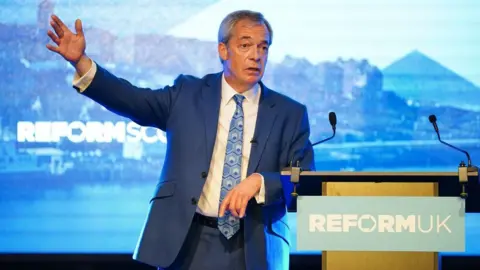
The manifesto was launched at Reform's first Scottish conference, with the party unveiling its constituency candidates for the election.
Farage, who also spoke at the conference, said his party stood "with our people, not those who come to Britain illegally".
He also predicted Reform would become Holyrood's second largest party, though he said the party could "surprise" some people.
The Courier newspaper has highlighted social media posts by one Reform UK candidate, in which she described the former first minister Humza Yousaf as a "grandstanding Islamist moron".
Linda Holt, who is standing for the party in Fife North East, also called Mr Yousaf a "brown fm", and said he was not British in posts on the X platform dating back to 2023.
Meanwhile Scottish Labour leader Anas Sarwar has called on Reform to remove Senga Beresford as its candidate for Galloway and West Dumfries after it emerged she had appeared to post support on X for calls to deport all Muslims from the UK in August 2024.
The previous month, she replied to a post by far-right activist Tommy Robinson - who Nigel Farage has said is not welcome in Reform - by saying she was "behind you all the way" in his efforts to hold a huge "patriotic rally" in Trafalgar Square.
Offord, a former Conservative minister who defected from the Tories in December, is standing for the party in Inverclyde, where he grew up.
Reform's Scottish leader began his speech by reiterating his ambition to become Scotland's next first minister after the vote on 7 May, with Reform aiming to substantially increase its current tally on one MSP.
He told the event in Renfrewshire that the party would "unleash Scotland's potential".
Offord says the party's tax plans would make Scotland the best place to live and work in the UK.
The Scottish government has used its devolved powers to set up a distinct income tax system, with six bands to the UK's three.
Reform is proposing to scrap Scotland's extra bands and align the remaining bands with rates in England. Thereafter the party aims to cut the rates by 1p - creating a 19p basic rate, a 39p higher rate and a 44p additional rate.
The manifesto sets out plans to cut each band by up to 3p lower than in England by the end of the parliamentary term.
The party estimated aligning that tax bands with the UK would cost £1.2bn a year, with every 1p cut thereafter costing £850m.
The Institute for Fiscal Studies says the party's costing for that initial cut, at £2bn, is a "reasonable estimate" in the short term, though costs would increase over time.
The manifesto says this would be "easily" afforded by cutting £1bn spent of "ideological" net-zero projects - designed to cut planet-warming emissions - and £6.5bn spent on 132 quangos - public bodies that operate at arms-length from the government, including health boards.
It adds that the cost would be offset by economic growth sparked by tax cuts.
Creating a 'wealth economy'
The Reform manifesto pledges to "make Scotland the most successful part of the UK".
It also says arguments for independence are "pie-in-the-sky", claiming there is "no appetite" for another referendum "any time soon".
Offord said Scotland had "a record amount of spending, but not the reward for it", as he pledged to create a "wealth economy".
While he described welfare as a necessary "safety net", he vowed to get thousands of economically inactive Scots back into work.
The gap between what the Scottish government spends on social security and what it receives from the UK Treasury as a result of equivalent spending south of the border is forecast to be £1.1bn in 2026-27, rising to £1.2bn by 2030-31. The overall social security bill is forecast to rise to £9.2bn by then.
Offord described this spending as unsustainable and says Reform will reduce the outlay on welfare. The manifesto also vows to impose "rigorous face-to-face assessments of claimants".

 PA Media
Offord pledged to scrap Glasgow's status as Scotland's main dispersal city for successful asylum seekers and said people with local links would be prioritised on council housing lists.
He said Scots were "fed up" about immigration, particularly in working-class communities. The former Conservative minister claimed that the "record numbers of strangers" coming to Glasgow meant the city was "less safe for women and girls".
Scotland's largest city houses more asylum seekers - about 3,800 - than any city outside of London.
A 2022 study analysing crime in 30 countries over 30 years said "no statistical evidence exists to relate an increase in the number of immigrants to the rise of any kind of crime". Another study, published in 2013, found "there is virtually no evidence in any country to suggest links between migration and violent crime".
'Immigration capital'
In his speech, Farage claimed Glasgow was the immigration "capital" of the UK.
Citing a mass Muslim public prayer in London on Monday, the Reform leader told the conference: "If it hasn't come to Scotland yet it will come soon."
He insisted his party would stand up for "Christian principles" against attempts to "overtake, intimidate and dominate our way of life".
Farage also claimed workers in the UK were over-taxed and having to work longer hours "than they every had to".
He told the conference: "When often their next-door neighbours rise at midday, have Deliveroo come, and smoke dope for the afternoon."
The Reform leader reiterated his view that an independence referendum was a "once-in-a-generation" event, saying he thought a generation was about 25 years.
In its manifesto Reform also says it will:
- Reduce the number of constituency seats in the Scottish Parliament from 73 to 57
- "Reboot" the education system
- Form a department of government efficiency to "cut waste and duplication"
- Ban mobile phones in schools
- Establish a Scottish Healthcare Reform Commission
- Phase out the Land and Buildings Transaction Tax - Scotland's equivalent of stamp duty, paid when buying property or land over a certain value - and non-domestic rates - known as business rates. These are to be replaced by an annual property tax
- Scrap all net-zero subsidies targets to cut fossil fuel emissions
- Impose harsher jail sentences for repeat offenders, increase prison capacity and end early release programmes
Reform says its income tax cuts will pay off in the long term by improving economic growth. But they will still need to be paid for in the short term.
The party says finding £2bn won't be difficult - and says it can get half of it by cutting "ideological net-zero projects".
For context, the Scottish government has said £5bn of spending will go towards climate-friendly initiatives in the coming year. But this is a broad definition including the £3bn budget for public transport (from nationalised rail services to ferries) and the £925m budget for affordable housing - both of which Reform agrees with investing in.
The entire allocation for the "climate action and energy" portfolio is £446m - which includes the running costs of bodies like Scottish Water, and already reflects a 17.2% cut from the previous year.
Reform also talks about clawing back £6.5bn of funding from "unaccountable quangos" - arm's length government bodies.
However by far the biggest spenders among these bodies are things like the Scottish Funding Council - which underwrites Scotland's colleges and universities to the tune of £2bn a year - where cuts also may not prove straightforward.
