Reform UK's Scottish manifesto pledges analysed

 Getty Images
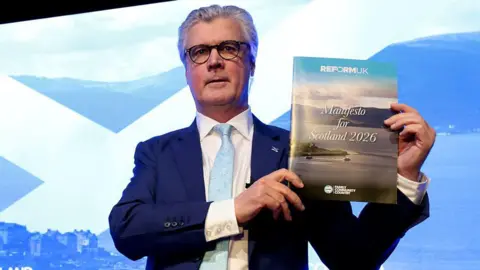
Reform UK's leader in Scotland, Malcolm Offord, has launched his party's 2026 election manifesto. The full document runs to 23 pages. So, what is the party promising? BBC Scotland journalists have been analysing the pledges.

Fix the NHS and cut waiting lists
Fixing the NHS is front and centre of this manifesto, but plans on how to do that are vague.
Reform says it would immediately establish an independent, expert review of healthcare.
It would look at plans to train more NHS staff, expand services in the community and in GP surgeries and come up with creative solutions for delayed discharge.
These are familiar themes and already part of Scottish government and health board plans, such as walk-in GP clinics.
A core Reform pledge is to "cut waiting lists" as one in nine Scots are waiting for specialist NHS treatment. This ambition is mentioned in the opening and final pages but with no further information.
Undoubtedly the NHS faces enormous strain with waiting lists and unfilled vacancies, but bold promises to make Scotland a world leader again will require significantly more detail.
Reform Holyrood
It's fair to say Reform have some pretty radical plans for Holyrood.
They have proposed cutting the number of MSPs by having larger constituencies, matching Westminster boundaries.
They want to impose compulsory physical attendance and voting, doing away with the current "hybrid" arrangement dating from the pandemic which lets members dial in remotely.
And they want to have a regular review of the Scotland Act itself, in terms of what powers are devolved to Holyrood and what is left to Westminster.
And that latter point perhaps goes to the heart of it - the manifesto is as much about winning power at Westminster at the next UK election as it is about Holyrood.
As much as Reform is hoping for a good result in Scotland, they aren't realistically expecting to end up making Malcolm Offord the first minister.
But they do think this year's elections can help them build momentum for a serious bid to make Nigel Farage the prime minister.

Give councils more power
Should councils deliver what are essentially national services, ultimately controlled by the Scottish government - like education - but tailor them to local requirements? Or do they exist to provide the local services local people say they want?
Both are important in reality. How should these aims be balanced?
Most council funding currently comes in one way or another from the Scottish government. If local authorities were to "raise their own revenue", some fear that councils would either be much smaller in their scope or would need to levy a wide range of charges.
The manifesto doesn't say what statutory obligations could potentially be lifted from local government. The devil would be in the detail. Some obligations are vague. For instance, councils need to have a library service - but there are no decrees over how many libraries there should be, when they should be open or how much should be spent on them.
Proposals to phase out Land and Buildings Transaction Tax and business rates and replace them with an annual property tax are an interesting contribution to the debate on how councils should be funded.
But there is no mention of replacing the council tax - an issue many in politics have grappled with for a long time.
Get school leavers into trades, rather than university

The manifesto states that Scotland sends half of school leavers to university - last year the figure was about 42% - and wants instead to "direct them into trades via technical colleges".
However, it doesn't give detail on the proportions of school leavers it would aim to send into vocational trades.
Scotland's colleges are currently experiencing a funding crisis – an Audit Scotland report stated that there had been a 20% real terms cut in funding across the sector and the Scottish Funding Council say the colleges are experiencing cuts to staffing and courses, with class sizes getting larger.
Whilst additional funding would be welcomed, it is not clear how this would be set out and if the sector could immediately handle additional volumes, given the current position with reduced provision.
Put locals first when considering housing applications
Amid rising homelessness figures and council housing stock under pressure, the Scottish government declared a national "housing emergency" in 2024.
In response, Reform wishes to reinstate the "local connection" rule that was scrapped more than three years ago.
Previously, a homelessness applicant needed to have a connection to the local authority – such as living in the council area for six months or more.
This was changed and councils must now provide temporary accommodation to those who present as homeless, regardless of point of origin.
The Scottish government and some charities had said this was to give homeless people more "choice and control about where they live".
But Reform argues this has led to "breaking point" and links the issue to the asylum system, particularly in Glasgow.
Using figures obtained by the Scottish Conservatives, Reform says 76% of applications with no connection to the city came from outside Scotland, referring to Glasgow as "the asylum capital of the UK".
While the manifesto links this to the abolishing of local connection rules, the city council said this was due to changes in the way asylum applications were processed by the Home Office.

