Pupils' poems on accent stigma shared at station

 Jamie Niblock/BBC
A project examining how Essex school girls feel about their accents has shared their spoken word poetry with train passengers on the morning commute.
Dr Tara McAllister-Viel at the University of Essex spoke to pupils at Westcliff High School for Girls and found some teenagers were changing the way they spoke because of negative stereotypes about the county.
Material written and recorded by the girls has been shared with passengers at Southend Central station, where a poem was also read over the PA system.
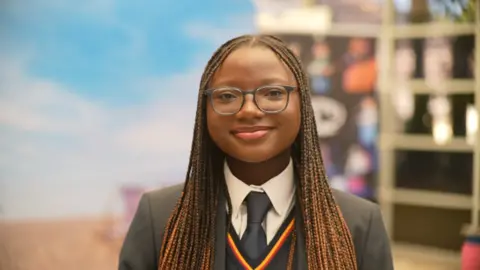
"I thought it would be a small scale thing and a couple of people on YouTube would see it. The way it's spread, I find it amazing," said Moriah, 16, one of the pupils who took part.
Dr McAllister-Viel said it had been "incredible" to see the poems shared with passengers, who were offered pamphlets with the poems and QR codes linking them to recordings on YouTube where they could leave a comment listing something they loved about their own accents.
 Jodie Halford/BBC
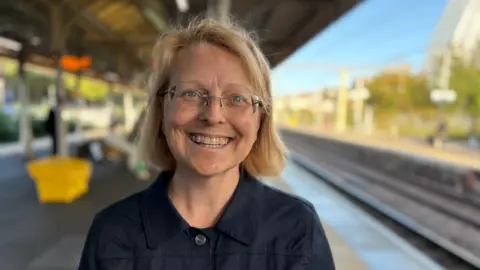
"Commuters on a train probably already have their phone out, they probably have their headphones in, they're in a perfect position to deeply listen to something," Dr McAllister-Viel told the BBC.
"It's one of the reasons we chose spoken word poetry - when you lift poetry off the page, you put it in your body and release it out into the world, it does something for the young poet.
"And hopefully it brings an opportunity to listen again to an Essex accent - not just what the girls are saying but how they say it."
 Jamie Niblock/BBC
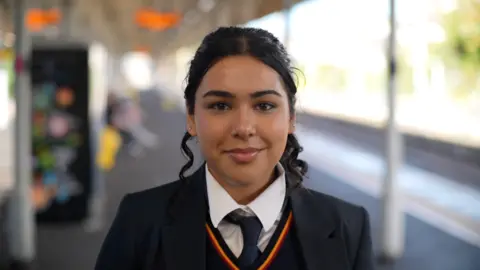
Another of those who took part, 16-year-old Nishaal, said she felt like she had to change her accent "a lot".
"I have immigrant parents and I've grown up watching them change themselves to have to fit in, so I think this has really changed the way I realise I code-switch with my accent," she said.
"I always want to be taken seriously when I have something to say, and when I have my relaxed, natural accent sometimes, people will write me off or think that I'm stupid."
 Jamie Niblock/BBC
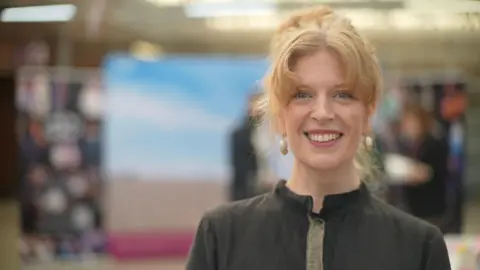
Sarah Perry, author of The Essex Serpent and chancellor of the University of Essex, spoke at the event.
"I wish I'd encountered a project like this when I was a young Essex girl because I probably wouldn't have bothered covering up my accent," she said.
"To see the university working with local schools to challenge these absurd prejudices around the Essex accent is really thrilling, especially to see the girls understand what it means to be able to take up space and have their voices heard in exactly the accent that they should have."
 Jodie Halford/BBC
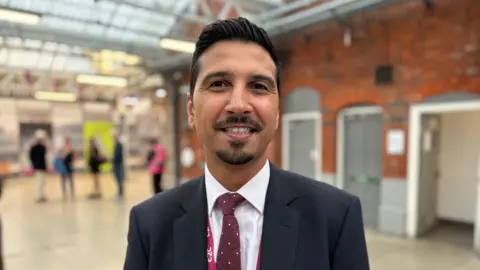
Abu Siddeeq, interim HR and communications director of train operator c2c, said the event was a "wonderful opportunity to get involved with celebrating people from Essex and east London".
"We're providing a listening experience to stop, pause and celebrate their accents," he said.
Follow Essex news on BBC Sounds, Facebook, Instagram and X.
