Saint's shrine returns to Minster after 500 years

 Danny Lawson/PA
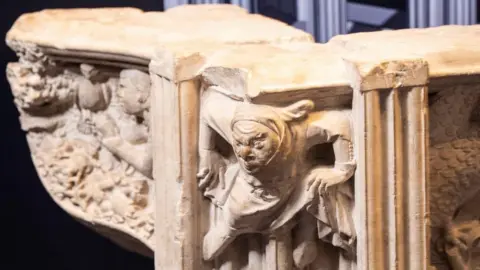
Parts of a 14th Century medieval shrine dedicated to York's patron saint have returned to York Minster for the first time in almost 500 years.
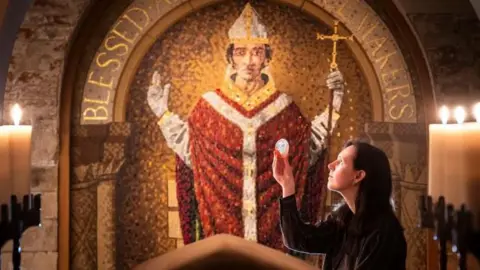
St William, also known as William Fitzherbert, was a prominent 12th Century figure - twice Archbishop of York, he allegedly died when his chalice was poisoned at Mass.
The shrine at his tomb in York Minster was dismantled and buried underneath the streets of the city between 1538 and 1541, during the Reformation, and rediscovered years later.
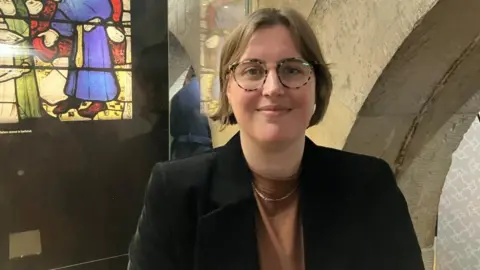
Dr Jennie England, research co-ordinator at the Minster, said it was "hugely significant" that fragments from the monument would now go on public display in a new exhibition.
She said it was "really amazing" to see the fragments pass the spot where they were originally installed when they arrived at the site earlier in the week.
"As a medieval historian, it was kind of overwhelming. As a curator, it was exciting and I think that was felt across the building on the day," England said.
The exhibition marks the 800th anniversary of the canonisation of St William and offers an "opportunity to reflect on his legacy on the history and fabric of the cathedral", she added.
Recovered pieces of the two-storey stone shrine have been loaned to the Minster by The Yorkshire Museum, displayed alongside other artefacts relating to St William.
The structure can also be seen in its entirety as a digital reconstruction in the exhibition.
Shrine fragments were scanned in 3D and visualised with technology that is also used to create video games, to put together an image of how it may have looked hundreds of years ago.
"It's amazing to be able to put the fragments back together, rebuild in some ways, and place in the context of the Minster," England said.
"When you see it, that's when you can begin to piece together how people may have interacted with this, how it may have worked in the building."
 Danny Lawson/PA
St William has been associated with miracles during life and death, the stories of which are depicted in the Minster's St William stained glass window.
His tomb, found in the building's crypt, and the shrine placed above, became an important site for pilgrimage.
However, the cause of his death is still a mystery, although the rumour of the poisoned communion chalice spread widely.
England added that the exhibition, which is open to the public from Saturday, had taken months to create.
"What I love is how we've been able to bring together different types of objects," she said.
"We've got the imagery of the stained glass, alongside the carved stone, beautiful medieval manuscripts - it's been a real treat."
Listen to highlights from North Yorkshire on BBC Sounds, catch up with the latest episode of Look North.
