Campaign for law to improve carers' hospital access

 Handout
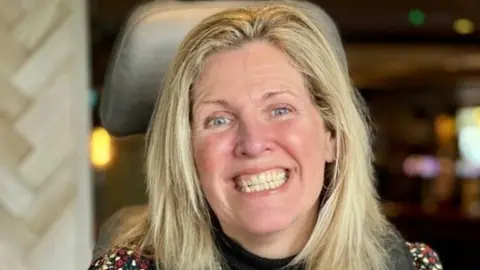
A woman with multiple sclerosis (MS) is campaigning for a new law which she says would allow disabled patients to receive extra support in hospital.
Nina Parry, from Swindon in Wiltshire, said some people with disabilities worried they would not be able to have their carers at their side if they were to be admitted to hospital.
Currently, carers can make themselves known to hospital staff and offer to help with personal and social care, such as eating and helping people to communicate.
However, Parry said there was no law to facilitate this and so Nina's Law would mean care firms must continue their visits to patients in hospital. NHS England has been contacted for comment.
Parry, who receives support from two carers four times a day, also claimed insurance issues can create hurdles for care companies when it comes to their staff providing assistance at hospitals.
If the petition reaches 100,000 signatures, Nina's Law could be discussed in Parliament. It currently has 47,000 signatures and has been backed by Cotswolds MP Roz Savage and Swindon MP Will Stone.
 Handout
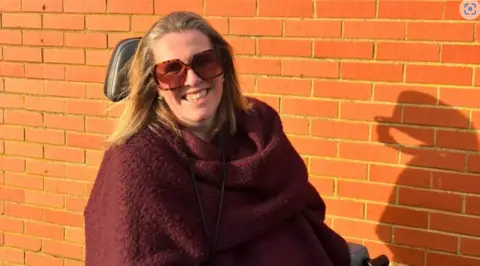
Parry, 51, said: "One morning I woke up and thought 'what would happen if I went into hospital?' and my carers said they could only be my companion. But I wouldn't want that, I'd want them as my carer.
"Since I've launched the campaign, people have told me they are terrified about going to hospital and not getting the care they need."
Great Western Hospital in Swindon, where Parry has previously been treated, welcomes carers into wards and said it recognised they are "the experts" in a patient's needs.
A spokesperson for the hospital said: "Our clinical staff always work in collaboration with both paid and unpaid carers to support patients while they are in hospital.
"While our staff maintain overall supervision of every patient, carers can undertake specific responsibilities in a ward environment to support a patient."
Joanna's 16-year-old daughter Poppy has cerebral palsy and lives with severe brain damage and blindness. She requires one-to-one-care whenever she is in hospital.
Joanna, who lives near Swindon and works as a nurse, said she thought Nina's Law would help staff pressures and create smoother discharges back into the community.
"It wouldn't be taking over the acute nursing, but the everyday things to work with them," she said.
She also said some people faced losing their trusted carers while in hospital, explaining: "Some carers still get paid if you go into hospital. But if they don't, and you are in hospital for three or four weeks, the carers don't get paid.
"They have bills to pay so they might go get another job. So then you are stuck in hospital trying to find a carer, which is not easy."
Follow BBC Wiltshire on Facebook, X and Instagram. Send your story ideas to us on email or via WhatsApp on 0800 313 4630.
