Girl designs glasses to help others with dyslexia

 BBC
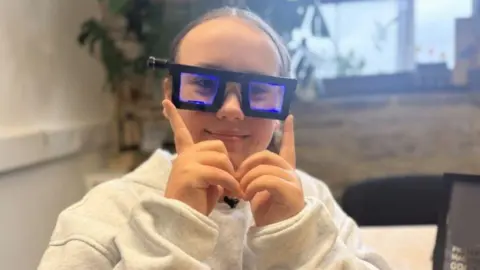
BBCAn 11-year-old girl with dyslexia has designed a pair of colour-changing glasses to help people with the learning disability to be able to read more easily and comfortably.
Millie, from Salford in Greater Manchester, first had the idea for the rainbow spectacles when she was eight years old.
The schoolgirl's glasses feature interchangeable coloured lenses, allowing users to select the hue that best alleviates visual stress and improves reading comfort.
Millie's mum Sarah said: "It's been amazing because I've seen how it's really affected her - really horrendous headaches, sickness, words constantly moving around."
Of her daughter's invention, Sarah added: "I think it's going to change people's lives if I'm honest."
Dyslexia mainly causes problems with reading, writing and spelling.
It is estimated up to one in 10 people in the UK has some degree of dyslexia, according to the NHS.
Millie's design won a gold medal at the Primary Engineer MacRobert Medal.
Out of more than 70,000 entries, her concept was selected to be made into a prototype by manufacturing firm Thales.

Benjamin Butcher, a graduate mechanical engineer at Thales, said: "I think it's a really innovative idea.
"It's something a lot of people have not thought of before and it's a real-world problem.
"It's been able to address something that's so common with people that people just tend to overlook a little bit."
Harry Topping, a manufacturing apprentice at Thales, said: "It's been impressive to see the idea that Millie came up with.
"The communication has been really good as well and to come up with an idea like that... hopefully in the future it can be something that's more popular."
The next step is to try to find funding to get the product on the shelves.
"I really hope they do get involved because it can help some of your lives," said Millie.
Read more stories from Cheshire, Lancashire, Greater Manchester and Merseyside on the BBC, watch BBC North West Tonight on BBC iPlayer and follow BBC North West on X.
