Cash may be rotting after UK's biggest raid - police

 Kent Police
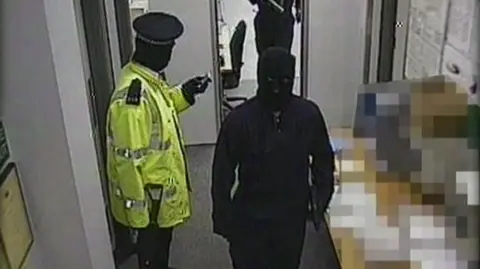
Twenty years after Britain's biggest cash robbery, a raid on a Securitas depot still grips the public imagination - and remains unfinished business for Kent's top police officer, with millions still missing and at least one gang member unaccounted for.
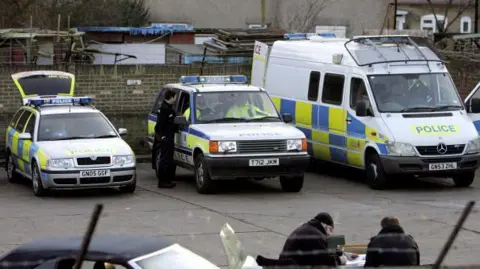
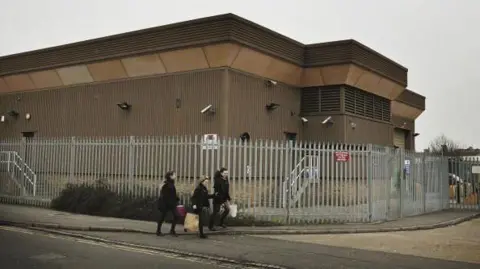
Robbers struck at the cash depot - a flat-roofed warehouse building in an industrial area of Tonbridge, close to the railway line and car repair firms - on 21 February 2006.
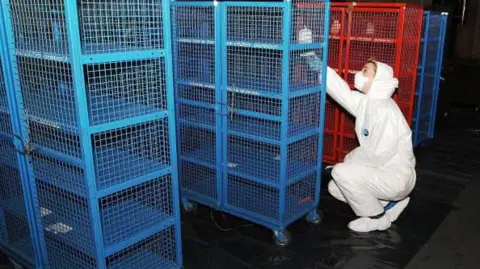
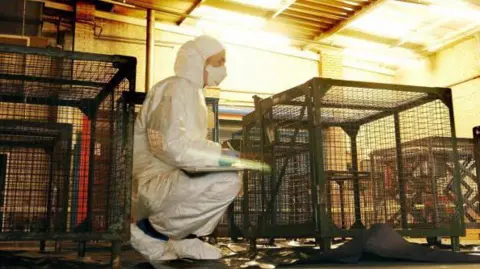
The site manager had been kidnapped with his wife and child to allow the armed gang to gain entry, and 14 staff members were held in cages at gunpoint, as robbers loaded nearly £53m in bank notes on to a lorry.
Millions were left behind because it was as much as the HGV could hold, with one crime writer saying the robbers did not know how much cash was in the building, and were unable to count it because "there was so much money".
Five men were convicted at the main Old Bailey trial in 2008. Stuart Royle, Lea Rusha, Jetmir Bucpapa, Roger Coutts and Emir Hysenaj were all handed prison terms. Lee Murray was jailed in Morocco and Paul Allen was jailed in the UK for his role in plotting the raid.
Of the £32m that was never recovered, Kent's chief constable Tim Smith still hopes part of the haul can be traced, but said the old paper notes may be buried in the ground and degrading.
"This was before plastic was introduced into bank notes, it degrades," he said. "So in 20 years of being buried... it is likely there's an awful lot of it that has been destroyed."
'Family terrorised at gunpoint'
Smith, the senior investigating officer on the night of the raid, recalled how in the first moments he knew only that staff had been kidnapped to gain access to a cash site he had never heard of.
Later at the depot, one worker said: "I think it could be £50m."
Smith said: "At that point, I realised there had probably never been a robbery of this much cash, certainly in the UK."
He said the family was "terrorised" by masked men with guns that night, adding: "For me it was a kidnap.
"This robbery was only facilitated by the kidnap of Mr Dixon and his wife and their child and they were put through hell."
He said the amount of control and fear the gang used was remarkable.
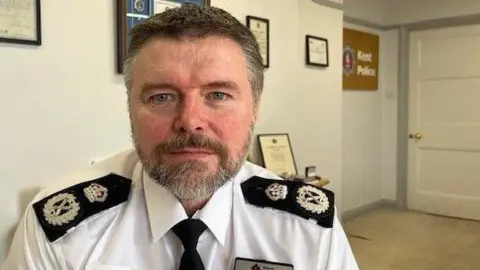
Two decades on, Smith says he is sure at least one suspect evaded capture.
"I'm convinced there are still people out there, one in particular who I think was probably in that cash depository that we've never traced," he said.
On the missing money, Smith believes some cash could still be traced.
Some notes were never in circulation, and police have the serial numbers.
"We would definitely be interested in any cache that anyone finds," he said.
 Getty Images
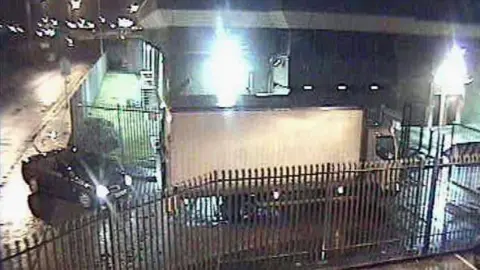
The raid started when depot manager Colin Dixon was pulled over in his car by men dressed as police officers.
Two other gang members, also posing as police, went to Dixon's home and told his wife and child the depot manager had been in an accident.
They were taken to a farm building in Kent, to where Dixon was also later driven.
He was tied up at gunpoint and told he and his family would be killed if they did not cooperate.
The family was later taken to the depot where Dixon was forced to let one of the gang into the site.
Staff at the depot were bound as the gang loaded bank notes into a 7.5-tonne white Renault truck, before they drove away.
After the raid, more than £9m was found in a container in Welling, south east London, and another £8m was found in a lock-up in nearby Southborough, with smaller sums elsewhere, but £32m had vanished.
 Getty Images
Journalist Nick Kochan described the raid as "massively audacious".
He said the thieves drove away with £53m, but left £154m behind, making it potentially a £200m robbery.
With £32m still missing, Kochan says much of that cash may have been absorbed into general circulation, now "floating around in our shops, in our pockets, in our banks".
Some money, he said, went on the "high living" of those later jailed, while other sums went into organised crime, including drugs and counterfeiting.
Anti-laundering systems today would flag large deposits or attempts to move large amounts abroad, he said, but two decades ago, the system "wasn't there".
"Unless you strike very quickly and find that money… your chances of it being brought back into the legitimate system have to be decreasingly positive," he said.
 Getty Images
True crime author Howard Sounes described the gang as "ragamuffins and misfits".
He said they did not have a strong idea of how much money there was in the building, adding: "They couldn't steal anymore because they couldn't fit it in the lorry.
"When it was counted, they didn't actually have the wherewithal to count it, there was so much."
The robbers had an "enormous" problem, because they stole too much money, he said.
"You think that's every robber's dream, isn't it, to have £53m, but it's very difficult to actually spend £53m in cash."
Some took their share abroad and turned it into Euros, but Sounes said others hid their cash in lock-ups, sports bags, wardrobes, and even a car glove compartment - and one gave his money to his mother.
He said the trial heard one man disappeared to the Caribbean. Sounes added he "is probably still there living it up".
 Getty Images
Confiscation orders were issued to several of those jailed, but money is still owed.
A CPS spokesman said three gang members had extra years added to their sentences for failing to pay their orders in full, adding: "Their full orders, plus interest, remain to be paid and we will not hesitate to bring these criminals back to court again if further assets come to light."
Hysenaj was ordered to pay £250,000 but failed to comply and had two years added to his sentence.
Royle was ordered to pay £2m but repaid £50,000, resulting in an additional six‑year term.
Allen was ordered to pay £1.23m and repaid £420; the CPS said he has no remaining assets.
Three others, Jetmir Bucpapa, Roger Coutts and Lea Rusha, paid nominal £1 orders.
The CPS said defendants could only be ordered to pay what assets they have, but orders could be increased if further assets were identified later.
 Getty Images
Twenty years after the raid, Kent's top police officer has made fresh appeals for information.
The chief constable said: "Ultimately, if someone should still face justice for this, I would want to see that happen for the victims."
Smith said there were "people out there who know something we don't" and one vital piece of information could lead to other suspects.
He said in a case of this size and magnitude, police would respond to information - because of the amount of money outstanding, and because of the seriousness of the kidnap and robbery itself.
Follow BBC Kent on Facebook, on X, and on Instagram. Send your story ideas to southeasttoday@bbc.co.uk or WhatsApp us on 08081 002250.
