World's rules-based order 'no longer exists', Germany's Merz warns

 EPA/Shutterstock
The rules-based world order "no longer exists", the German Chancellor has warned at a major security summit.
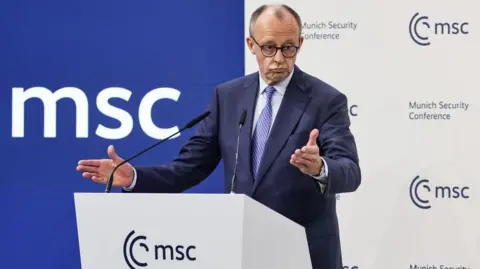
Opening the annual Munich Security Conference, Friedrich Merz told other world leaders that "our freedom is not guaranteed" in an era of big power politics, and that Europeans must be ready to make "sacrifice".
He also admitted that "a deep divide has opened between Europe and the United States".
The conference is taking place on the backdrop of US President Donald Trump threatening Denmark's sovereignty over Greenland by pledging to annex the Arctic territory and his tariffs on imports from European nations.
US Secretary of State Marco Rubio, who was listening to Merz and will deliver his own speech on Saturday, earlier spoke of a "new era in geopolitics".
Some 50 world leaders are expected to attend this year's conference, where European defence and the future of the transatlantic relationship will be discussed.
It comes at a time when US commitments to the Nato military alliance have been called into question. Trump's ambition to acquire Greenland has also been viewed by many European leaders as a watershed moment that has eroded trust with their biggest ally.
Trump told reporters outside the White House on Friday: "Greenland's gonna want us... We get along very well with Europe. We'll see how it works out. We're negotiating right now for Greenland."
The Russia-Ukraine war, tensions between the West and China, as well as a potential Iran-US nuclear deal are also on the agenda at the annual gathering.
Referring to multiple warnings that the rules-based order was collapsing, Merz told the conference: "I fear we must put it even more bluntly: this order, however imperfect it was even at its best, no longer exists in that form."
He also said that "a rift, a deep divide has opened between Europe and the United States. Vice-President JD Vance said this very openly here in Munich a year ago".
Merz continued: "He was right. The culture war of the Maga [Make America Great Again] movement is not ours. Freedom of speech ends here with us when that speech goes against human dignity and the constitution. We do not believe in tariffs and protectionism, but in free trade."
Last year, Vance attacked Europe, including the UK, for policies on free speech and immigration. His speech triggered a year of unprecedented transatlantic tension.
But Merz did not write off the decades-long partnership, instead appealing directly to the US by saying "let's repair and revive transatlantic trust".
The German leader also revealed that "confidential talks" were ongoing with French President Emmanuel Macron on creating a joint European nuclear deterrent. He gave no further details.
France and the UK are the only two nuclear powers in Europe - but Germany and many other European nations have traditionally relied on the US nuclear umbrella within the Nato alliance for deterrence.
Addressing the conference later on Friday, Macron reiterated his call for Europe to "learn to become a geopolitical power" in the new global context.
He said Europe was already re-arming following Russia's full-scale invasion of Ukraine in 2022 - but stressed that "we have to accelerate" and work collectively across the continent.
Describing the war in Ukraine's as Europe's "existential challenge", the French leader urged others not to "cave in to Russian demands" - but rather to increase pressure on Moscow to achieve a just peace.
Ahead of the Munich conference, Rubio warned that "the world is changing very fast right in front of us" after being asked whether his message to Europeans would be more conciliatory than Vance's a year ago.
"We live in a new era in geopolitics, and it's going to require all of us to sort of re-examine what that looks like and what our role is going to be," he said.
Tensions have been heightened in recent months as Trump has repeatedly said that Greenland is vital to US national security, stating without evidence that it was "covered with Russian and Chinese ships all over the place".
Danish Prime Minister Mette Frederiksen said earlier in the day that she planned to meet Rubio to discuss the US threats to seize Greenland from its Nato ally.
