Indian firms feel the squeeze as Iran war disrupts gas supplies

 Reuters
Indian businesses say they are struggling to keep operations running as gas supplies are disrupted by the US and Israel's war on Iran.
Restaurant owners are scrambling to keep kitchens running and entrepreneurs in industries like ceramics and fertilisers say they are unable to maintain their production and are warning of shutdowns.
India has said it is not short of gas but has invoked emergency measures to ensure supplies get to domestic consumers and other key users.
The country meets half of its total gas consumption through imports, much of which comes through the Strait of Hormuz - a narrow Gulf chokepoint - where shipping has effectively been halted by retaliatory Iranian strikes.
The conflict - now in its 11th day - has led to millions of barrels of oil and gas getting stuck near the Strait of Hormuz.
About 40-50% of Indian crude oil imports pass through the narrow waterway. It also carries roughly 50-60% of the country's liquefied natural gas (LNG) imports and about 80-85% of its liquefied petroleum gas (LPG) shipments.
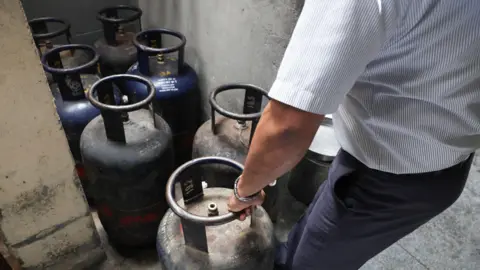
For restaurants, cafes and millions of other eateries across India, the top concern is LPG, widely used as cooking gas.
India imports about 60%of the LPG it consumes annually - making it the world's second-largest LPG importer after China. Almost all of it comes from Gulf producers - mainly Qatar, Saudi Arabia, the UAE and Kuwait - passing through the Strait of Hormuz.
Analysts say LPG supply is the more immediate vulnerability for India. Stocks held by refiners and distributors are estimated to cover only about two to three weeks of demand.
"Most restaurants hardly have two days of LPG buffer with them currently. Many of them may have to close business in the next few days if the LPG shortage continues," Manpreet Singh, treasurer of the National Restaurants Association of India, told the BBC.
Some restaurant owners believe that in a day or two they will have to rely entirely on electric ovens and coal, which will force them to trim their menus.
"We are not closing down. But it is possible that depending on the stocks of cylinders, hotel owners may decide to reduce the items available on the menu," Subramanya Holla, president of a hotels' association in the southern city of Bengaluru, told BBC News Hindi.
In India, households have to book LPG cylinders with authorised distributors - in the wake of the supply crunch, the government has increased the gap between two bookings from 21 days to 25 days.
Commercial users, however, can access LPG cylinders at a day's notice. Commercial cylinders have around 33% more gas than the ones meant for households but cost almost double.
Some dealers are charging 2,500 rupees ($27; £20) per LPG cylinder these days, hotel owners in Bengaluru and Delhi say.
"We normally get three cylinders every morning. Today, we received just one… The delivery person told us that if supplies arrive, he will bring the remaining cylinders. If he doesn't come, we may have to consider shutting down," says Manjunath Shetty, a restaurant owner in Bengaluru.
 Reuters
The disruption is not limited to restaurants.
The fertiliser sector - natural gas being its main feedstock - has been affected. Some manufacturers have announced planned production cuts as gas supplies tighten.
Industry-wide reductions could curb fertiliser availability just as farmers prepare for the country's major cereal planting season, Reuters news agency reported.
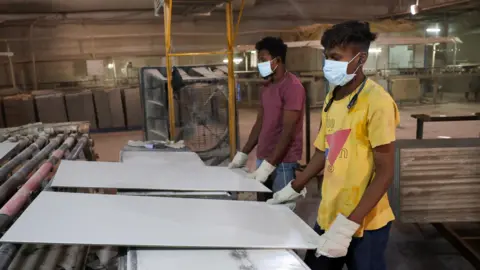
The ceramic and tiles industry - which primarily uses propane and natural gas - is also hit.
"While propane supply has entirely stopped for two days now, natural gas supplies will be there for another five days. We are considering a month-long shutdown from 15 March if the situation does not improve," says Mukesh Kundariya of the ceramic association in the western city of Morbi, India's tiles and sanitaryware production hub.
India's domestic LNG output meets only a fraction of demand in an economy that increasingly depends on gas for electricity generation, fertiliser production, city gas distribution, transport and industry.
Additional reporting by Imran Qureshi from Bengaluru
