Gazans returning through Rafah crossing describe checks by Palestinian militia

 EPA
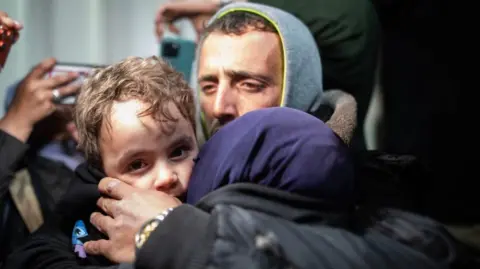
EPATwo Gazan women who passed through the newly reopened Rafah crossing with Egypt on Monday have told the BBC that a local Palestinian militia linked to Israel carried out checks at an Israeli military checkpoint inside the Gaza Strip.
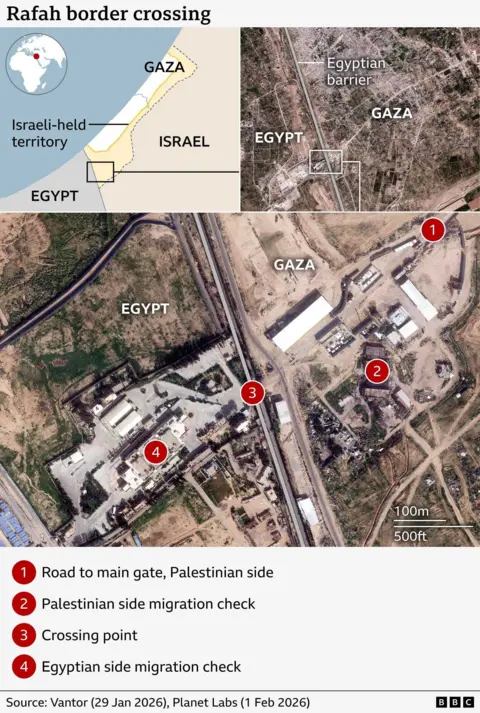
Lamia Rabia, who was travelling with her children, said they were escorted by Israeli forces from the border to a nearby checkpoint where members of the Abu Shabab militia, also known as the Popular Forces, searched them and their belongings.
"There was a woman from the Abu Shabab group who conducted the searches on the women," she told the BBC.
"They didn't speak with us, they only searched us and then we went to the Israelis, who questioned us.
"The Israelis and the Abu Shabab group were together at the same point."
The BBC asked the Israel Defense Forces (IDF) about these claims and whether they were coordinating with a local militia group in this way - they said they were unable to comment.
Israel's Shin Bet internal security agency has also been approached for comment, but the BBC has not received a response so far.
The Abu Shabab militia is an anti-Hamas group that receives support and weapons from Israel, and operates in the Rafah area under Israeli military control.
Ghassan al-Dheini, head of the militia, was quoted in Israeli media on Monday as saying his unit would play "an important security role regarding entry and exit through the Rafah crossing".
Asked how they could be sure the checks were carried out by Abu Shabab, one of the women the BBC spoke to said they had introduced themselves.
The BBC has not been able to reach the militia leaders to confirm their involvement directly.
One of the women, who the BBC is not naming in order to protect her identity, said that the group told her they would help her travel to Europe if she co-operated.
She also said she was mistreated by the militia, alleging that she was beaten and strip-searched along with three other women, and that they had been handcuffed and verbally abused.
Rabia said her experience of the process had been easy with no negative effects.
The European Union, which has monitors at the crossing to check people who are leaving, is reportedly considering whether to escort new arrivals to the Israeli checkpoint, after reports of harsh treatment there.
Both the women the BBC spoke to also said that EU officials working with Palestinians inside the Rafah crossing had confiscated a wide variety of their belongings.
"They took perfumes, accessories, make-up, cigarettes, headphones - everything, they didn't leave anything with us," one woman told the BBC.
"The Europeans took from us anything that was liquid, like a cough syrup," said Rabia. "They also took from us perfumes, and make-up, as well as phones and power banks. Any toy with a remote-control was taken."
Rabia said there was also a limit on the amount of money each person could carry into Gaza, set at $600 (£438).
Anouar El Anouni, EU Spokesman for Foreign Affairs, said EU Border Assistance Mission to Rafah personnel were present at the crossing only to monitor the Palestinian-run operations there, and were not confiscating any items.
"The list of items that are authorised to enter into Gaza is part of the overall agreement process between the Israelis, Egyptians, and the Palestinians," she said, adding any unauthorised items would be confiscated by Palestinian officials.
 Reuters
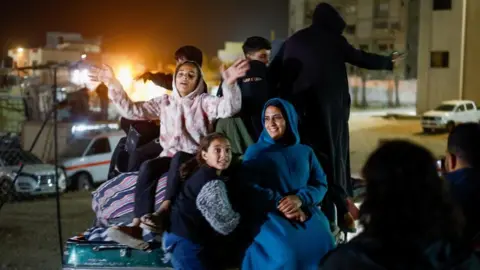
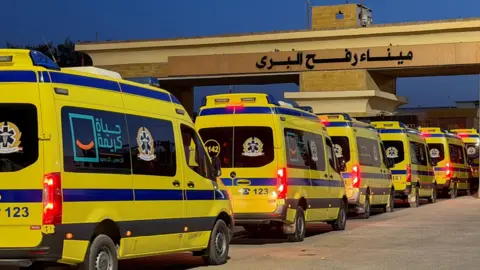
Fifty patients were due to return to Gaza through Rafah on Monday after completing treatment in Egypt. They arrived at the Egyptian side of the crossing in the early hours of the morning, with their accompanying relatives.
But only 12 people made it across, despite all passenger names being screened by both Egyptian and Israeli security in advance.
A Palestinian employee working on the Gaza side of the Rafah crossing said that the patients and their companions arrived from Egypt, and that Palestinian staff and European monitors completed security checks, passport checks and stamping procedures.
Speaking on condition of anonymity because he was not authorised to talk to the media, he said the travellers then waited for several hours inside the crossing compound, before Israeli authorities called forward only 12 people - nine women and three children - escorting them to an Israeli inspection point.
The remaining passengers were ordered to return to Egypt, without explanation.
Eight of them were the relatives of Awad Abu Talha. He had waited for his cousins all day and evening as they progressed slowly through the crossing. Some had made it through to the Palestinian side, before all were sent back to Egypt, because of a technical problem.
On Tuesday afternoon, his family finally managed to cross into Gaza.
 Reuters
Confusion and obscurity has surrounded the reopening of the Rafah crossing.
The Israeli government organisation responsible for civilian liaison in Gaza (Cogat) has not responded to repeated requests to confirm the number of people who crossed in and out of Rafah on Monday.
The World Health Organization said that five patients and seven companions were transferred out of Gaza for medical care on Monday, adding that it was a drop in the ocean of the 18,500 Gazans needing medical evacuations.
"It's a start of a process," said its spokesperson, Christian Lindmeier. "We're hoping this is increasing and turning into a process where many more of those who need medical evacuations can actually leave."
The Palestinian Red Crescent in Gaza said the number of evacuations had risen slightly on Tuesday, with 16 patients and 40 companions leaving the territory.
Its spokesman, Raed al-Nims, accused Israel of delaying procedures, and called on the international community to put pressure on Israel to increase the flow of patients.
 EPA
EPAThe new travel mechanism through the Rafah crossing has also become a real test of Hamas control in Gaza, highlighting the difficulty of excluding the group from the territory's affairs.
And the new procedures at Rafah - which bypass Hamas - are showing signs of weakening under pressure from the militant group to reassert control.
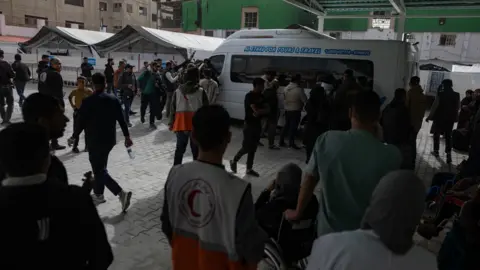
On Monday, evacuees assembled in Gaza at a medical point 4km (2.5 miles) from Nasser Hospital, in Khan Younis. The hospital itself is under the authority of Gaza's Hamas-controlled health ministry.
On Tuesday, Palestinian officials and local journalists said members of the health ministry had unexpectedly appeared at the medical point, along with representatives from Hamas's media office and interior ministry, and that they had begun intervening directly in preparations for the second day of evacuations.
These developments have also exposed the limited role currently played by the new National Committee for the Administration of Gaza, which has played no part in the evacuation process despite being designated as Gaza's new temporary administrators under US President Donald Trump's plan.
The reopening of Rafah signals the start of a new and difficult phase of that plan, hinging on the disarmament of Hamas, the withdrawal of Israeli forces, and the authority and control of a new administration.
The disagreements, fractures and confusion around Rafah are a warning of the tougher challenges that lie ahead.
Additional reporting by Orsi Szoboszlay
