Big names on Trump's peace panel face huge challenges in Gaza

 Getty Images
The White House has announced the first members of its Gaza "Board of Peace", and the list of names will do little to dispel the criticism from some quarters that the US president's plan resembles, at its heart, a colonial solution imposed over the heads of the Palestinians.
There are still several unknowns - namely who else might be added, and the exact structure of what is currently a rather complicated layout.
So far, no Palestinian names are included on the two separate senior boards that have been officially unveiled.
One is a "founding Executive Board", with a high-level focus on investment and diplomacy. The other, called the "Gaza Executive Board", is responsible for overseeing all on-the-ground work of yet another administrative group, the National Committee for the Administration of Gaza (NCAG).
That committee is made up of supposedly technocratic, apolitical Palestinians, led by Dr Ali Shaath, a civil engineer by training who's held ministerial positions in the Palestinian Authority.
But of the seven members of the founding Executive Board, six are Americans - including US Secretary of State Marco Rubio and other members of Trump's inner circle like his son-in-law Jared Kushner, and Steve Witkoff, who is US Special Envoy to the Middle East, but also a friend of the president and a fellow real estate developer.
Ajay Banga, president of the World Bank, is something of an exception as an Indian-born US citizen. Sir Tony Blair, meanwhile, is a former UK Prime Minister, and his inclusion is likely to further fuel concerns about how the Board of Peace will operate.
Over the past few weeks, criticism of Sir Tony's possible inclusion has come from figures like prominent politician Mustafa Barghouti, general secretary of the Palestinian National Initiative, and newspaper reports quoting unnamed officials from Arab states in the region.
Sir Tony's central role in the Iraq war, coupled with Britain's own colonial history in the Middle East, is deemed by his opponents to make him entirely unsuitable.
Francesca Albanese, the United Nations' special rapporteur on human rights in the occupied Palestinian territories, wrote on social media last year: "Tony Blair? Hell no. Hands off Palestine."
Even Trump seemed to acknowledge the issue.
"I've always liked Tony, but I want to find out that he's an acceptable choice to everybody," the president said last October.
There is significant overlap between the two senior boards, with Kushner, Witkoff and Sir Tony appearing on both.
But the Gaza Executive Board does include the names of some senior political figures and diplomats from Turkey, Qatar and the United Arab Emirates. It will be headed by the former Bulgarian politician, Nickolay Mladenov, who's been given the title of High Representative for Gaza.
Yakir Gabay, a businessman born in Israel and now based in Cyprus is the only Israeli member.
In its statement announcing the names, the White House said those chosen will work to ensure "effective governance and the delivery of best-in-class services that advance peace, stability, and prosperity for the people of Gaza".
And whatever the concerns and complexities, the plan remains the only game in town, with many world leaders pledging their support and commitment to helping make it a success.
Its architecture is further complicated by the fact that, sitting above all the structures announced so far, will be the Board of Peace itself, with President Trump as the chairman.
Names of that supreme body have not yet been announced, but the current UK Prime Minister Sir Keir Starmer, Turkish President Recep Tayyip Erdogan, Egypt's Abdel Fattah El-Sisi and Canadian leader Mark Carney have reportedly been invited to join.
In the end, whether the most vocal critics can be assuaged will depend on how quickly the new members of the senior teams can begin to drive change that makes a real difference in both daily life for Palestinians and, crucially, further concrete steps towards a lasting peace.
 Getty Images
Major challenges remain to both of those goals.
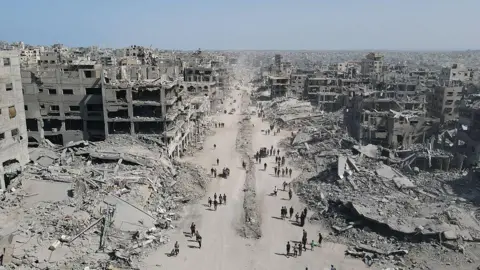
The UN estimates around 80% of buildings in Gaza have been destroyed or damaged and families who have survived the war are now struggling with the winter weather, and a lack of food and shelter.
While aid groups say there has been some improvements, they accuse Israel of imposing continuing restrictions upon their work.
Israel says that it is facilitating humanitarian assistance, and has blamed the UN for failing to distribute supplies already in Gaza. It argues any restrictions are designed to stop Hamas infiltrating and exploiting relief efforts.
Showing meaningful progress towards rebuilding will also be a Herculean task, involving not only the removal of an estimated 60 million tonnes of rubble, but first finding and disposing of the dead bodies and unexploded bombs contained within it.
Perhaps the biggest challenge though is maintaining the fraying ceasefire itself.
Another name has been released by the White House, that of Major General Jasper Jeffers as the Commander of the International Stabilization Force (ISF).
Backed by a UN mandate, it will have the tough job of ensuring the demilitarisation of Gaza.
As yet, there's no clear road map for how Hamas will be persuaded to give up its weapons, nor any clear idea of which country will provide troops for that force or what its remit and rules of engagement will be.
Hamas has said it will only disarm as part of a wider deal establishing a Palestinian state.
Israel, whose ground troops still control more than half of the Gaza Strip, has said it will only withdraw if Hamas disarms.
How that catch-22 can be resolved is perhaps the biggest test of all.
