Legal challenge against Sizewell C turned down

 Reuters
A High Court legal challenge against the Sizewell C nuclear power station has been turned down.
Together Against Sizewell C (TASC) launched the action in June, on the basis that the plant may add extra coastal flood defences at the site which were not outlined in the original planning application.
The group appealed for a judicial review into this, but on Friday, the application was refused by a High Court judge.
Sizewell C said it was pleased the legal claims were dismissed.
Development consent for the new plant near Leiston was granted in July 2022 before the government committed £14.2bn of investment earlier this year.
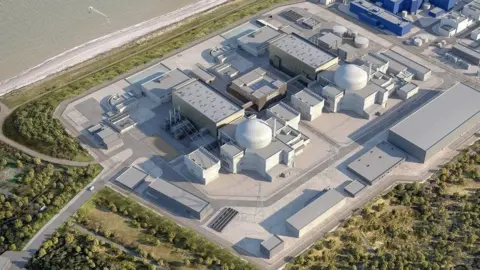
In the approved plans, Sizewell C said the power station would be built on a platform 7m above the current sea level and protected by a "sea defence structure which will be more than 14m above mean sea level".
Sizewell C said its "sea defence will be adaptable and could be raised in future if sea level rise turns out to be greater than current predictions".
TASC claimed the power station wanted to build two more flood barriers standing at nine and 10m high further inland.
Sizewell C declined to comment on the extra details of how flood defences could be changed, when approached by the BBC previously.
The group had argued the defences needed to be consulted on and had approached Energy Secretary Ed Miliband asking him to revoke or change the development consent order.
This was not accepted, so the group opted for a judicial review, and argued that Miliband had breached his obligations and duties.
 Sizewell C
Barristers from Francis Taylor Building represented Sizewell C at the High Court.
A spokesperson from the law firm said Mr Justice Mould decided it was up to Miliband whether or not to "exercise his powers" given the "fundamental uncertainty as to whether any such further flood protection would be required".
In a statement after the court's ruling, TASC said it was "immoral to proceed with Sizewell C in the knowledge that the project, as approved in the development consent order, is not resilient to an extreme sea level rise scenario".
According to the Suffolk Coast Forum - a partnership of local agencies - a sea level rise at Sizewell of up to 0.9m is predicted by 2105.
The shoreline is predicted to retreat by somewhere between 10m and 97m in that time.
"This will result in future generations having to pick up the pieces from ill-thought out decisions made today," said TASC
"Future generations need government to move forward with sustainable development, not questionable climate change solutions, such as Sizewell C, which come with hidden risks that have been denied public scrutiny, assessment and full consideration of alternatives."
'Cheaper power'
A Sizewell C spokesperson said: "Many thousands of hours have gone into assessing future flood risk at Sizewell, including flood risk arising from climate change, and our plans will ensure the power station is protected, even in extreme scenarios."
The Department for Energy Security and Net Zero (DESNZ) welcomed the court's judgement, and said the government was unlocking a "golden age of nuclear".
"Sizewell C will deliver clean electricity for the equivalent of six million of today's households for at least six decades, and once operational it could save £2bn a year across the future low-carbon electricity system, resulting in cheaper power for consumers," they added.
Follow Suffolk news on BBC Sounds, Facebook, Instagram and X.
