Vets issue fish hook danger warning to dog owners

 University of Edinburgh
Vets have issued a warning to pet owners after treating three dogs who swallowed discarded fish hooks over the course of one month.
One of the dogs treated at The Royal (Dick) School of Veterinary Studies in Edinburgh swallowed one hook and got another embedded in its lip.
Another was Sheila Baillie's dog, Chip. He swallowed fishing bait while on a weekend walk at Lochinch estate near Stranraer last September.
"It was just a simple split second that this happened and then we had the trauma and the worry that we could have lost him that night," Sheila said.
 Sheila Bailie
She told BBC Scotland News that she was walking the spaniel with a friend shortly after lunch when the incident happened.
"He was sniffing away and the next thing I could see, he was getting quite agitated, shaking his mouth, shaking his head a lot," Sheila said.
When she looked in his mouth, she spotted a "foreign body" hanging out. It turned out to be an eel, which was being used as bait.
"And then from out of the undergrowth, from beside the water in the bushes emerged a fisherman and he apologised," Sheila said.
"He said 'I'm really sorry - that's bait and there's a hook on it'.... He'd left his line with the bait on it lying on the grass behind him which Chip had sniffed out."
The hook was initially caught on Chip's tongue but it dislodged as he shook his head and he swallowed it.
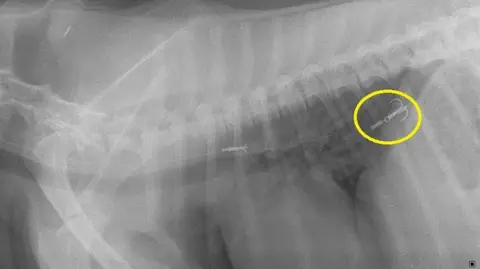
Sheila, a primary school headteacher, managed to get Chip to an out-of-hours vet in Stranraer where they sedated him and carried out x-rays.
At that point the hook was in his oesophagus, a tube that links the mouth with the stomach.
But the local vets were unable to treat him and instead found a specialist at the Hospital for Small Animals at the Royal Dick in Edinburgh - a three hour drive away.
"Even the journey itself was quite traumatic," Sheila said as they were instructed to lie him flat for the whole trip.
"What upset me the most was the vet said that should he start haemorrhaging on the journey, we were just to Google where the nearest vets were, to see if they could do anything.
"He was obviously at risk of this barbed hook doing some damage internally as it passed through his organs."
 Sheilie Gillies
They finally got to Edinburgh late on the Sunday night and had to leave Chip with the veterinary experts.
By that point, they found that the hook had slipped into the dog's stomach, making retrieval more complex.
The vet team operated on his tongue, which had been ripped quite badly, before using a tube to remove the hook from the dog's stomach.
Sheila said it took Chip a few weeks to recover. "But to look at him now you wouldn't know anything had ever happened," she said.
"He's bounced back to his happy wee self and loving life and loving all the cuddles."
Dr Ben Lloyd-Bradley, from the Hospital for Small Animals said: "We are delighted that, due to the expertise of multiple teams, the fish hook could be retrieved by endoscopy which saved Chip from requiring abdominal surgery."
He warned that, unlike many foreign bodies, fish hooks rarely pass safely as their barbs can anchor into tissue, damaging the mouth, oesophagus, stomach or intestines.
Vets warn that if dogs ingest a fish hook it should always be treated as an emergency and owners should never pull or cut the fishing line, or attempt to remove the hook themselves.
