'People who hurt animals can go on to hurt people'

 BBC
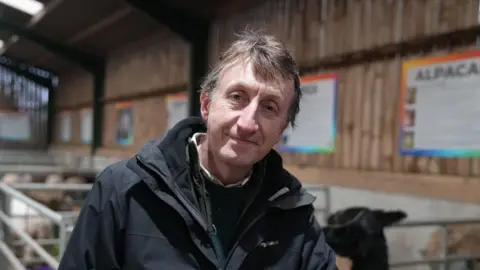
BBCWildlife crime often happens out of sight, but the clues left behind on dead or injured animals can be far harder to hide.
A new collaboration between Lincolnshire Police and forensic veterinary expert Dr Sean Taylor aims to turn those injuries into evidence that can help identify offenders.
"It's crucial," says the veterinary surgeon, "because people who hurt animals often go on to hurt people."
His unapologetic remarks are aimed at silencing those who have criticised Lincolnshire Police for pursuing hare coursers, criminals who use dogs to chase and kill hares for pleasure.
"Because in my view," says Taylor, "the animal abusers of today, are tomorrow's rapists and murderers".
It is a bold claim for which Taylor says studies are ongoing.
Existing research from the National Wildlife Crime Unit examined the records of 128 people convicted of wildlife crimes in 2024 and found that 72% of those convicted of poaching and 78% of those convicted of hare coursing were also associated with violent crimes and theft or criminal damage offences.
The same research found 49% of those offenders have also been involved in weapons offences.
 Lincolnshire Police
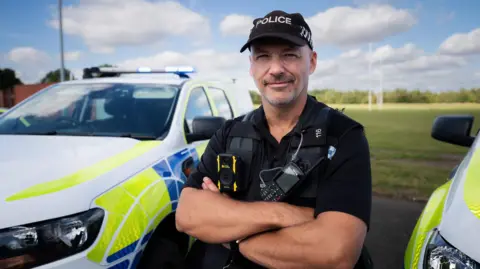
These statistics highlight why working with Taylor is "hugely important" to Lincolnshire Police's investigations, according to Det Con Aaron Flint, the force's wildlife crime officer.
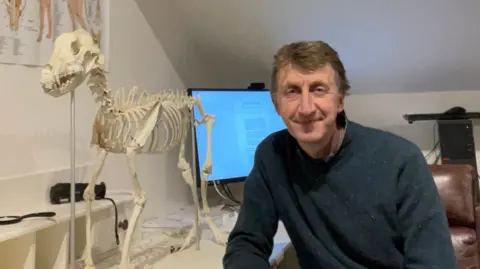
As Taylor talks in his study, standing nearby is a life-sized model of a canine skeleton. "I use this when I'm asked to report on whether a dog's injury is non-accidental."
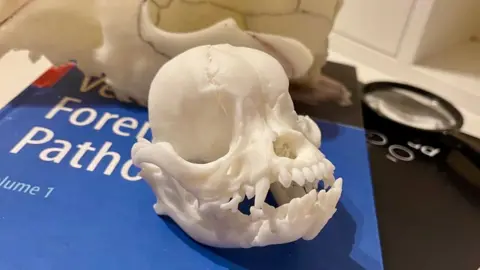
On his desk is a model of a juvenile shih tzu's skull, which Taylor tells me he produced using a 3D printer and X-rays of an injured dog's head.
The skull has a deep, long crack down the middle. He explains how he uses these models to recreate the scenarios that owners' claim led to injuries.
 Ava Taylor
In another case he was asked whether a border collie's fractured skull was accidental. Its owner claimed the dog was the victim of a road traffic accident.
"That raises suspicions instantly," says Taylor.
"Dogs are intelligent creatures, and when they see incoming car headlights, they automatically turn to run.
"Data shows that dogs hit by a car most often suffer a broken pelvis, not a fractured skull."
Taylor says he has worked on "many cases" where it was proven that a man had gifted a puppy to his wife as a form of coercive control.
"In these cases, the men purposefully injured the puppy, then called their fleeing wife home on the basis that the puppy needed her.
"It's not an uncommon story."
 Ava Taylor
The Links Group is a UK charity that trains professionals including vets, social workers and police officers to recognise signs of abuse in animals.
David Martin, trustee of The Links Group praised Lincolnshire Police's approach.
He said pursuing wildlife criminals can open "a whole Pandora's box of other criminality" that might otherwise have been difficult to access.
While The Links Group's work focuses on raising awareness of the correlation between animal abuse in the home and domestic violence, the collaboration between Taylor and Lincolnshire Police looks at wildlife crime that blights rural communities.
Titled Operation Major, it wants people to alert them of suspicious injuries to dogs used in crime – that may lead them to the criminals exploiting the animals.
These include badger baiting, dog fighting and lamping. The operation is in conjunction with the RSPCA, the Badger Trust, the League Against Cruel Sports and Naturewatch.
When a criminal is charged, Taylor is on hand to report on any injuries.
"It gets all silent witness in here," says Taylor.
"I like to look at the animal as a mini crime scene all of its own."
"The dog gives me clues as to exactly what happened – which in many cases leads to their abusers being convicted."
"And then, I like to think that the dog has had the last laugh."
