The islands where emergency care requires a plane

 BBC
BBCEmergency transfer services in the Channel Islands say they provide a "vital lifeline" during the toughest moments of patients' lives.
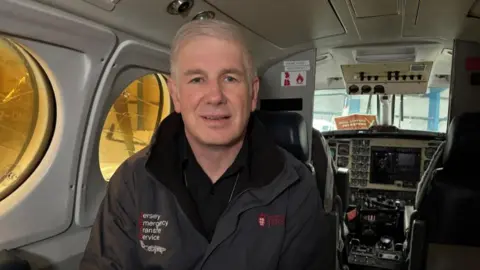
The Jersey Emergency Transfer Service (JETS) operates a plane to transport patients experiencing medical emergencies from the islands to NHS hospitals in the UK for treatment.
It is required as with populations of 65,000 in Guernsey and 105,000 in Jersey, there is a limit to what hospital services residents can access close to home. JETS manager, Ryan McNay, said it transferred 304 patients last year.
Dave Miller, who manages off-island logistics for Guernsey patients, said his team provides patients with a "hand to hold" through those difficult journeys.
'Numbers were increasing'
McNay began working in the service in 2007, and at that time, he said there were just "two transfers a week".
"Numbers were increasing, so that's when the JETS service started," he said.
McNay described the operation as "bed to bed".
"We stabilise the patients in the hospital first. We assess them, we make referrals to the UK if they need it and then we actually prepare them. We find a team and use the aircraft and resources we've got on island to then transfer them to the UK."

McNay continued: "We've got one aircraft and we can call upon others. We've also got the back-up of helicopters and the coast guard when we need it.
"It's a mini-intensive care unit, we take a range of patients from level 1, which could be a patient that needs a stretcher for cancer treatment, right up to level 3, which could be an intensive care patient that needs to be ventilated.
"We can take whole ventilators, we've also got facilities to take incubators for babies, and we also take psychiatric patients and patients from the prison too.
"It's a vital service; it's a lifeline service… we'd be in a bit of a fix [without it]. Last year we did 304 transfers, and the year before that was 360, almost one a day."
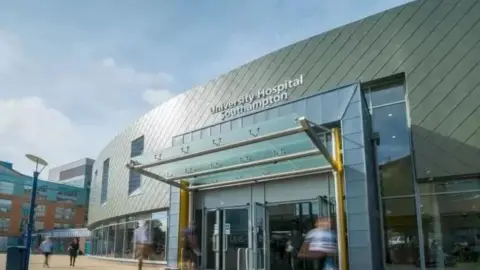
The majority of patients are treated in Southampton or London. But some go to Oxford, Cambridge, Wigan and Salford.
For those not needing an emergency transfer, logistics teams on both islands manage things like patient travel and accommodation.
In 2025, Guernsey referred 2,370 cases to the UK, while Jersey sent 2,501 patients for treatment on the mainland.
Miller, Guernsey's off-island manager, said his team is "very aware" that when people are referred to the UK, it's often at one of the most difficult times of their lives.
"The team are just excellent at taking those people, reassuring them and giving them the information they need," he said.
 Getty Images
The Channel Islands Liaison at Southampton Hospital, Jane Taylor, manages the discharge of patients.
"We will visit wards daily, collaborating with clinical and travel teams," she said.
"One of our challenges is [cancelled flights] because of the weather... sometimes they might not be able to get a patient off-island to come here or get them back.
"We have to explain that to the patient, phone the families and just be there caring and supporting them, because it's a very anxious time to be off-island.
"Currently we've got 26 inpatients and several radiotherapy patients and that's rolling, it can increase every week, the numbers ebb and flow. It's a high number, for sure."
'Well looked after'
Hundreds of Guernsey and Jersey patients are referred to UK hospitals for cancer treatment each year.
When Tim Ashton Barnett was diagnosed with prostate cancer he received treatment in Cambridge, because the equipment needed to carry out a prostatectomy is not available in the Channel Islands.
While he would have preferred to have the treatment at home near his family and in familiar surroundings, he described the decision to go to Cambridge as a "no-brainer".

He said he felt the relationship between Jersey and UK hospitals was "very important" and that Channel Islanders are "well looked after".
It is a sentiment shared by Dr Paul Fenton, the clinical lead for oncology in Southampton, who said he thinks islanders are getting an efficient service.
"I think the Channel Islands medical set up is very supportive of pursuing cancer care and getting people through the system and getting to treatment, and clearly, the relationship with places such as Southampton for some of the more complex elements of cancer care is a really important part of that."
Follow BBC Guernsey on X and Facebook. Follow BBC Jersey on X and Facebook. Send your story ideas to channel.islands@bbc.co.uk.
