The seaside town that was a fascist hotbed

 Getty Images
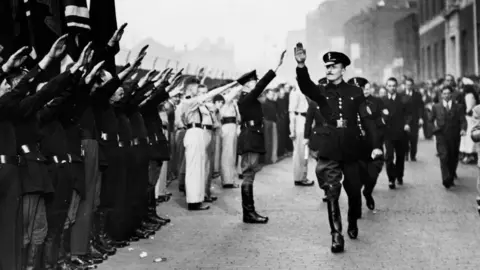
In the 1930s, Worthing was a hotbed of fascism.
Oswald Mosley, the leader of the British Union of Fascists, was a frequent visitor and held several public meetings in the West Sussex town.
His presence often led to rowdy scenes.
But on one October night in 1934 it sparked a riot.
"People were very fired up politically at that time," said local historian and author Chris Hare.
"Mosley was gaining a lot of traction. He'd been a member of the Labour government and resigned because he didn't think they were doing enough to kick-start the economy."
Hare told BBC Secret Sussex the far-right group - which was ultranationalistic and demonised minorities - was viewed by many as a "novelty" then.
"People didn't really know what it was, it was quite attractive to a lot of young people who were looking for something new, something different in politics.
"Obviously, we associate fascism with racism, concentration camps and world war, but probably a lot of people who joined in the early days - that wasn't their reason.
"Other things motivated them," he said.
 Getty Images
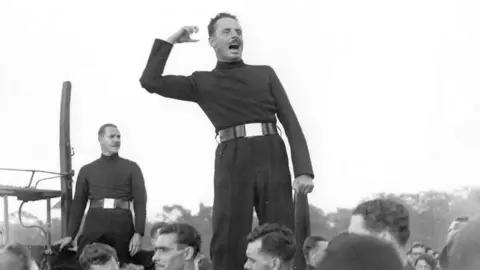
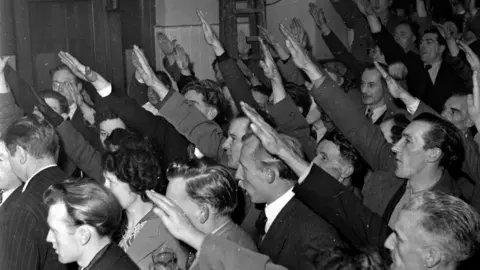
When Mosley visited Worthing on 9 October, 1934, he made a speech in the pavilion on the pier.
He had come to the seaside town because it was the first in England to elect a fascist councillor, according to Hare.
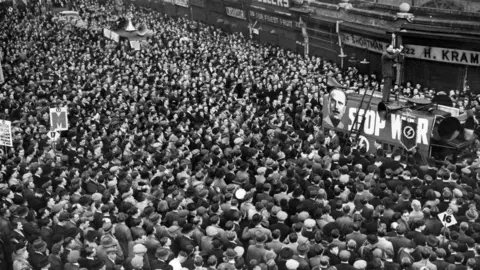
The Victorian pavilion was packed with Mosley's supporters, however there were "even more people outside opposing him", he said.
"It would have been quite an event for Worthing, quite a sleepy town in 1934."
Hare told Secret Sussex Mosley got a "rapturous response" from the audience, but some anti-fascists had managed to get in and started to heckle him as he spoke.
"Big, burly Blackshirts from the East End of London then grabbed them and threw them out," he said.
"That created an electricity in the room."
 Getty Images
When the fascists left the building, Hare told BBC Secret Sussex that fights broke out, especially on South Street.
He said Mosley and a group of Blackshirts went inside a cafe in the Royal Arcade opposite the pier and were surrounded by a "huge, hostile" crowd.
A group of protesters climbed on top of the building and pushed off a stone that smashed through the glass - just missing those below.
"There's a lot of devil-may-care, youthful excess going on here," Hare said.
"You often wonder how politically-motivated they were [or whether] this was just an opportunity for a good scrap".
Police eventually escorted Mosley and others to safety, though street brawls continued for several hours, according to Hare.
"It would have been pretty lawless," he said.
A few days later, police decided to charge Mosley and some of his followers who had been involved in the ruckus, though they were later acquitted.
"There may have been pressure from central government," said Hare.
"There was probably a concern that Mosley was potentially destabilising the country.
"If you can get a riot on the streets of a small town like Worthing, you could get a riot anywhere."
"They didn't want to encourage that."
When Winston Churchill became prime minister in May 1940, he introduced internment without trial, leading to the arrest of hundreds of fascist sympathisers.
Hare said: "No county in the whole of England had more people interned than West Sussex.
"It was a county that was viewed as being friendly to Mosley in his objectives."
 Getty Images
The events on 9 October, 1934, came to be known as the Battle of South Street.
"The local papers said that scenes from revolutionary Spain were witnessed on the streets of Worthing, which is a bit of an exaggeration.
"But I suppose it highlights how out of the ordinary this was."
He said it was a "very difficult time" with "very high unemployment... and a lot of polarisation of politics" across Europe.
"You had the rise of fascism and Nazism," Hare said.
"There was a fear that Britain might go the same way."
Follow BBC Sussex on Facebook,X and Instagram. Send your story ideas to southeasttoday@bbc.co.uk or WhatsApp us on 08081 002250.
