One of UK's richest men wants German citizenship over 'hostility' to Jews
"Britain is an uncomfortable place for Jews today," Cardiff-born billionaire Sir Michael Moritz has said.
The Welsh investor said Britain was "far more hostile than the US" towards its Jewish community, citing the attack on Manchester's Heaton Park synagogue in 2025.
Sir Michael, who has written about his family's experience of the Nazis, said "antisemitism is always in the air" and there were modern parallels to the persecution they had faced.
He said he was applying for a German passport, which is what he calls an "insurance policy" that would allow him the opportunity to flee the US or the UK in a way that some of his ancestors were unable to escape persecution.
He also argued that the UK was a less attractive place to do business compared with the US and China, and that the growing use of AI could be "deeply disruptive" for white-collar workers.

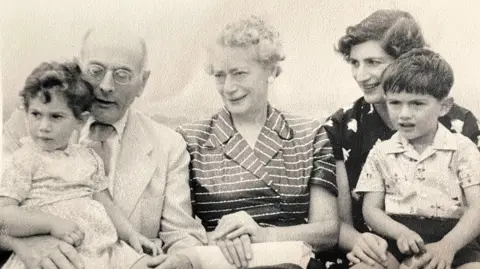 Moritz family photo
The 71-year-old, who holds both UK and US passports, is the richest Welshman who has ever lived, with a wealth built on investments in companies like Yahoo and Google that made him billions during the dot-com boom of the early 2000s.
In a memoir called Ausländer – the German word for foreigner or outsider – Sir Michael charts his family's treatment under the Nazis.
His paternal grandparents, Max and Minnie Moritz, were among swathes of relatives killed during the Holocaust.
Using public archives he found that two of his relatives, his great-uncle Oskar Moritz and his cousin Mira Marx, were photographed by the Gestapo as they were forced onto buses that transported them to their deaths.
Sir Michael's parents had escaped Germany and settled in Cardiff, where he attended the now-closed Howardian High School in Penylan.
He said the sense of being an outsider had accompanied him since childhood and recalled opening the phone directory as a teenager and scanning the "M" section, hoping his family would not be the only entry under "Moritz".
"There was no shortage of Evans' and Thomas', but we were the only Moritz.
"And to me, that was as if – in the margin, in big black capital letters – it said Jew."
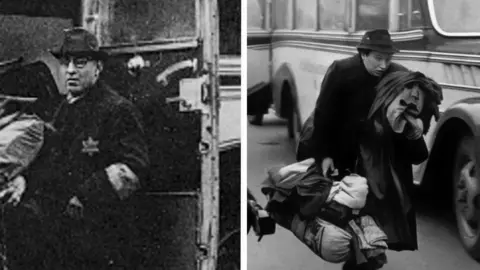 United States Holocaust Memorial Museum Archives
Speaking to BBC News, Sir Michael said that while antisemitism was an issue in many societies, including California where he has spent his working life, he said Britain was "far more hostile than the US" for Jews.
"I have cousins who live less than half a mile from the Heaton Park synagogue," he said, referring to the scene of a deadly attack on Yom Kippur in October 2025.
"And while they weren't members of that particular synagogue, they knew a whole bunch of people who were there."
Sir Michael said antisemitism also meant there were "kids in north-west London who no longer wear their school blazers" to avoid being identified as attending Jewish schools.
"It's all these anecdotes that strike home more than anything else."
His comments come as reports of antisemitism incidents in the UK spiked after the synagogue attack.
Sir Michael said he was now applying for a German passport, saying: "I think it's the one place in Europe where what happened [nearly] 100 years ago forms a very central part of the educational system, so you have generations that have been reared with that as part of their consciousness.
"Does that mean it will prevent dreadful things happening in the future? No, but it gives me some mild form of reassurance."
Despite his huge personal success, Sir Michael said a meeting with former Welsh First Minister Rhodri Morgan in 2001 had brought back those feelings of being different.
During a Welsh government trade trip to Silicon Valley, he said Morgan opened the conversation with: "So Michael, what's a nice Jewish boy like you doing in Silicon Valley?"
The line, he recalled, instantly transported him back to his childhood in Cardiff, stirring "all of those feelings of not being Welsh, of being different. It struck a nerve... it was really raw".
Sir Michael said he did not respond at the time.
"I bit my tongue. There was no need to get into a slanging match... but obviously it cut deep and I remember it."
He does not believe that comments such as this had "a huge amount of malevolence" associated with them, but they fit into a wider pattern he described of growing up and living as a Jew in Britain.
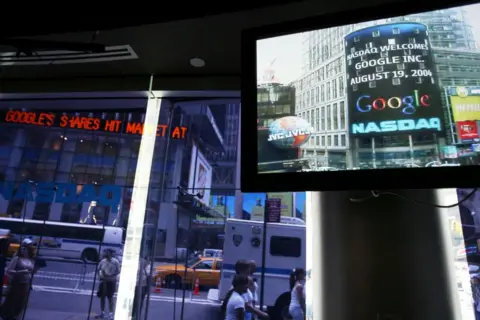 Getty Images
Sir Michael remains a committed investor and philanthropist, but said the UK and Europe did not afford the same kind of unified market that was available in the US and China.
He also repeated criticism that boards of directors in the UK sometimes lacked the expertise to nurture new technology in the way that American companies, particularly in Silicon Valley, have achieved.
Asked about the impact of AI on business, Sir Michael said his main observation was of a looming impact on the lower rungs of the workforce.
"It'll be fantastically liberating for creative types who can master all of these incredible tools.
"I think for people in white-collar jobs, lower-skilled white-collar jobs, irrespective of the pursuit that they happen to be in, it's going to be a very disruptive, dislocating experience.
"You're going to be able to assemble businesses and run companies with far fewer people in the future than you require today," he said.
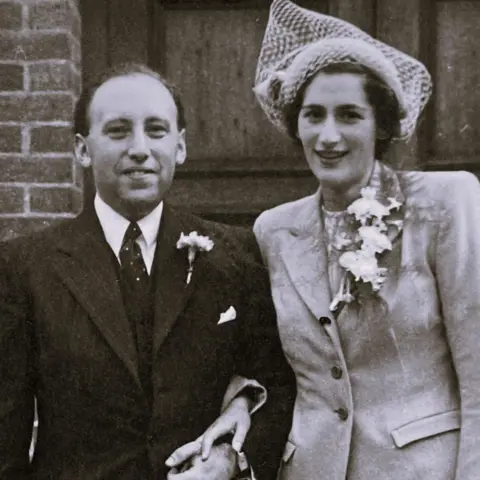 Moritz family photo
Sir Michael rolled his eyes when asked about his annual listing as Wales' richest person, and said his "very parsimonious" mother, Doris, would bring him back down to earth.
"She was always afraid of standing out," he recalled, adding that she "got alarmed" when his name appeared in newspaper rich lists.
"I think until the end of her days, she was convinced that I must have been a crook," he laughed.
"I'm sure if I'd been sitting having a cup of tea with her in her living room here in Cardiff and there was a knock at the door and there was a policeman there, she would have said 'oh, you must be looking for Michael'."

Get our flagship newsletter with all the headlines you need to start the day. Sign up here.
