'I've had to prove myself as a woman in tech'

 Mel Brooker
When Mel Brooker was working for a well-known website in her late 20s, she says male colleagues – including some she was managing – would openly comment on what she was wearing.
"I found it like really humiliating," she recalls. "It doesn't matter what I'm wearing, I'm still here to do a job. I could be in the shorts and T-shirt, I could still do my job."
Brooker, now 42, adds: "A man wouldn't find themselves in that position. So why should a female?"
The tech sector is a major driver in the global economy and the UK government has said it will invest billions into growing it, but figures show women make up only about a fifth of the workforce in roles such as IT, programming and cyber security.
Industry leaders have urged ministers to help close the gender gap in order to meet their ambitious goals.
Brooker believes sexism in the industry has meant she has had to work harder than her male peers to get ahead.
At Sauce, a Hull-based software consultancy company where she is a client product manager, she oversees relationships with major companies including Nestlé, Ideal and Siemens.
She says Sauce is very inclusive, but most applicants for roles are still men and just three of her 16-strong team are women – an imbalance she has lived with since setting out on her career in tech.
When Brooker enrolled on an IT and computer science course in 2000, she was one of only two women. By the end of the course, she says she was the only woman left.
"I didn't think at college it was going to be a very male-dominated environment," she recalls. "I just adapted to get on with the guys."
After graduating, she was one of just two women in a team of 32 at a telecoms firm, where she eventually showed she was "quite capable of managing a team".
"Maybe it took me longer to prove that because I was female," she adds.
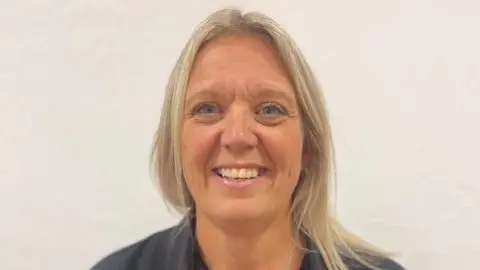 Melissa Barker-White
Women in science, engineering and technology make up only 27.2% of the workforce, according to the Nomis Annual Population Survey, covering the 12 months ending September 2025.
And that figure drops to 20.3% for the IT category of jobs, which includes programmers, software developers and cyber security.
Melissa Barker-White, a computer science teacher at Lincoln University Technical College (UTC), thinks the lack of women in tech is a societal issue.
Only 12.5% of students studying computer science at the college, which specialises in science, technology, engineering and mathematics (STEM), are female.
Barker-White, from Bridlington, blames part of the problem on video games, which she says are mainly marketed towards boys and men.
"They're all quite masculine, male-dominated – that kind of male gaze side of things, when you think about Lara Croft," the 53-year-old says.
Attempts to change the landscape have not been helped by incidents such as Gamergate - an online harassment campaign targeting women in the video-gaming industry in 2014.
Barker-White says girls who study the subject have to be "confident and quite resilient".
"A girl has to think, I might be the only girl doing this," she adds.
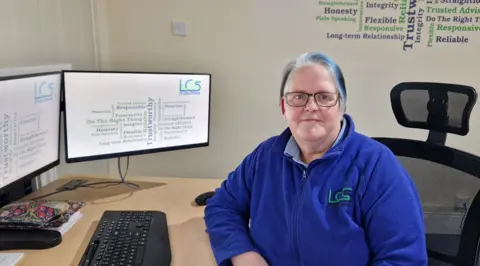 Emma Bygraves
Emma Bygraves, a service delivery manager for Lincoln-based LCS IT Solutions, is a second-generation woman in tech.
She says she got the confidence to join the industry from her mum, who was an electronic engineer.
"In the 60s, 70s, that wasn't the norm," the 56-year-old from Boston says.
"In my upbringing, it was the case that if you wanted to achieve something, there was nothing that's going to stop you."
When she was training as an electronic engineer, there were six female students, while during her computer science degree, women made up about 10%.
Even today, Bygraves is the only woman working in a tech role in her company.
"I'm treated as one of the lads, but I don't know anything different," she says.
"I'm quite surprised things haven't changed in the 30 years that I left university."
In June last year, the government pledged to invest £86bn in science and technology, and in December, the technology secretary Liz Kendall launched a taskforce to help women "enter, stay and lead" in the UK tech sector.
Kendall said the Women in Tech group would "break down the barriers that still hold too many people back".
Her pledge came as BCS, the Chartered Institute for IT, said closing the gender gap would be a crucial step in growing the AI sector.
"We cannot create high-trust, high-integrity AI systems if the profession behind them is missing out on the talents and perspective of half the population," said chief executive Sharron Gunn.
In Lincoln, there are signs of improvement. Since the UTC opened, it has seen an 8.1% increase in the intake of female students.
Meanwhile, Brooker has been taking part in events in Hull to promote women in STEM.
"There's now these events to say, we're girls, we can do this, we're established," she says.
"If I was talking to 16 year old me, I would probably just say, if this is something that you're interested in, it doesn't matter if you've got males, females, you're going in to do something that you enjoy.
"So forget about the men that are there, the boys that are there, even the females that are there – you're there to prove something to yourself – that you can do what you want to do and what you enjoy doing."
Listen to highlights from Hull and East YorkshireorLincolnshireon BBC Sounds, watch thelatest episode of Look North.
Download the BBC News app from the App Storefor iPhone and iPad orGoogle Play for Android devices
