'People don't expect to see a female lorry driver'

 BBC
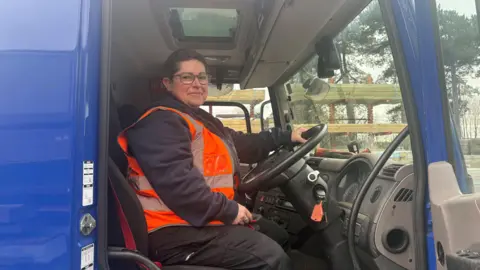
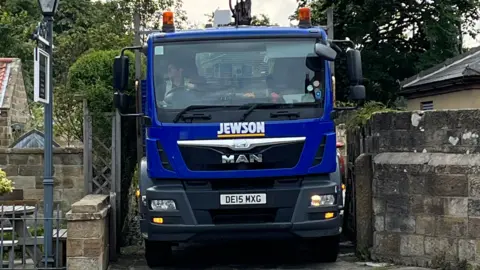
BBCIt is a scene witnessed around the country thousands of times a day as a 26-tonne lorry backs into a tiny space at a builders' yard. But as Nerys Mitchell climbs down from the cab, she is often met with looks of surprise, curiosity and sometimes even doubt.
Nerys is the only female HGV driver out of the 75 who work for this particular transport firm.
"Watching people see you arrive on a Monday morning, you can kind of judge that they're not really expecting a woman," the mum-of-one says.
"You've got to be confident in what you're doing... I have had occasions where I've had to empower myself to ensure that I can do my job."
Nevertheless, as soon as Nerys's colleagues and customers see her working, operating machinery and loading and unloading materials, the looks of judgement disperse.
"As one or two days go by, you can see that you've changed their attitudes, and their attitude towards you is friendlier and warmer," she says.
Although women have been driving trucks in this industry for decades, only about 1% of HGV drivers in England are women, according to the Nomis Annual Population Survey covering the 12 months ending September 2025.
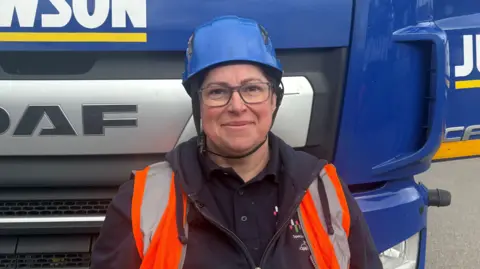
Simon Pritchard, managing director at Specialist Driver Resourcing, the company that employs Nerys, says: "I think it's difficult to recruit women into this industry because that of age-old saying of you can't be what you can't see.
"Traditionally, it's not seen as a job that's suitable for women. Obviously, there are a lot of outdated stereotypes around the physicality of the job that perhaps aren't true anymore."
He adds: "Nerys is an excellent driver for us... one of our highest performing drivers and one that we get some of the best feedback on."
Nerys, who was a bricklayer and groundworker before she got her HGV licence, delivers building materials to construction sites and homes around the country.
The 50-year-old, from Driffield, East Yorkshire, says driving a lorry has been an ambition of hers from an early age.
"Seeing different parts of the country, driving, meeting new people – every day is different and I enjoy every aspect of it," she says.
"I was just made to do it."
 Nerys Mitchell
Nerys spends most days on her own on the road. When she is at the yard, loading and unloading the lorry, she is usually the only woman there.
She says working with mostly men "can be a bit of a struggle".
"I feel like I have to work much harder to prove myself, which can be challenging and it also can be exhausting," she explains.
"I do feel like I have to work much harder to break down these barriers."
But those early looks she gets – the raised eyebrows and the double-takes – are also the ones that keep her going.
"It can be quite intimidating but it's also quite rewarding knowing I'm changing people's attitudes towards this kind of line of work," she says.
"It feels empowering."
 Ellie Shores
Nerys says working away from home and her family can be tough.
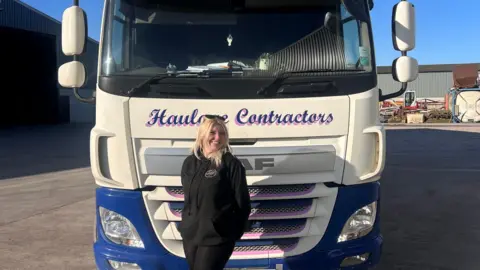
Ellie Shores, a lorry driver who runs DA Shores Transport in Hull, agrees.
She says the long hours can be an unappealing aspect of the role, especially for women.
"I lose out a lot from doing this sort of job," the 30-year-old says.
"If I need to get my eyebrows done, have a facial or a doctor's appointment booked in... I've missed so many appointments because you just don't know when you're coming home."
But, for Nerys, the main reason for the lack of women in the industry is visibility.
"I don't think many women do this job because you don't see many women around building yards like this, so they don't see that this could potentially be a role for women," she says.
The industry can be "quite daunting" for women, and she adds they may find it intimidating.
Ellie agrees, and says many people still see HGV driving as being a man's job.
Road Haulage Association policy lead Sally Gilson said: "Road transport, much like construction and manufacturing, has long been perceived as a male domain.
"There is no inherent reason for this, but changing perception takes time."
She adds: "Until people can see someone who looks like them in a role, preconceptions are difficult to shift."
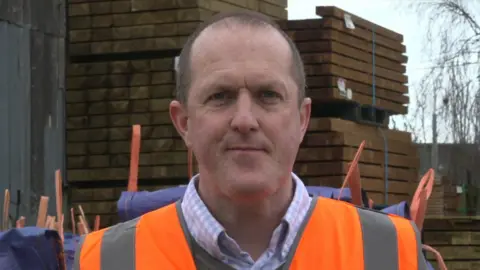
Nerys's boss Simon says a lot more needs to be done to encourage more women – and men – to enter the HGV industry.
"The first thing that needs addressing is the fact that there's an overall shortage, male and female, of HGV drivers," he says.
In September 2025, Logistics UK reported an annual 1.9% decline in HGV drivers, which has been put down to a declining workforce, ageing demographics and training gaps.
According to the Office of National Statistics, less than 2% of HGV drivers are under 25.
A spokesperson for HGV Training Network in Hull says: "There is now a clear focus across the industry to open doors to more women, both to tackle driver shortages and to benefit from a wider pool of talent."
They say the company is working on investing in better welfare facilities and flexible working patterns to make roles better suited to different lifestyles.
And they add that while women still make up a minority of drivers, 8% of the inquiries they receive now come from women.
"I think it's a brilliant sector to work in," says Nerys. "I thoroughly enjoy my role in what I do here.
"I love that fact that we're breaking boundaries, and I'd love to encourage more women to do this role."
Listen to highlights fromHull and East Yorkshire on BBC Sounds, watch the latest episode of Look North.
Download the BBC News app from the App Storefor iPhone and iPad orGoogle Play for Android devices
