Allan Massie obituary: Acclaimed novelist, critic and commentator

 Alamy
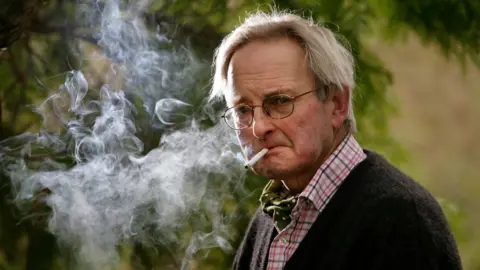
AlamyAllan Massie, who has died aged 87, stood apart from his contemporaries and from the mainstream of Scottish literary life.
Politically conservative and a Unionist, he was born into privilege in colonial Singapore and was educated at Glenalmond College and the University of Cambridge.
He made his home in the Scottish Borders and wrote readable, accessible novels in the realist tradition. His best and most successful works took place in the past and were in the line of one of his heroes, the high-Tory Borderer Sir Walter Scott.
All of this set him apart from his predominantly working-class, west of Scotland contemporaries such as Alasdair Gray, James Kelman and William McIlvanney, the big beasts of the Scottish fiction renaissance which began in the late 1970s.
Massie pursued a parallel career as a prolific journalist for publications across the world. He spent five decades writing about books for The Scotsman, filing weekly reviews alongside columns, features, political analysis and even rugby reports.
He was Scotland's last freelance man of letters, equally and happily at home between the covers of books and the pages of newspapers, able to turn his hand, it seemed, to any commission.
His death robs the nation of a brilliant, witty commentator who was never afraid to stand against the consensus.
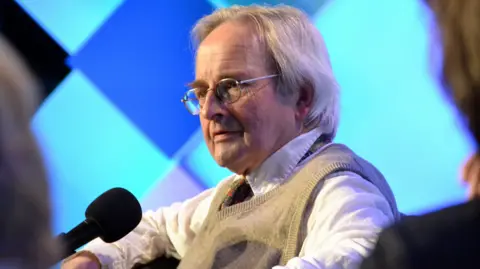
His success was all the more remarkable given he did not turn to full-time writing until he was 38.
After a childhood split between the far east and Aberdeenshire, Massie read history at Cambridge before spending more than a decade teaching at schools in Scotland and Italy.
While teaching English as a foreign language in Rome, Massie submitted an article on Italian politics to The Scotsman. He was then commissioned to write book reviews, and his belated career as a writer was underway.
Gripping stories
The two authors most cited in reference to Massie are Sir Walter Scott and John Buchan. Both were popular novelists of rip-roaring historical fiction, both were politically active Tories, and both had the Borderlands at the heart of their works and lives.
The comparisons are apt. Massie once wrote that "narrative is at the heart of fiction" and that was certainly true of his work. He had a gift for pulling in the reader by placing credible characters inside gripping stories in historical periods, most successfully imperial Rome, the Dark Ages, and World War Two.
Massie embraced the whole of Scott's inheritance, acting as champion for the writer and the conservation of his country seat at Abbotsford, near Melrose. In 1994 he wrote The Ragged Lion, a fictionalised memoir of the lawyer, author and laird.
Massie's work cleverly engaged the reader in big ideas – imperialism, the clash between personal relationships and ideological movements, myth and reality in the stories we tell ourselves about political leaders – while never forgetting to entertain.
That's a rare gift and his readability perhaps militated against him when it came to the big literary awards. He won the Saltire Society book the year award for his novel A Question of Loyalties in 1989, but the Booker judges' failure to shortlist him for a later novel led to one of the panel resigning.
There was too a steady stream of non-fiction including studies of writers Muriel Spark and Eric Linklater, the House of Stuart, pamphlets on market economics and the Union and portraits of Scottish rugby and his beloved local club, Selkirk.
 Alamy
AlamyAnd then there was the journalism.
In an interview published to mark Massie's retirement as The Scotsman's chief literary critic, David Robinson outlined what he called the author's "love affair" with the paper, as well as the scale of his output.
Calculating that Massie had reviewed more than 3,000 books for the paper, and perhaps more than 5,000 when his other outlets were considered, Robinson wrote: "However you look at it, this is an extraordinarily well-read man."
Massie could be a waspish commentator and was unsparing in his political commentary. But he was also a generous critic. Though they were political opposites, he was a close friend of the late William McIlvanney and thought highly of his work.
Though he wasn't always a fan of James Kelman's books, he named his 2016 novel Dirt Road as the best of that year and later described him in The Guardian as "a true and honest writer, which is why he is one of the fairly few who really matter".
Scottish and British
As a political commentator, Massie rattled Scotland's cages. He admired Margaret Thatcher, was sceptical about devolution and the performance of the Scottish Parliament and was a firm "No" when it came to independence in 2014.
During the referendum debate, he wrote a pamphlet taking the Unionist view. It was published side-by-side with a pro-independence argument from his friend McIlvanney.
Massie wrote: "It is, for me, a matter of self-confidence. If you feel the lack of that, you will vote for independence. If you feel confident of Scotland's ability to remain Scottish and prosper in the Union, you will agree that we are indeed Better Together and vote 'no'.
"The Unionist says, 'I am Scottish'. Nevertheless. I am also British, and value the Union with England, 'our sister and ally', as [Sir Walter] Scott called her."
The pamphlet's title was Nevertheless, a word and idea he had picked up from Muriel Spark, and which he quoted in his 2018 introduction to her novel The Comforters.
"Writing about her youth in Edinburgh, Spark recalled that the essential characteristic Edinburgh word was 'nevertheless'. A statement might be made, apparently truthfully, or an argument advanced, seemingly cogently; nevertheless there was always something to be said on the other side."
Summing up such a long, distinguished and varied career is not easy, though "nevertheless" may help.
Allan Massie was a Unionist who nevertheless cared deeply for the Scottish nation and its people. He was a serious novelist who nevertheless entertained his readers. He was a high-minded historian and literary critic who nevertheless loved writing about rugby and cricket.
All in all, a very Scottish mind, writer, and life.
