Scottish Parliament rejects prostitution bill at stage one

 Getty Images
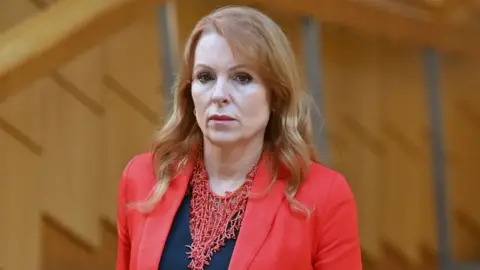
The Scottish Parliament has rejected proposed legislation that would have criminalised the act of paying for sex.
Soliciting in public, "kerb crawling" and brothel-keeping are illegal in Scotland but paying for sex and arranging for it online are legal.
The Prostitution (Offences and Support) (Scotland) Bill, tabled by independent MSP Ash Regan, would have created a criminal offence for paying for sexual services and repealed the existing offence of soliciting.
It was rejected by 64 votes to 54, with no abstentions.
The bill fell at stage one, when MSPs are asked to agree its general principles.
The government did not support the bill, sparking a rebellion among a small group of SNP MSPs.
While ministers said they supported the fundamental principle of the proposals, they argued the bill was too flawed to be passed before Holyrood splits up for May's election.
Following the vote, Regan said: "Today, Parliament chose cowardice over action - despite overwhelming evidence, survivor testimony, and support from police, prosecutors and international experts.
"Inaction is not neutral. It is a decision, and it has consequences."
 Getty Images
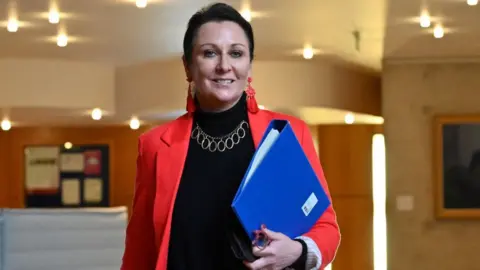
Regan had sought to target the buyers of sexual services by creating a new offence of paying for sexual acts.
Existing soliciting offences would have been repealed, with historic convictions quashed. Sex workers would also have been granted the right to support and assistance.
During the debate at Holyrood, Regan told MSPs: "This 'Unbuyable Bill' recognises prostitution for what it is – a system of exploitation and violence sustained by demand. It decriminalises those who are sold, recognising them as people constrained by vulnerability and not offenders.
"And it places criminality where it has never properly sat in Scots law, with those who buy sexual access and those who profit from the sale of sexual access to human beings."
She told MSPs any issues with the bill were not "insurmountable".
In an impassioned closing speech, Regan said the vote would be a "stain" on the record of those who did not back the bill.
Victims minister Siobhian Brown expressed regret that the government could not support the bill, but said there was not sufficient time to "develop" the proposals and address "very significant" issues they have with the bill.
The minister had raised doubts about how the new offence could be enforced, noting particular concerns over online activity. She also cited concerns that the bill could increase the risk of violence against sex workers because it could reduce their ability to assess the risk of buyers.
Brown told MSPs: "I do not think that in six short weeks the bill can be amended sufficiently to allay those concerns and the other flaws in the bill."
She also reiterated her commitment that an SNP administration would revisit the issue if returned to power after May's election.
SNP MSP Michelle Thomson, who rebelled against the government, told the BBC's Scotcast that her party should have been given a free vote on the bill.
She told MSPs that sex workers were at a much higher risk of being attacked and murdered, more likely to develop drug and alcohol issues and suffer mental ill-health than other women.
She urged MSPs to reject "the entitlement of some men to demand the purchase of women", adding that they should not be "traded as commodities".
The bill was backed by the Conservatives and Labour, with the Greens and Liberal Democrats opposed.
Tory justice spokesman Liam Kerr described the bill as "flawed", citing concerns from Police Scotland that the proposed legislation would have cost up to £321m a year to enforce.
However, he urged MSPs back the proposals at stage one as part of efforts to reduce violence against women and girls.
Labour's Pauline McNeill, backing the bill, said there was an "uneven power dynamic" within prostitution "where it is overwhelmingly women who are exploited and men causing harm".
She said prostitution was not a "true choice" for women who are "driven into sex work through poverty and other traumatic circumstances".
Speaking against the bill, Green MSP Maggie Chapman said: "Where sex work happens between consenting adults, I believe the state should support people not penalise them for how they choose to live."
The Liberal Democrats also opposed the bill. Party leader Alex Cole-Hamilton said evidence from other countries, such as Australia, suggested criminalisation can result in increased marginalisation and additional barriers to accessing support services.
"We can't wish prostitution away and as it will forever exist we need to make sure it happens in the safest possible way," he told MSPs.
However, Regan insisted that the "Nordic model" proposed in her bill was the only way to reduce harm.

There are very strong feelings on both sides of this debate.
Ash Regan – and many others – believe that paying for sex is inherently violent and exploitative, and that men who do so (and it is mostly men) should be criminalised.
Others think that this industry will never disappear, regardless of how the law changes.
And therefore, they argue, more restrictive laws would simply drive it underground and lead to women taking more risks.
Even within the SNP there are different views on this, evidenced by the small rebellion we saw in this evening's vote.
And that may well be a factor in the Scottish government saying they support the principles of this bill, but would rather legislate in the next parliament.
Inside the SNP there is disagreement, and it may be less painful to have that internal debate in a few month's time, once the election is done and dusted.
