US embassy to provide passport services at West Bank settlements

 AFP
AFPThe US is preparing to start offering passport services in Israeli settlements in the occupied West Bank for the first time.
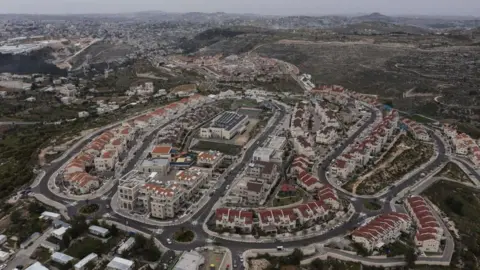
A statement posted on Tuesday to the US embassy's X account said consular officers "will be providing routine passport services" to US citizens in the settlement of Efrat on Friday.
It names another settlement, Beitar Illit, as the location for a similar outreach service in the coming months, saying the aim is "to reach all Americans".
Settlements are seen as illegal under international law. Much of the world considers them to be on land intended for a future Palestinian state and views them as an obstacle to peace.
However, under President Donald Trump, the US has broken with decades of foreign policy and given settlements greater legitimacy.
Trump, a strong supporter of Israel, has only said he opposes Israeli annexation of the West Bank.
The embassy's moves come after the Israeli government approved new measures this month, making it easier for settlers to seize Palestinian land in the West Bank. Palestinians said this amounted to "de facto annexation".
In a joint statement on Monday, 19 foreign ministers representing mostly European and Arab countries said they condemned "in the strongest terms a series of recent Israeli decisions that introduce sweeping extensions to unlawful Israeli control over the West Bank".
It went on: "We reaffirm our commitment to taking concrete steps, in accordance with international law, to counter the expansion of illegal settlements in Palestinian territory and policies and threats of forcible displacement and annexation."
Settlements have been expanding at a record rate and there has been a recent acceleration in settler violence against Palestinians.
The family of a 19-year-old Palestinian-American man shot dead in the village of Mukhmas last week, Nasrallah Abu Siyam, said he was killed by settlers.
He was at least the sixth American citizen to be killed by Israeli soldiers or settlers in the West Bank in the past two years.
The US embassy in Jerusalem said that, in addition to Efrat and Beitar Illit, its consular officers planned one-day outreaches in Ramallah, Haifa, Jerusalem, Netanya and Beit Shemesh.
The embassy has previously provided consular services to American-Palestinian dual citizens in Ramallah and other Palestinian cities in the West Bank. It can be very difficult for those living there to access US consular services in Jerusalem or Tel Aviv.
However, there are not the same movement restrictions on American-Israeli nationals who live in West Bank settlements. They are thought to number tens of thousands.
Efrat, south of the Palestinian city of Bethlehem, has a large number of US citizens among its residents. However, it is only about 30 minutes' drive from Jerusalem - as is nearby Beitar Illit.
"We appreciate the important decision by the US embassy to extend consular services to Efrat, in Judea and Samaria," Israel's Foreign Minister Gideon Saar said on Wednesday, using a biblical term for the West Bank.
The Palestinian Authority's Wall and Settlement Resistance Commission condemned the move, saying that it constituted "a clear violation of international law and a blatant favouring of the occupation [Israeli] authorities".
The governing coalition of the Israeli Prime Minister, Benjamin Netanyahu, has a large voter base among settlers.
It includes many members who want Israel to annex the West Bank, which was captured from Jordan in the 1967 Middle East War. Israel claims ideological and religious ties to the land.
More than 500,000 Israeli settlers live in the West Bank, excluding East Jerusalem, along with some three million Palestinians. Most settlements are built-up urban areas, surrounded by fences or walls and guarded by Israeli soldiers.
