Breaking even will be a 'challenge' for Aberdeen University

 University of Aberdeen
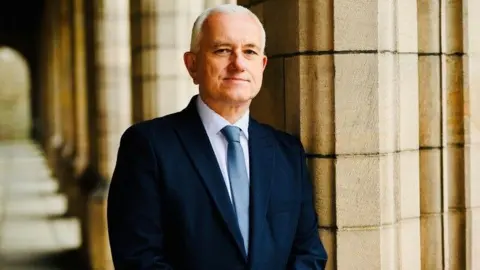
The University of Aberdeen managing to achieve a break-even financial position by 2028 will be a "real challenge", according to its new principal.
Prof Peter Edwards - who took up the role last month - said while progress had been made in finding more than £5m of savings, there was still a "lot of work to do".
He told BBC Scotland News he hoped redundancies could be avoided, but said there needed to be a "fundamental look" at the current funding model for universities.
The Scottish government said it wanted a successful and sustainable future for higher education.
The university reopened a voluntary severance and early retirement scheme in April this year to help find £5.5m in savings.
It also froze recruitment and asked departments to identify further measures to save money.
It recently confirmed that 41 people took up the offer of a severance package or early retirement.
The institution said that "wide-ranging measures" had allowed it to reduce its deficit for 2024/25 to £4.3m, and that it was on track to achieve the budget approved by its governing body for this year, with work continuing to return to a break-even position by 2028.
 University of Aberdeen
Prof Edwards took over the role of principal from Prof George Boyne on 1 November, amid ongoing financial challenges.
The new principal said in an interview: "It is my ambition, and the ambition of the senior management team, that this current financial year will see another improvement again."
But he added: "I think achieving a break-even in 2028 will still be a real challenge, because we are obviously continuing to see our costs increasing."
Prof Edwards said the funding universities received for Scottish students had been in decline and needed to be reviewed.
"There has to be a fundamental look at what that model needs to be in the future," he said.
Last month, a leaked report seen by BBC Scotland News highlighted concerns over "power struggles" between decision-makers at the university, and a "toxic culture" at some meetings.
 Getty Images
"I think some of the behaviours that we have seen have been challenging," Prof Edwards said, adding that he wanted a culture of respect.
In 2023, the university faced criticism over redundancy plans and for its decision to no longer offer single honours degrees in modern languages.
Its annual report that year said there was "material uncertainty that may cast significant doubt over the ability to continue as a going concern".
Prof Edwards said the university would be looking at all its degree programmes at undergraduate and postgraduate level and could not rule out that more courses may be scrapped.
"We are looking to make sure that there is a market for them that they meet the needs of students, that they meet the needs of employers," he said.
Asked about any future job cuts, Prof Edwards said: "We have had a number of colleagues leave us through voluntary severance schemes, but no-one has been made redundant.
"I'd hope that we can make the change that we need to make at the university over the next couple of years without resorting to redundancies."
Commitment to free tuition
Elsewhere in Scotland, Edinburgh University announced £140m of cuts to tackle financial difficulties, while the Scottish government bailed out Dundee University with £40m of emergency funding.
A Scottish government spokesperson said: "Ministers are working closely and collaboratively with Scotland's colleges and universities to ensure a successful and sustainable future.
"They make an enormous contribution to our economy, culture and wider society, which is why we continue to invest over £2bn in the post-school sector this year and provide the most generous student support in the UK.
"The sector is aware ministers are open to exploring the future funding model of universities, but we are clear this government will not reintroduce tuition fees. Access to higher education must be based on the ability to learn, not the ability to pay."
The statement added: "Our resolute commitment to free tuition means we are seeing record levels of Scots securing a university place in Scotland, and student debt levels are also the lowest in the UK - almost three times lower than in England."
