'Son's brain tumour was misdiagnosed as anxiety'

 Brain Tumour Research
A mum has said she wants to create "hope for families like ours" after the symptoms of her son's brain tumour were misdiagnosed as being caused by anxiety.
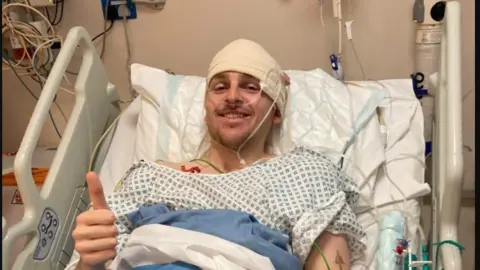
In 2020, Ollie Knight developed vision issues and dizziness, which doctors initially thought were the result of stress, but he was later rushed to the hospital where scans discovered a brain tumour the size of a satsuma.
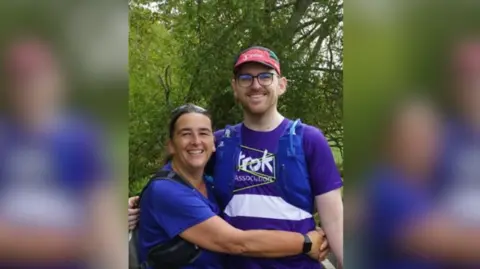
His mum Heidi Knight, 57, from Gloucestershire is taking on the 13.1 mile Bath Ultra Challenge on Saturday to raise funds and awareness for Brain Tumour Research.
She said the challenge was "my way of turning something so frightening into something positive" and added: "we need more funding and more research".
After Ollie's CT scan in 2020, he was transferred to National Hospital for Neurology and Neurosurgery in London, where he underwent a six-hour awake craniotomy operation which allowed surgeons to successfully removed 80% of the tumour.
He later underwent radiotherapy and chemotherapy.
Ollie, who is 29 and previously lived in St Albans in Hertfordshire, went on to complete a master's degree in Sports Performance Analysis at the University of Gloucestershire, achieving the highest grade in the university that year.
He now works for English Heritage, is seizure-free, and preparing to marry his fiancée, Laura, in June.
Heidi, who previously completed a 50k walk with Ollie and Laura, says this year's challenge is about both giving back and raising awareness.
She added: "I thought Ollie might die during surgery or be severely impacted for life. His story is one of hope.
"He is still living with a brain tumour, but it doesn't mean it's the end."
 Brain Tumour Research
This month alone, more than 1,000 people will be told they have a brain tumour, according to Brain Tumour Research.
Brain tumours kill more children and adults under 40 than any other cancer, which campaigners say underlines an urgent need for greater awareness and funding for research.
Letty Greenfield, community fundraising manager at Brain Tumour Research, said: "Stories like Ollie's remind us why our work is so vital. Supporters like Heidi are helping us to give hope to everyone affected by this disease."
Follow BBC Gloucestershire on Facebook, X and Instagram. Send your story ideas to us on email or via WhatsApp on 0800 313 4630.
