'We just want to go back to work': The ex-miners on strike again at Christmas

 Elizabeth Baines/BBC
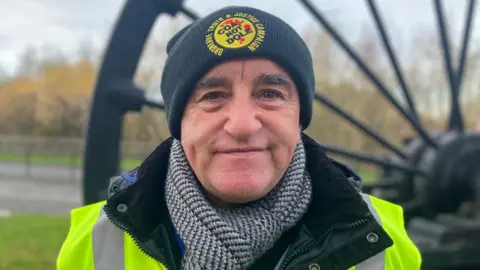
"It is my favourite time of year to work. It is a fantastic time of year to work and I have been robbed of that this year," says Alan Woodcock, a former miner and now a tour guide at the National Coal Mining Museum, near Wakefield.
The 64-year-old would usually spend December taking excited families 460ft (140m) underground to meet Father Christmas, but this year he is out on the picket line - the second time in his life he has been on strike during the festive period after having also taken part in the 1984-5 miners' strike.
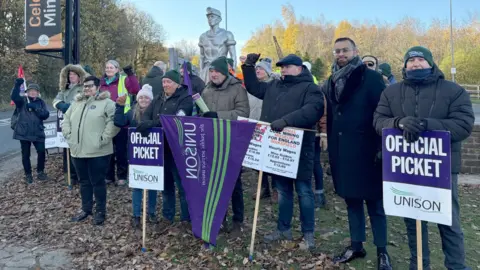
About 40 members of Unison who work at the museum walked out back in August calling for higher pay - and they have been on strike ever since.
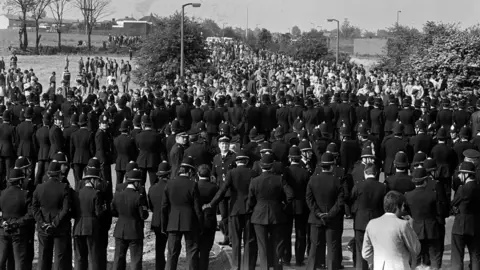
The picket line is familiar territory for Alan. He was among thousands of miners who went on strike during the 1984-5 dispute which is seen as a defining moment in the history of British coal mining and was the biggest industrial dispute in post-war Britain.
That strike pitted thousands of miners and their trade union against then prime minister Margaret Thatcher and her Conservative government, which supported plans to shut 20 pits that would mean 20,000 jobs could be lost.
Alan had started working at Nostell Colliery, near Wakefield, in 1978 as an apprentice electrician. He recalls that by Christmas Day 1984 he had been on strike for eight months, by which time, he says: "I had nothing".
 Alain Nogues/Getty Images
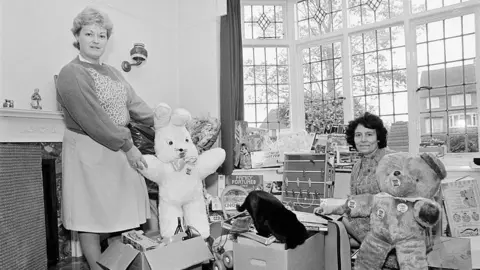
By Christmas 1984, Alan was relying on soup kitchens for meals three times a week - and admits doing that had been difficult.
"At first, I would not go because I felt embarrassed," he says. "But they made sure we had a Christmas dinner, pudding and punch."
Without a wage because of the industrial action, Alan, then aged 24, was unable to buy Christmas presents for his sweetheart at the time, who later became his wife.
"Times were hard, it made me feel low," he says. "My sister fed me, too - proper platefuls. She tried to make things normal for me."
Alan says that even though he is on strike again at Christmas, at least with a pit pension he is better off financially in 2025 then he was four decades ago.
However, he says he is still in "disbelief" to be on a picket line at this time of year and the whole experience is "surreal, really".
Alan says he misses working in the museum during the festive season: "I get visitors singing. I get them telling jokes. That is something I am really missing."
 Elizabeth Baines/BBC
Ian Steele, a colleague of Alan's at the National Coal Mining Museum, worked at North Gawber Colliery in Barnsley until its closure in 1987.
He says that when the 1984-5 miners' strike started, he and his young family had just moved homes and had recently taken out a mortgage, which quickly became a major concern as the money ran out.
"I went to see the guy at [building society] Bradford and Bingley and he was gobsmacked. We all were," he says.
With a new mortgage, two children and parents who were pensioners, Ian says he depended on friends to get him through Christmas 1984.
"My best man rolled up with a Christmas card that had a cheque for the local butchers," Ian remembers.
"He paid for our pork, turkey and pigs in blankets - it was a godsend."
Meanwhile, an unexpected twist to Christmas Day came from overseas.
"We could hear bells coming down the street: the town twinned with Barnsley had sent presents," he says.
"Father Christmas knocked on our front door. He had this sack and said to my lads in a German accent, 'get your hands in and get what you want'.
"There were books and drawing books and pens in there. I was made up."
 Elizabeth Baines / BBC
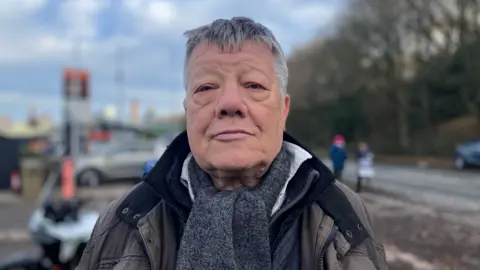
Joining Alan and Ian on the picket line at the National Coal Mining Museum this December is tour guide Eric Richardson, who was also on strike during the 1984-5 miners' strike.
Eric remembers his concerns about gifts for his children while on strike at Christmas in 1984.
"We had not got the money to buy presents," he says. "It was a really worrying time.
"The trade union movement across Europe sent lorries full of Christmas presents or food. There were a lot of foreign foods and things that you would not have thought about eating - but we were thankful for it."
 PA Media
Eric says that 40 years on, he no longer worries about presents or Christmas dinner, but he admits he is anxious to get back to work as a tour guide at the National Coal Mining Museum.
"We did not want to come out and strike in the first place," he says.
Eric, along with Ian and Alan, is among the striking National Coal Mining Museum staff to urge its trustees to "use common sense" and negotiate.
"The longer they keep it shut, the harder it is going to be to open it up again," Ian says.
"If we do not [resolve the strike], we risk this national diamond being threatened with closure."
Alan agrees, saying: "We just want to go back to work."
 Zoe Head-Thomas/PA Wire
Unison has said that many of its members at the museum currently earn about £12.60 an hour.
Several pay offers have been rejected by the union over concerns staff would be worse off than under an earlier proposal which was thrown out.
In September, councillors in Wakefield criticised the museum's bosses and voted to withhold funding for the museum until the dispute is settled, saying the ongoing strike was putting the attraction "at risk".
Earlier in December, Unison warned that the strike action could be extended until next summer, with the result of a ballot held in December due to be announced in January.
'Different time'
In a statement, a spokesperson for the museum trustees said they were "disappointed their previous pay offers have been rejected over the past three months".
They were "deeply saddened that industrial action continues", the spokesperson said.
"We have made several offers to resolve this dispute, none of which have been accepted by the union.
"These offers would see our guides on a full-time equivalent salary of over £25,000 per year, with higher rates for skilled roles."
Meanwhile, the spokesperson also reflected on comparisons to the miners' strike in 1984-5, calling it a "very different time".
"Working underground as a miner meant enduring some of the toughest conditions imaginable, and those men were fighting for their livelihoods and communities," they said.
"Today, we are a museum rather than a working coal mine and our guides do not mine coal but are passionate storytellers who bring that history to life through our underground tours.
"They do this for a charity to keep the story of coal mining burning bright."
Listen to highlights from West Yorkshire on BBC Sounds, catch up with the latest episode of Look North.
