Prospect of US-Iran talks puts Netanyahu under pressure

 Getty Images
With mixed signals over US plans for fresh talks with Iran, the exchange of fire between Iran and Israel - the Middle East's two arch-enemies - continues.
Iran fired several missiles at targets in northern and southern Israel overnight, after Israel carried out "dozens" of air strikes inside Iran on Monday, hitting command centres of the Islamic Revolutionary Guards Corp (IRGC) and Intelligence Ministry in Tehran, Israel's army said, as well as weapons stores and air defences.
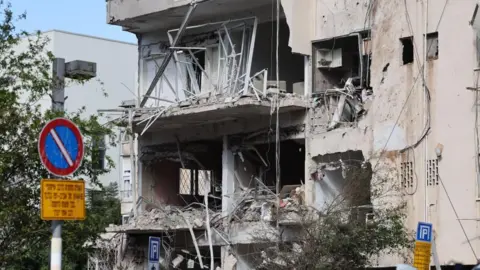
Around the latest blast site in northern Tel Aviv, balconies have been sheared off, and walls are shedding masonry into a crater between a cluster of residential buildings.
Local reports suggest this was a direct hit from an Iranian missile that narrowly missed several apartment blocks. Six people were reportedly wounded in the attack, though none seriously.
One man who lives on the road behind the impact site told the BBC he didn't have time to get to the shelter when the sirens sounded, and had just reached his front door when it was blown open by the blast.
He described fleeing from his apartment in bare feet as glass shattered around him. When he looked back, a fire had already broken out in the debris behind him, he said.
There is still widespread speculation over Donald Trump's motivation for opening a new dialogue with Tehran; negotiations have been used by the White House before as a smokescreen for military escalation, and thousands of US marines are currently being sent to the Middle East.
But to some in Israel, talk of negotiations is another indication that the US president is looking for a way out of the war, and that the goals of Israel and its superpower ally are starting to diverge.
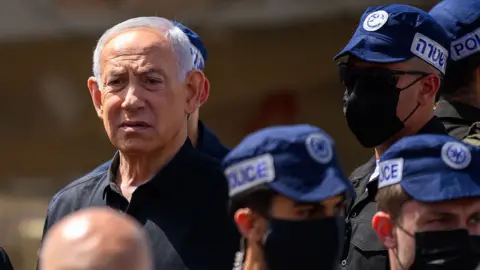
"[Israeli Prime Minister Benjamin] Netanyahu doesn't want a deal," says Michael Milstein, a former military intelligence officer in Israel and now head of the Palestinian Studies Centre at Tel Aviv University.
"There is a kind of contradiction between Trump's stance and Netanyahu's," he told the BBC.
"Netanyahu wants to continue the war. He promised this war would end all the existential threats to Israel, and maybe even promote conditions to change the regime in Iran, and right now there is a gap between his promises and what is happening on ground."
If Trump is serious about finding a way out of this war, he says, Israel's prime minister could find himself in an impossible situation.
"It's Catch-22 because if there are negotiations, he will not be able to promote the war, and he can't say to Donald Trump, 'I'll continue the war without you'. He understands that he'll have to accept it."
 EPA
EPABut Netanyahu is treading a fine line, after promising Israelis this war would end the immediate threat from Iran and its network of proxies around the region. The bar for a deal he can sell to Israeli voters and allies is high at this point in the war.
"Israelis want the war to end. We just understand that the right way for it to end is by us defeating the regime, and not by just having this come back to haunt us over and over again," said Dan Illouz, another Likud member of parliament.
"We've tried the containment policy in the past, we've done it with Hamas, we saw it blew up in our faces on Oct 7th, so we don't want the same thing to happen with Iran."
After speaking to President Trump on Monday, Netanyahu said Israel was continuing to attack both Iran and Lebanon, and would "protect [its] vital interests in any situation".
Israeli Defence Minister Israel Katz said on Tuesday that Israeli forces would establish a security zone in a large swathe of Lebanon south of the Litani River, and that residents would not be allowed back there until Israeli communities were safe from attack by Hezbollah, which is backed by Iran.
Israel is widely expected to continue its military campaign against Hezbollah, even if a deal is reached to end the war with Iran.
But Iran analyst Danny Citrinowicz, from the Institute for National Security Studies in Tel Aviv, says a deal on Iran is unlikely, because the gaps in both position and expectations are too wide to bridge.
"From the Iranian side, they're winning, not losing, so they'll demand compensation and guarantees," he said. "On the other side, you have Trump thinking that [Iran] will approve all the requirements of the US from the get-go."
To get an agreement, he says, Trump and Netanyahu will either have to change the regime, or forego their requirements.
"This regime is not going to capitulate - they're not going to give the Americans something they didn't give them before the war," he said. "They control the bottleneck of the international economy – the Strait of Hormuz – one of the world's busiest oil routes, which Iran has blocked - and they feel they have the upper hand in negotiations."
That confidence will have been boosted by Trump's withdrawal of an ultimatum to Iran last week to reopen the Strait of Hormuz, or face widespread attacks on its energy infrastructure.
He withdrew the threat after Tehran threatened to retaliate against US-linked energy sites in the region.
Analysts have pointed out that Donald Trump has little to lose in appearing to signal US openness to a new round of talks – whether it's intended to calm energy markets, sow division inside Iran's leadership or buy time for fresh military action.
One observer told me it wouldn't be a surprise if he woke up on Friday to a fresh US military offensive on Iran.
This war now appears poised between capitulation and escalation, with neither side yet weak enough to make the deal its enemy wants.
