What Iranians make of the possibility of talks to end the war

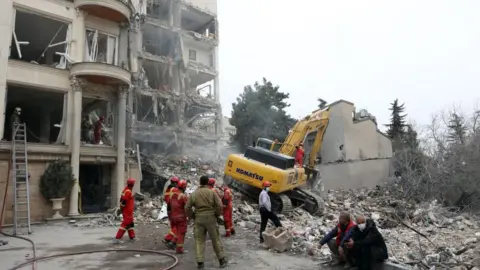 EPA
EPADonald Trump had issued an ultimatum to Iran to reopen the Strait of Hormuz - the narrow passage whose closure has caused the price of oil to spike across the world - or face the wrath of the US in the shape of attacks on its power plants.
Hours before it was due to expire on Monday, the US president said the threatened attacks were being paused for five days as Tehran and Washington were making "major" progress towards a deal to bring more than three weeks of US and Israeli air raids and Iranian retaliatory attacks to an end.
Several Iranian top officials, such as Iran's parliament Speaker Mohammad Bagher Ghalibaf, said there were no talks - it was all "fake news". A day later, however, Trump said the US was talking to "the right people" in Iran.
What the BBC is hearing from Iran is a glimpse into the country that remains largely cut off from the world as a result of a government-imposed internet outage.
Whilst ordinary Iranians go to great lengths to find ways to link up with the outside world, such as paying high prices for satellite internet Starlink connections - itself illegal in the country - officials and some government supporters do have access to the internet.
The latter have rallied for the government in the aftermath of the large-scale US and Israeli attacks. State media amplify this support showing nightly gatherings of loyal supporters across Iran. This group echoes the views of officials regarding talks with the US - and they are pretty unified.
But there are also those who want to see the end of the Islamic government of Iran. They are divided. Whilst most would welcome an end to the war, many are wary of talks that could result in an agreement to keep the current leadership in place.
Note: All names have been changed to protect the privacy of our interviewees.
Kiana, a woman in her 20s, lives in the capital, Tehran. From day one, she has repeatedly said she wants the war to end, but now that the possibility of a ceasefire which would keep the leaders of the Islamic Republic in power is being mooted, she said she felt confused.
"I don't know how to feel. If the war ends, the sounds of explosions will stop and the situation will become OK, but at the same time it's going to be us and a regime that's very weak," she says.
"But they still have power over their own people. And they will become even more violent, I think."
"I just want to blink and have it all done and over. I don't even want to think about the next steps," Kiana said.
She has in mind the unprecedented government crackdown on demonstrations that swept across the country in December and January.
At least 7,000 people were killed during that wave, including 6,508 protesters and 226 children, according to US-based Human Rights Activists News Agency (Hrana).
Armin, another Tehran resident in his 20s, said he wanted the war to "end now".
At the same time, however, he said he was "against any negotiations in all shapes and forms" with the Islamic Republic.
"It makes Iran credible on a global scale and will allow them to oppress people," he explained.
"But I also don't think we will end up anywhere with this current war. There should have been support for movements against the regime inside the country," Armin said.
Trump and Israeli Prime Minister Benjamin Netanyahu have often said they are creating conditions for Iranians to rise up and take power in their own hands.
So far, there have been no signs that their messages have been heard - or heeded.
Since the war started on 28 February, the Islamic authorities have warned Iranians - whether through statements or mass text messages - not to come out on to the streets to protest.
Iran's police chief, Brig Gen Ahmadreza Radan, warned that his forces would treat anyone who took to the streets "at the enemy's request" as an "enemy".
Under these conditions, there are Iranians who support the continuation of the war.
"I feel terrible about negotiations. I'm very anxious that they might stay," said Parsa, a man in his 30s who lives in Karaj, a city near Tehran, referring to the current leadership in Iran.
"They're in a position of weakness. If they stay, they will massacre people inside. They are still really strong, they need to be weakened a bit more for people to revolt against them."
Some people have moved out of Tehran to other cities and provinces to be somewhere safer.
Sadaf, a woman in her 20s currently in the northern Mazandaran province, is one of them.
"I don't want any negotiations at all. I want them all [clerics] gone. But yes, obviously I'm scared of electricity and water outages."
Somewhere in the middle are those like Mahtab, a woman in her 20s, living in Tehran, who are resigned to any outcome.
"The thing I keep thinking about the most is how, in every situation, so much of the blame somehow ends up on us, and we tell ourselves we're in control... while at the same time, there's basically nothing we can actually do," she said.
"And these world powers are just the ones make all the decisions for us people here," Mahtab said.
