Huge queues for jabs as meningitis vaccination scheme expanded

 PA Media
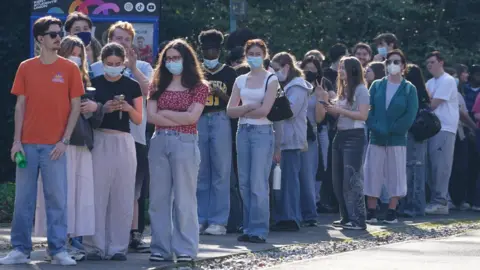
A meningitis vaccination programme has been expanded following a deadly outbreak in Kent - with university students queuing for hours for jabs.
Previously, only University of Kent students living in halls had been offered the meningitis B (MenB) vaccine but it is now being offered to anyone who attended the nightclub where the outbreak is thought to have originated.
The UK Health and Security Agency (UKHSA) said anyone who went to Club Chemistry in Canterbury between 5 and 15 March was eligible.
With confirmed and suspected cases now at 27, sixth form students in Kent where confirmed or probable cases have been identified are also eligible, along with anyone who has been offered preventative antibiotic treatment by the UKHSA.
A 21-year-old University of Kent student and an 18-year-old sixth former have both died from the illness.
More than 100 students queueing for vaccines at the university were turned away on Thursday.
This was not due to vaccine availability, but rather the queue was too long for all to be seen before staff left at 17:00 GMT.
At least 1,600 jabs had been administered as of Thursday evening, NHS England said.
A new vaccination centre will open at Faversham Health Centre on Friday as part of the expansion, with jabs available to those eligible from 09:00.
Vaccines will also be available at the Vicarage Lane Clinic in Ashford.
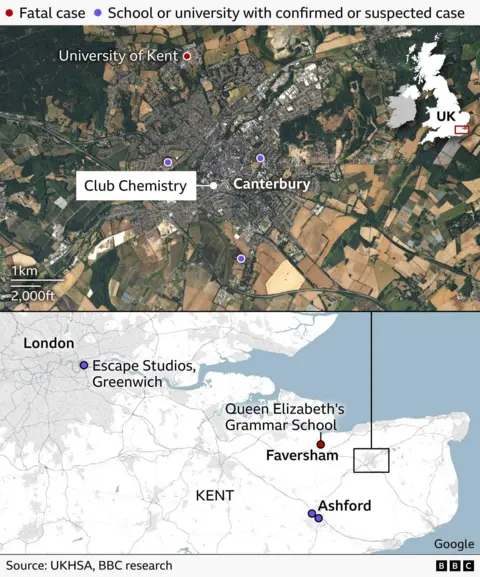
There are 27 confirmed or suspected cases linked to the outbreak, the UKHSA said, up from 20 on Wednesday.
A case has been confirmed at a higher education institution in London, which the UKHSA said was "directly linked" to those in Canterbury.
Three cheerleaders from the University of Kent are among those in hospital, according to a team member, and supermarket chain Morrisons said that a member of its staff who attended Club Chemistry had contracted meningitis.
Health Secretary Wes Streeting told the BBC that the risk remained "extremely low".
"It's absolutely fine for people to go about living their lives in a normal way," he said.
"There is no reason for me to be the fun police today and tell students across the country that they shouldn't be going out this weekend."
There are at least 350 meningitis cases in a typical year, he said.
"People are frightened. There's a lot of fear and anxiety," she said.
Jones-Roberts added that two of the nightclub's staff members remained in hospital with meningitis.
Students at the University of Kent have called the campus a "ghost town", as people returned home or stayed indoors.
Tumi, who studies computer science, said she had decided not to head home to stop the infection from spreading.
"I just don't think it's quite safe," the 20-year-old said.
Long queues of people seeking antibiotics have been seen at the campus throughout the week.
Many of those in line have worn masks and socially distanced in scenes reminiscent of the Covid-19 pandemic.
Canterbury Rugby Football Club said it was suspending all games this weekend.
Businesses in Canterbury said they were losing trade as a result of the outbreak, with one hotel manager telling the BBC that a third of bookings had cancelled this week.
Alice Antonsen, who works in a pharmacy in the city, said there were "definitely fewer people about".
The UKHSA has issued a public health alert for doctors in England to watch out for meningitis symptoms.
Its chief executive, Prof Susan Hopkins, told the BBC that she had never seen "such an explosive start to a meningitis outbreak".
She said the strain that had been detected had been circulating for five years.
Hopkins added that the bacteria was being studied and hopefully there would be more answers in the coming days and weeks.
Historically the "vast majority" of meningitis outbreaks had been successfully controlled by interventions, she added.
MenB is the most common cause of meningococcal meningitis in the UK, but routine vaccinations were only rolled out in 2015, meaning the current generation of students and others in their late teens are not covered.
Follow BBC Kent on Facebook, on X, and on Instagram. Send your story ideas to southeasttoday@bbc.co.uk or WhatsApp us on 08081 002250.
