Meningitis can go from zero to 100, survivor says

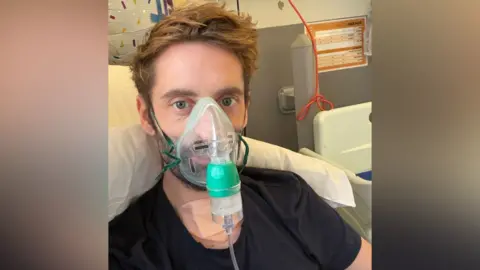 Daniel Harding
A man who spent three weeks in a coma and nearly died after contracting Meningitis B (MenB) has spoken of how the disease can go "from zero to 100".
Daniel Harding, 40, who grew up in Southend-on-Sea, Essex, and now lives in London, fell ill with MenB after having an ear infection and was hospitalised in December.
"To hear you nearly died but obviously survived and slept through Christmas and New Year is quite a shocker... It is a condition that goes from zero to 100, and within 24 hours it can take a life," he told the BBC.
Following the deaths of two people in Kent from an outbreak of meningitis, Harding said he felt "horrendous" for those "living this right now".
"People should brush up now on the condition and hopefully, if it comes to them, they'll spot it later - but I hope it doesn't come to anyone, it's a horrible, horrible thing," he said.
The Department of Health and Social Care said a targeted vaccination programme was taking place for students living in halls of residence at the University of Kent in Canterbury, following an "unprecedented" ongoing outbreak.
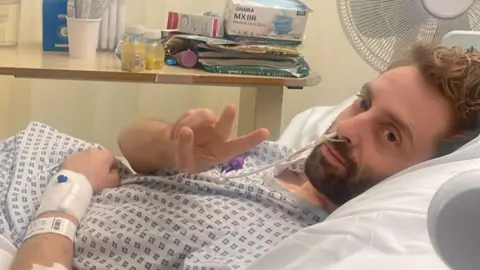 Daniel Harding
Harding, a video editor and writer, said he had been a "workaholic" before becoming ill on 14 December.
After he woke from his coma on 2 January, Harding has had to relearn to walk and talk, and suffered difficulty with his hearing and vision, chronic fatigue and dizziness.
"I do feel lucky continuously and every time I'm able to do physio or stuff like that, I do feel incredibly fortunate," he said.
"You ask any doctor and they'll tell you it varies from case to case - some people could recover quite quickly, others will take a long time, some people won't ever recover," he added.
 Daniel Harding
Harding's sister, Laura, called paramedics after he fell unconscious and collapsed onto a coffee table in their home.
"[The doctors] were kind of preparing us and telling us, you know, he might not make it. It was that bad," she said.
"You've got a million questions going around in your mind. I must say the doctors and nurses were incredible," Laura added.
The pair said acting fast if meningitis was suspected was vital, as someone's condition could deteriorate quickly.
"I think what's really important is to notice if something's different, and you know it's not right," Laura told the BBC.
"I look back and I think on that Sunday, Dan felt a bit ill - but I think it was a bit different, it was a bit worse, and maybe we didn't pick up on that," she added.
Follow Essex news on BBC Sounds, Facebook, Instagram and X.
